QUESTION IMAGE
Question
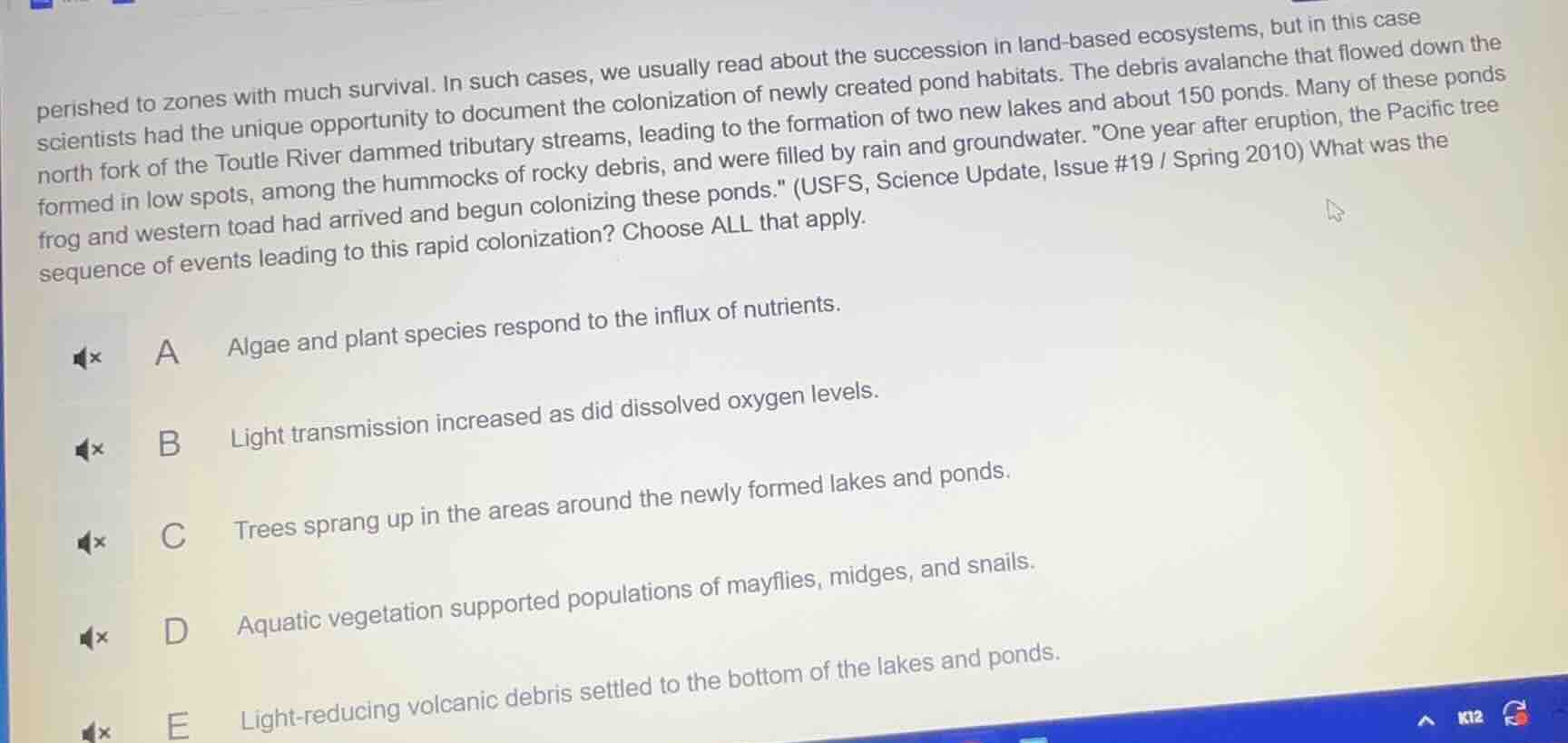
perished to zones with much survival. in such cases, we usually read about the succession in land-based ecosystems, but in this case scientists had the unique opportunity to document the colonization of newly created pond habitats. the debris avalanche that flowed down the north fork of the toutle river dammed tributary streams, leading to the formation of two new lakes and about 150 ponds. many of these ponds formed in low spots, among the hummocks of rocky debris, and were filled by rain and groundwater. \one year after eruption, the pacific tree frog and western toad had arrived and begun colonizing these ponds.\ (usfs, science update, issue #19 / spring 2010) what was the sequence of events leading to this rapid colonization? choose all that apply.
a algae and plant species respond to the influx of nutrients.
b light transmission increased as did dissolved oxygen levels.
c trees sprang up in the areas around the newly formed lakes and ponds.
d aquatic vegetation supported populations of mayflies, midges, and snails.
e light-reducing volcanic debris settled to the bottom of the lakes and ponds.
- First, volcanic debris settles, clearing the water (E).
- This allows more light and dissolved oxygen (B).
- Algae and plants then grow using nutrients (A).
- Aquatic vegetation supports invertebrates (D).
- Tree growth (C) happens later, not in the rapid initial colonization sequence that supports amphibians.

Snap & solve any problem in the app
Get step-by-step solutions on Sovi AI
Photo-based solutions with guided steps
Explore more problems and detailed explanations
A. Algae and plant species respond to the influx of nutrients.
B. Light transmission increased as did dissolved oxygen levels.
D. Aquatic vegetation supported populations of mayflies, midges, and snails.
E. Light-reducing volcanic debris settled to the bottom of the lakes and ponds.