QUESTION IMAGE
Question
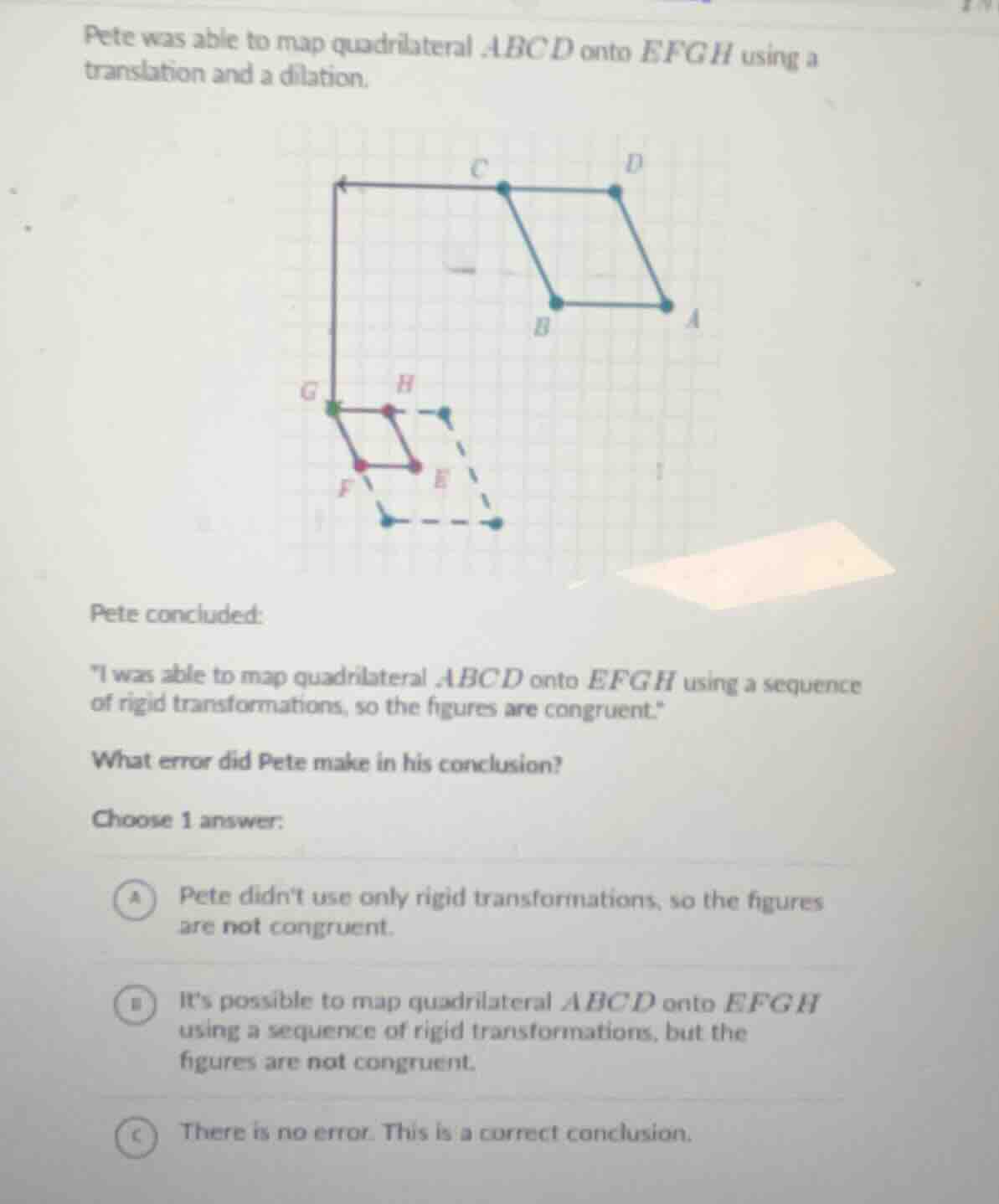
pete was able to map quadrilateral abcd onto efgh using a translation and a dilation.
pete concluded:
\i was able to map quadrilateral abcd onto efgh using a sequence of rigid transformations, so the figures are congruent.\
what error did pete make in his conclusion?
choose 1 answer:
a pete didnt use only rigid transformations, so the figures are not congruent.
b its possible to map quadrilateral abcd onto efgh using a sequence of rigid transformations, but the figures are not congruent.
c there is no error. this is a correct conclusion.
Rigid transformations (like translation, rotation, reflection) preserve the size and shape of a figure, so congruent figures can be mapped using only rigid transformations. Dilation is a non - rigid transformation (it changes the size of the figure). Pete used a dilation along with a translation. So he didn't use only rigid transformations, and since dilation changes the size, the figures are not congruent. Option A correctly identifies this error. Option B is wrong because if only rigid transformations were used, the figures would be congruent, and option C is wrong as there is an error in Pete's conclusion.

Snap & solve any problem in the app
Get step-by-step solutions on Sovi AI
Photo-based solutions with guided steps
Explore more problems and detailed explanations
A. Pete didn't use only rigid transformations, so the figures are not congruent.