QUESTION IMAGE
Question
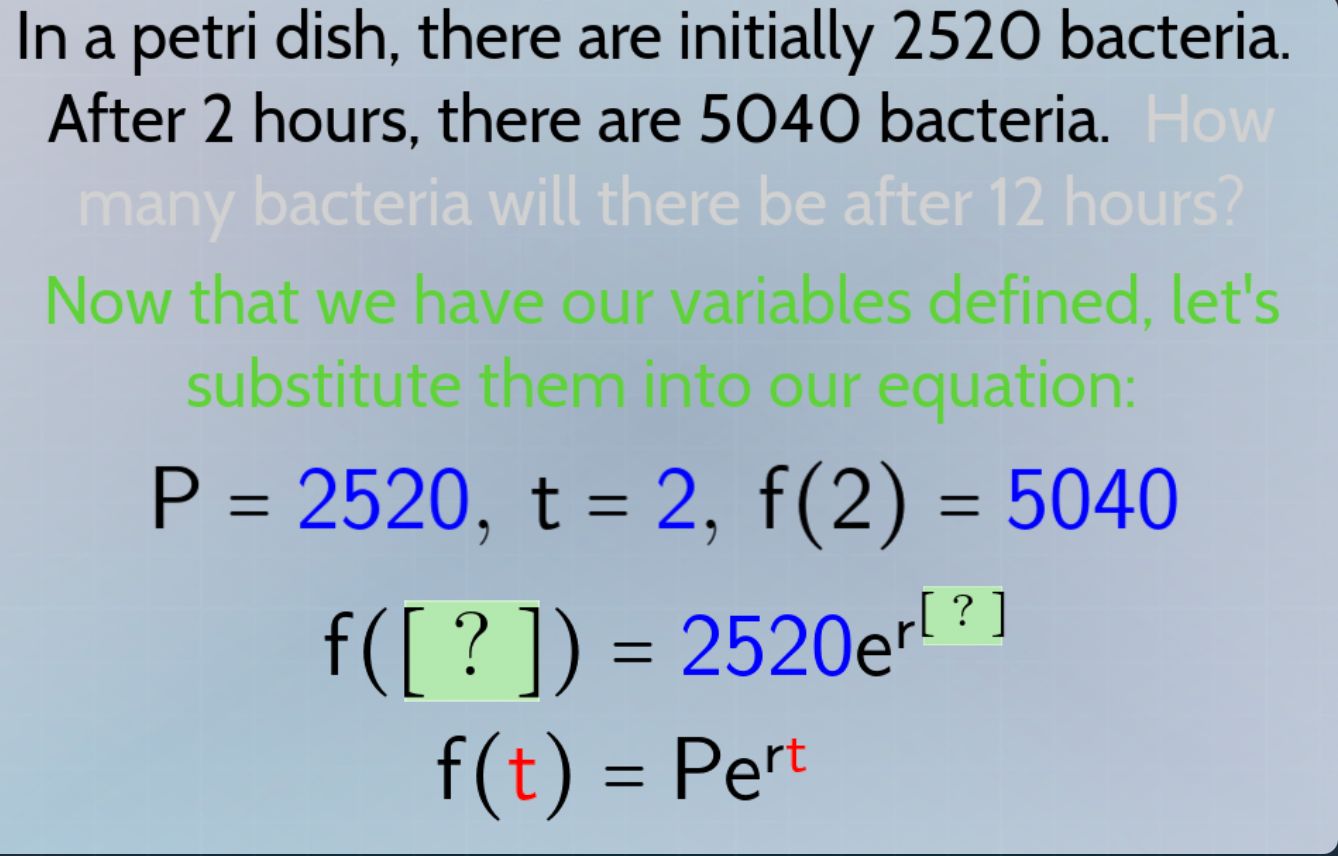
in a petri dish, there are initially 2520 bacteria. after 2 hours, there are 5040 bacteria. how many bacteria will there be after 12 hours? now that we have our variables defined, lets substitute them into our equation: p = 2520, t = 2, f(2) = 5040 f(?) = 2520e^{r?} f(t) = pe^{rt}
Step1: Identify the function variables
We know the exponential growth function is \( f(t) = Pe^{rt} \), where \( P = 2520 \) (initial bacteria), \( t = 2 \) (time in hours), and \( f(2)=5040 \) (bacteria after 2 hours). So we substitute \( t = 2 \) into the function.
\( f(2)=2520e^{r\times2} \)
Step2: Solve for the growth rate \( r \)
We have \( 5040 = 2520e^{2r} \). Divide both sides by 2520: \( \frac{5040}{2520}=e^{2r} \), which simplifies to \( 2 = e^{2r} \). Take the natural logarithm of both sides: \( \ln(2)=\ln(e^{2r}) \), so \( \ln(2) = 2r \). Then \( r=\frac{\ln(2)}{2} \).
Step3: Find the number of bacteria after 12 hours
Now we use the function \( f(t)=2520e^{rt} \) with \( t = 12 \) and \( r=\frac{\ln(2)}{2} \). Substitute \( r \) into the function: \( f(12)=2520e^{\frac{\ln(2)}{2}\times12} \). Simplify the exponent: \( \frac{\ln(2)}{2}\times12 = 6\ln(2)=\ln(2^6)=\ln(64) \). Then \( f(12)=2520e^{\ln(64)} \). Since \( e^{\ln(x)} = x \), we get \( f(12)=2520\times64 \). Calculate \( 2520\times64 = 161280 \).

Snap & solve any problem in the app
Get step-by-step solutions on Sovi AI
Photo-based solutions with guided steps
Explore more problems and detailed explanations
161280