QUESTION IMAGE
Question
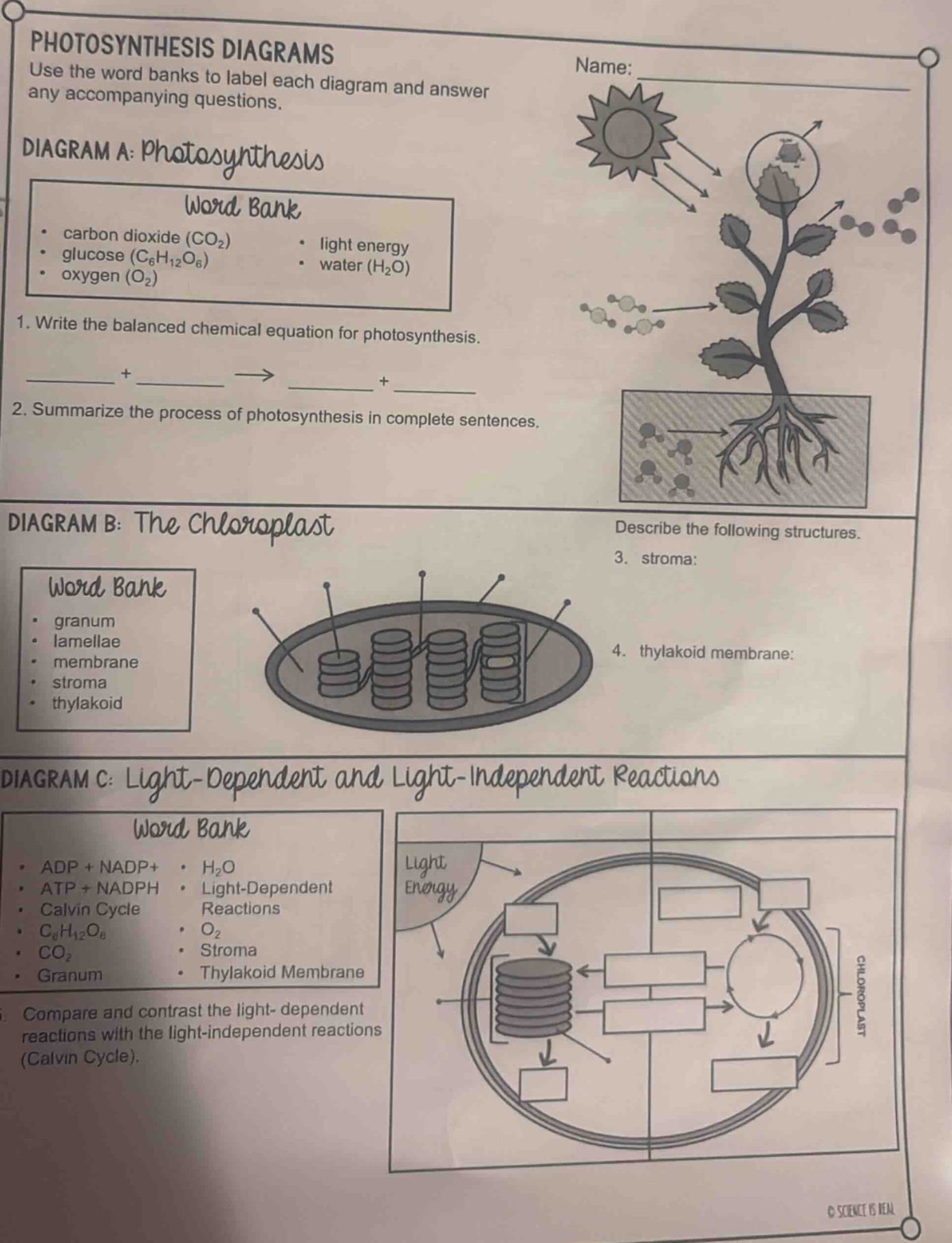
photosynthesis diagrams
use the word banks to label each diagram and answer any accompanying questions.
name:
diagram a: photosynthesis
word bank
- carbon dioxide (co₂)
- light energy
- glucose (c₆h₁₂o₆)
- water (h₂o)
- oxygen (o₂)
- write the balanced chemical equation for photosynthesis.
____ + __ → __ + ____
- summarize the process of photosynthesis in complete sentences.
diagram b: the chloroplast
word bank
- granum
- lamellae
- membrane
- stroma
- thylakoid
describe the following structures.
- stroma:
- thylakoid membrane:
diagram c: light-dependent and light-independent reactions
word bank
- adp + nadp+
- h₂o
- atp + nadph
- light-dependent reactions
- calvin cycle
- o₂
- c₆h₁₂o₆
- stroma
- co₂
- thylakoid membrane
- granum
- compare and contrast the light- dependent reactions with the light-independent reactions (calvin cycle).
Step1: Balance photosynthesis equation
$$6\text{CO}_2 + 6\text{H}_2\text{O} \xrightarrow{\text{light energy}} \text{C}_6\text{H}_{12}\text{O}_6 + 6\text{O}_2$$
Step2: Summarize photosynthesis process
Photosynthesis is the process by which plants, algae, and some bacteria use light energy from the sun, carbon dioxide from the atmosphere, and water from the soil to produce glucose (a sugar for energy and growth) and release oxygen as a byproduct, all occurring within chloroplasts.
Step3: Define stroma
The stroma is the gel-like fluid matrix that fills the space inside a chloroplast, surrounding the thylakoid structures; it is the site of the light-independent (Calvin Cycle) reactions of photosynthesis.
Step4: Define thylakoid membrane
The thylakoid membrane is the flattened, disc-like membrane structure that forms individual thylakoids (stacked into grana) in chloroplasts; it contains chlorophyll and is the site of the light-dependent reactions of photosynthesis, where light energy is captured and converted into chemical energy.
Step5: Label Diagram C (clockwise from top left)
- Granum (labels the stacked disc structure)
- Light-Dependent Reactions (labels the process in the thylakoid)
- $\text{H}_2\text{O}$ (input for light reactions)
- $\text{O}_2$ (byproduct of light reactions)
- ATP + NADPH (energy carriers from light to dark reactions)
- Stroma (labels the fluid space for Calvin Cycle)
- Calvin Cycle (labels the light-independent reaction)
- $\text{CO}_2$ (input for Calvin Cycle)
- $\text{C}_6\text{H}_{12}\text{O}_6$ (glucose, product of Calvin Cycle)
- ADP + NADP+ (molecules recycled back to light reactions)
Step6: Compare/contrast light reactions & Calvin Cycle
Similarities:
Both are interconnected stages of photosynthesis that work together to convert light energy into chemical energy (glucose) for the plant. Both occur within the chloroplast, and the products of one reaction are the reactants/energy sources for the other.
Differences:
| Feature | Light-Dependent Reactions | Light-Independent Reactions (Calvin Cycle) |
|---|---|---|
| Light Requirement | Requires light energy to proceed | Does not require direct light (uses stored energy from light reactions) |
| Inputs | $\text{H}_2\text{O}$, light energy, ADP + NADP+ | $\text{CO}_2$, ATP + NADPH |
| Outputs | $\text{O}_2$, ATP, NADPH | $\text{C}_6\text{H}_{12}\text{O}_6$ (glucose), ADP + NADP+ |
| Primary Function | Convert light energy into temporary chemical energy (ATP/NADPH) and split water to release oxygen | Use stored chemical energy to fix carbon dioxide into glucose for long-term energy storage and growth |

Snap & solve any problem in the app
Get step-by-step solutions on Sovi AI
Photo-based solutions with guided steps
Explore more problems and detailed explanations
- $6\text{CO}_2$ + $6\text{H}_2\text{O}$ $\xrightarrow{\text{light energy}}$ $\text{C}_6\text{H}_{12}\text{O}_6$ + $6\text{O}_2$
- Photosynthesis is the process where plants, algae, and some bacteria use sunlight energy, carbon dioxide from the air, and water from the soil to produce glucose (a sugar for energy and growth) and release oxygen as a waste product, all occurring in the chloroplasts of plant cells.
- The stroma is the gel-like fluid inside chloroplasts, surrounding the thylakoid grana, and is the site of the Calvin Cycle (light-independent reactions).
- The thylakoid membrane is the membrane that forms individual disc-shaped thylakoids (stacked into grana) in chloroplasts; it contains chlorophyll, captures light energy, and is the location of the light-dependent reactions of photosynthesis.
- (Diagram C labels, clockwise from top left): Granum, Light-Dependent Reactions, $\text{H}_2\text{O}$, $\text{O}_2$, ATP + NADPH, Stroma, Calvin Cycle, $\text{CO}_2$, $\text{C}_6\text{H}_{12}\text{O}_6$, ADP + NADP+
- Similarities: Both are linked stages of photosynthesis in chloroplasts; the products of light reactions power the Calvin Cycle, and the byproducts of the Calvin Cycle are recycled back to the light reactions.
Differences: Light-dependent reactions require light, occur in the thylakoid membrane, use water and light energy to make ATP, NADPH, and oxygen. The Calvin Cycle (light-independent) does not need direct light, occurs in the stroma, uses ATP, NADPH, and carbon dioxide to make glucose, recycling ADP and NADP+ back to the light reactions.