QUESTION IMAGE
Question
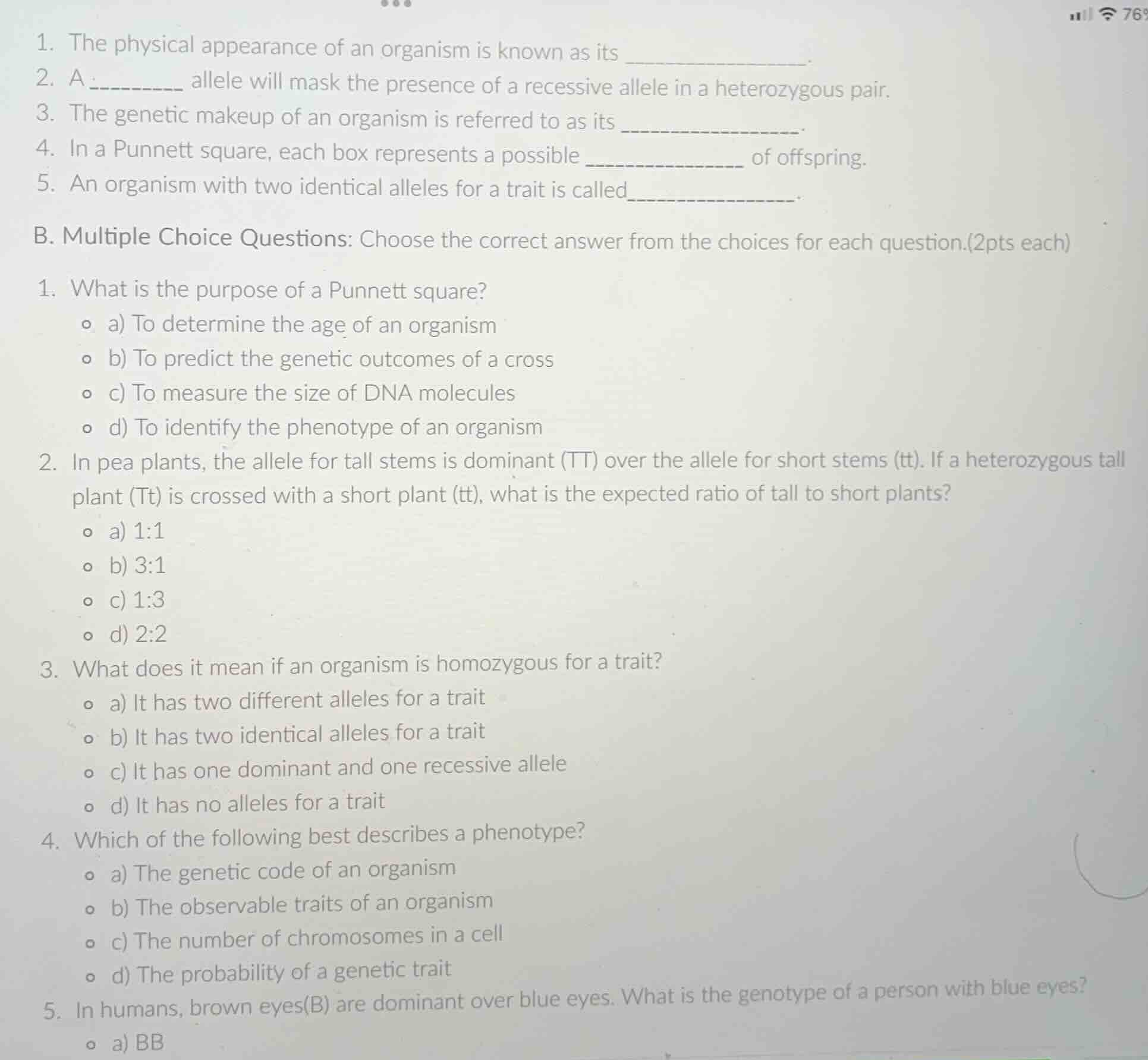
- the physical appearance of an organism is known as its _____________.
- a ______ allele will mask the presence of a recessive allele in a heterozygous pair.
- the genetic makeup of an organism is referred to as its _____________.
- in a punnett square, each box represents a possible ____________ of offspring.
- an organism with two identical alleles for a trait is called_____________.
b. multiple choice questions: choose the correct answer from the choices for each question.(2pts each)
- what is the purpose of a punnett square?
- a) to determine the age of an organism
- b) to predict the genetic outcomes of a cross
- c) to measure the size of dna molecules
- d) to identify the phenotype of an organism
- in pea plants, the allele for tall stems is dominant (tt) over the allele for short stems (tt). if a heterozygous tall plant (tt) is crossed with a short plant (tt), what is the expected ratio of tall to short plants?
- a) 1:1
- b) 3:1
- c) 1:3
- d) 2:2
- what does it mean if an organism is homozygous for a trait?
- a) it has two different alleles for a trait
- b) it has two identical alleles for a trait
- c) it has one dominant and one recessive allele
- d) it has no alleles for a trait
- which of the following best describes a phenotype?
- a) the genetic code of an organism
- b) the observable traits of an organism
- c) the number of chromosomes in a cell
- d) the probability of a genetic trait
- in humans, brown eyes(b) are dominant over blue eyes. what is the genotype of a person with blue eyes?
- a) bb
Response
Part A (Fill - in - the - blanks)
- Question 1
- Brief Explanations: The physical appearance of an organism, which includes its observable traits like height, color, etc., is called the phenotype.
- Answer: phenotype
- Question 2
- Brief Explanations: In a heterozygous pair (having two different alleles), the dominant allele is the one that is expressed and masks the recessive allele.
- Answer: dominant
- Question 3
- Brief Explanations: The genetic makeup of an organism, which is the combination of alleles it has for a particular trait or set of traits, is called the genotype.
- Answer: genotype
- Question 4
- Brief Explanations: A Punnett square is used to show the possible genetic combinations of offspring from a cross. Each box in the Punnett square represents a possible genotype of the offspring.
- Answer: genotype
- Question 5
- Brief Explanations: An organism with two identical alleles (either two dominant or two recessive) for a trait is called homozygous. For example, AA or aa.
- Answer: homozygous
Part B (Multiple - Choice Questions)
- Question 1
- Brief Explanations: A Punnett square is a tool in genetics. Option a is wrong as it has nothing to do with age. Option c is wrong as it doesn't measure DNA size. Option d is wrong as it is used to predict, not identify phenotype directly. It is used to predict the genetic outcomes of a cross.
- Answer: b) To predict the genetic outcomes of a cross
- Question 2
- Brief Explanations: When a heterozygous tall plant (Tt) is crossed with a short plant (tt), the Punnett square will have Tt and tt as the possible genotypes. So the ratio of tall (Tt) to short (tt) plants is 1:1.
- Answer: a) 1:1
- Question 3
- Brief Explanations: Homozygous means having two identical alleles for a trait. Option a is heterozygous, option c is heterozygous, and option d is incorrect as organisms have alleles for traits.
- Answer: b) It has two identical alleles for a trait
- Question 4
- Brief Explanations: Phenotype is the observable traits of an organism. Option a is genotype, option c is about chromosomes (not phenotype), option d is about probability (not phenotype).
- Answer: b) The observable traits of an organism
- Question 5 (Incomplete, but we can analyze based on given info)
- Brief Explanations: Since brown eyes (B) are dominant over blue eyes, blue eyes are recessive. So a person with blue eyes must have two recessive alleles (bb). But since the options are not fully shown, if we assume the options are like a) BB, b) Bb, c) bb, d) B - (incomplete), the correct answer would be the one with two recessive alleles (bb). But based on the given start of options, if we assume the missing options and the logic, the genotype for blue eyes (recessive) is homozygous recessive (bb). If the options were a) BB, b) Bb, c) bb, d) B, then the answer is c) bb. But as the question is incomplete in the provided text, we can say that the genotype should be the homozygous recessive for the blue eye trait.

Snap & solve any problem in the app
Get step-by-step solutions on Sovi AI
Photo-based solutions with guided steps
Explore more problems and detailed explanations
Part A (Fill - in - the - blanks)
- Question 1
- Brief Explanations: The physical appearance of an organism, which includes its observable traits like height, color, etc., is called the phenotype.
- Answer: phenotype
- Question 2
- Brief Explanations: In a heterozygous pair (having two different alleles), the dominant allele is the one that is expressed and masks the recessive allele.
- Answer: dominant
- Question 3
- Brief Explanations: The genetic makeup of an organism, which is the combination of alleles it has for a particular trait or set of traits, is called the genotype.
- Answer: genotype
- Question 4
- Brief Explanations: A Punnett square is used to show the possible genetic combinations of offspring from a cross. Each box in the Punnett square represents a possible genotype of the offspring.
- Answer: genotype
- Question 5
- Brief Explanations: An organism with two identical alleles (either two dominant or two recessive) for a trait is called homozygous. For example, AA or aa.
- Answer: homozygous
Part B (Multiple - Choice Questions)
- Question 1
- Brief Explanations: A Punnett square is a tool in genetics. Option a is wrong as it has nothing to do with age. Option c is wrong as it doesn't measure DNA size. Option d is wrong as it is used to predict, not identify phenotype directly. It is used to predict the genetic outcomes of a cross.
- Answer: b) To predict the genetic outcomes of a cross
- Question 2
- Brief Explanations: When a heterozygous tall plant (Tt) is crossed with a short plant (tt), the Punnett square will have Tt and tt as the possible genotypes. So the ratio of tall (Tt) to short (tt) plants is 1:1.
- Answer: a) 1:1
- Question 3
- Brief Explanations: Homozygous means having two identical alleles for a trait. Option a is heterozygous, option c is heterozygous, and option d is incorrect as organisms have alleles for traits.
- Answer: b) It has two identical alleles for a trait
- Question 4
- Brief Explanations: Phenotype is the observable traits of an organism. Option a is genotype, option c is about chromosomes (not phenotype), option d is about probability (not phenotype).
- Answer: b) The observable traits of an organism
- Question 5 (Incomplete, but we can analyze based on given info)
- Brief Explanations: Since brown eyes (B) are dominant over blue eyes, blue eyes are recessive. So a person with blue eyes must have two recessive alleles (bb). But since the options are not fully shown, if we assume the options are like a) BB, b) Bb, c) bb, d) B - (incomplete), the correct answer would be the one with two recessive alleles (bb). But based on the given start of options, if we assume the missing options and the logic, the genotype for blue eyes (recessive) is homozygous recessive (bb). If the options were a) BB, b) Bb, c) bb, d) B, then the answer is c) bb. But as the question is incomplete in the provided text, we can say that the genotype should be the homozygous recessive for the blue eye trait.