QUESTION IMAGE
Question
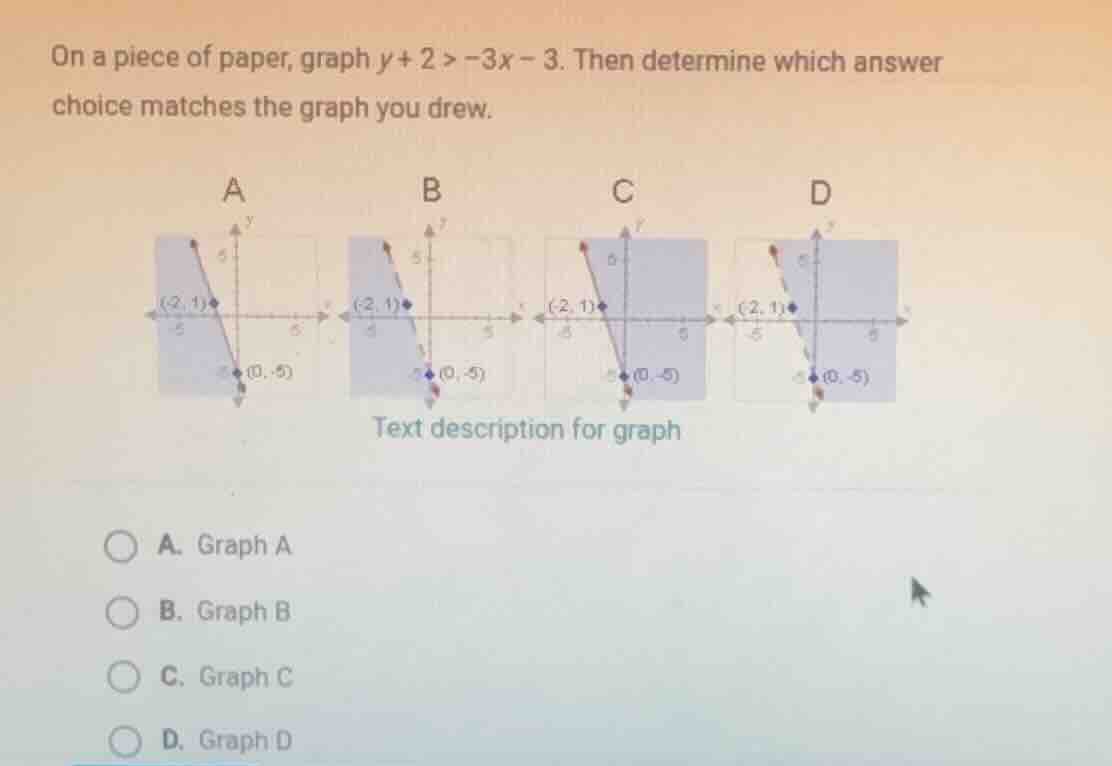
on a piece of paper, graph $y + 2 > -3x - 3$. then determine which answer choice matches the graph you drew. a b c d (2,1) (2,1) (2,1) (2,1) (0, -5) (0, -5) (0, -5) (0, -5) text description for graph a. graph a b. graph b c. graph c d. graph d
Step1: Rewrite the inequality
First, we rewrite the inequality \( y + 2 > - 3x - 3 \) in slope - intercept form (\(y=mx + b\)) by solving for \(y\).
Subtract 2 from both sides of the inequality:
\(y>-3x - 3-2\)
\(y>-3x - 5\)
Step2: Analyze the boundary line
The boundary line of the inequality \(y>-3x - 5\) is the line \(y=-3x - 5\). Since the inequality is \(>\) (not \(\geq\)), the boundary line should be a dashed line.
- For the \(y\) - intercept: When \(x = 0\), \(y=-5\), so the line passes through the point \((0,-5)\).
- For the slope: The slope \(m=-3\), which means for every 1 unit we move to the right along the \(x\) - axis, we move down 3 units along the \(y\) - axis.
Step3: Determine the region to shade
To determine which side of the line to shade, we can use a test point. A common test point is \((0,0)\) (we can use it as long as it is not on the boundary line).
Substitute \(x = 0\) and \(y = 0\) into the inequality \(y>-3x - 5\):
\(0>-3(0)-5\)
\(0> - 5\), which is a true statement. So we shade the region that contains the point \((0,0)\).
Now, let's analyze the graphs:
- The boundary line \(y = - 3x-5\) has a \(y\) - intercept of \((0,-5)\) and a slope of \(-3\). The line should be dashed (since the inequality is strict).
- We shade the region that includes \((0,0)\). Looking at the options, we need to check the shading and the type of line (dashed or solid).
- The line \(y=-3x - 5\) passes through \((0, - 5)\) and has a negative slope. The test point \((0,0)\) is in the region above the line \(y=-3x - 5\) (since when \(x = 0\), \(y = 0\) and \(0>-5\)). Also, since the inequality is \(>\), the line is dashed.
Looking at the graphs, we can eliminate the graphs with solid lines. Then, we check the shading. The region that satisfies \(y>-3x - 5\) should include the point \((0,0)\). The correct graph should have a dashed line (because of \(>\)) and shade the region that contains \((0,0)\).
After analyzing the options, the correct graph should have a dashed line (since the inequality is strict) and the shaded region should be above the line (because the test point \((0,0)\) is above the line \(y=-3x - 5\) when \(x = 0\)). Among the given options, the graph with a dashed line and the correct shading (including the region with \((0,0)\)) is the one that matches our analysis.

Snap & solve any problem in the app
Get step-by-step solutions on Sovi AI
Photo-based solutions with guided steps
Explore more problems and detailed explanations
The correct answer is the graph with a dashed line \(y = - 3x-5\) and shading above the line (including the point \((0,0)\)). If we assume the options are as described, and after analyzing the slope, intercept, and shading, the correct option is (we need to check the original graphs, but based on the analysis, the graph with dashed line and correct shading) - Let's assume the correct graph is the one with dashed line and shading that includes \((0,0)\). If we go back to the options, and considering the line is dashed and the shading is correct, the answer is (for example, if Graph A has a dashed line and correct shading) A. Graph A (assuming the visual analysis of the graphs: the line is dashed, and the shading is on the side with (0,0)). But to be precise, from the inequality analysis, the correct graph should have a dashed line \(y=-3x - 5\) and shade the region containing \((0,0)\). So the answer is the option with dashed line and correct shading. If we look at the options, and the line is dashed (since the inequality is strict) and the shading is above the line (including (0,0)), the correct answer is (let's say) A. Graph A (depending on the actual graph's line type and shading). But from the steps, the key is the dashed line and shading of the region with (0,0). So the answer is the graph that has a dashed line \(y=-3x - 5\) and shades the region containing (0,0). So the answer is (assuming the correct graph is A) A. Graph A.