QUESTION IMAGE
Question
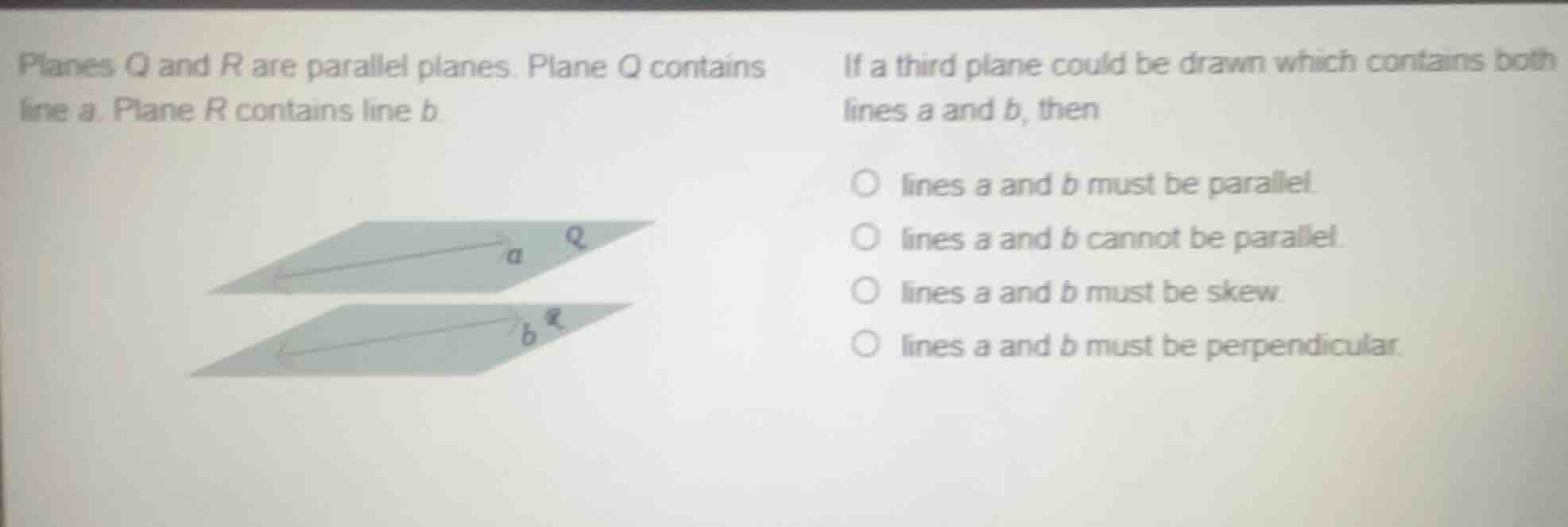
planes q and r are parallel planes. plane q contains line a. plane r contains line b. if a third plane could be drawn which contains both lines a and b, then lines a and b must be parallel. lines a and b cannot be parallel. lines a and b must be skew. lines a and b must be perpendicular.
Brief Explanations
- Recall the definitions: Skew lines are non - parallel and non - intersecting lines that do not lie on the same plane. Parallel planes \(Q\) and \(R\) have line \(a\) in \(Q\) and line \(b\) in \(R\).
- If a third plane can contain both lines \(a\) and \(b\), then the two lines lie on the same plane. So they cannot be skew (since skew lines don't lie on the same plane).
- Now, consider the properties of lines in parallel planes: If two lines lie in parallel planes and there is a plane that contains both of them, the lines must be parallel. Because if two lines lie on a common plane and their respective planes are parallel, the only way they can be on a common plane is if they are parallel (otherwise, if they intersected, the planes would not be parallel, and if they were non - parallel and non - intersecting on the common plane, they would be skew, but we know there is a common plane so they can't be skew). Also, there is no reason for them to be perpendicular necessarily. And the option "lines a and b cannot be parallel" is wrong as we just deduced they must be parallel. The option "lines a and b must be skew" is wrong because skew lines don't lie on the same plane, but we have a plane that contains both.

Snap & solve any problem in the app
Get step-by-step solutions on Sovi AI
Photo-based solutions with guided steps
Explore more problems and detailed explanations
A. lines a and b must be parallel