QUESTION IMAGE
Question
plant structures
read the passage and study the diagrams below. you can use a separate sheet of paper to answer the questions that follow.
bubbling leaves
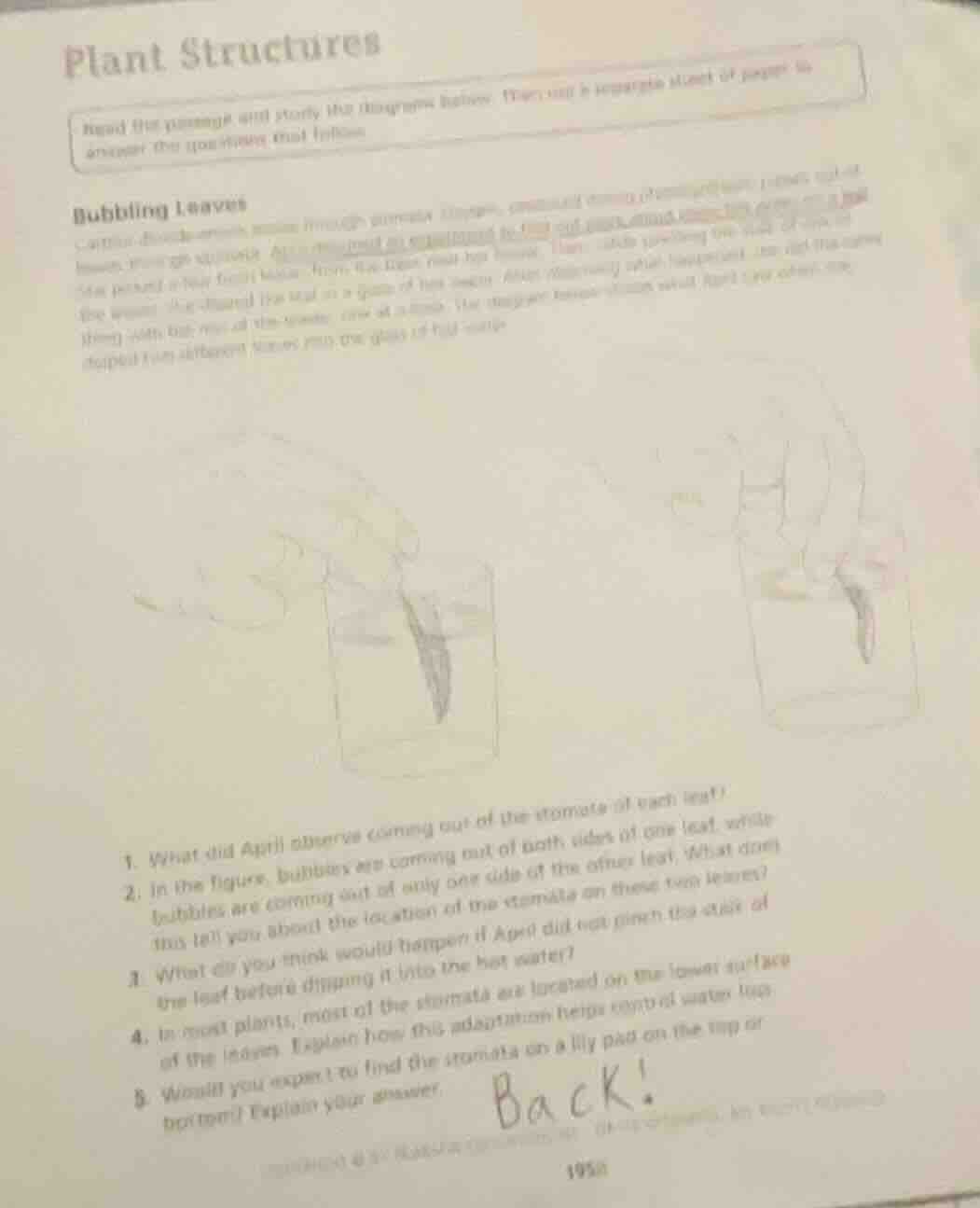
the passage text here is partially unclear due to image quality, but the main topic is about leaf stomata and an experiment with leaves in water, observing bubbles.
- what did april observe coming out of the stomata of each leaf?
- in the figure, bubbles are coming out of both sides of one leaf, while bubbles are coming out of only one side of the other leaf. what does this tell you about the location of the stomata on these two leaves?
- what do you think would happen if april did not pinch the stalk of the leaf before dipping it into the hot water?
- in most plants, most of the stomata are located on the lower surface of the leaves. explain how this adaptation helps control water loss.
- would you expect to find the stomata on a lily pad on the top or bottom? explain your answer.
back!
1958
Brief Explanations
- April observed air bubbles coming out of the stomata of each leaf. This is because the hot water forces air out of the leaf's intercellular spaces through the stomata.
- The leaf with bubbles on both sides has stomata on both its upper and lower surfaces, while the leaf with bubbles on only one side has stomata only on that single surface (most commonly the lower surface for most land plants).
- If April did not pinch the stem, air would escape through the cut end of the stem instead of being forced out through the leaf stomata, so few to no bubbles would be seen coming from the leaf surfaces.
- Stomata on the lower leaf surface are shaded from direct sunlight and are cooler, which slows down the rate of water evaporation (transpiration). This helps the plant conserve water by reducing the amount of water lost through stomatal transpiration.
- Stomata on a lily pad would be found on the upper surface. Lily pads float on water, so their lower surface is submerged; having stomata on the upper surface allows the plant to take in carbon dioxide for photosynthesis and release oxygen, since the submerged surface cannot exchange gases with the air effectively.

Snap & solve any problem in the app
Get step-by-step solutions on Sovi AI
Photo-based solutions with guided steps
Explore more problems and detailed explanations
- Air bubbles coming out of the stomata.
- One leaf has stomata on both surfaces; the other has stomata only on the side with bubbles.
- Few/no bubbles would come from the leaf, as air would escape through the stem.
- It reduces water loss by slowing transpiration (cooler, shaded lower surface).
- Upper surface; the lower surface is submerged, so upper stomata enable gas exchange.