QUESTION IMAGE
Question
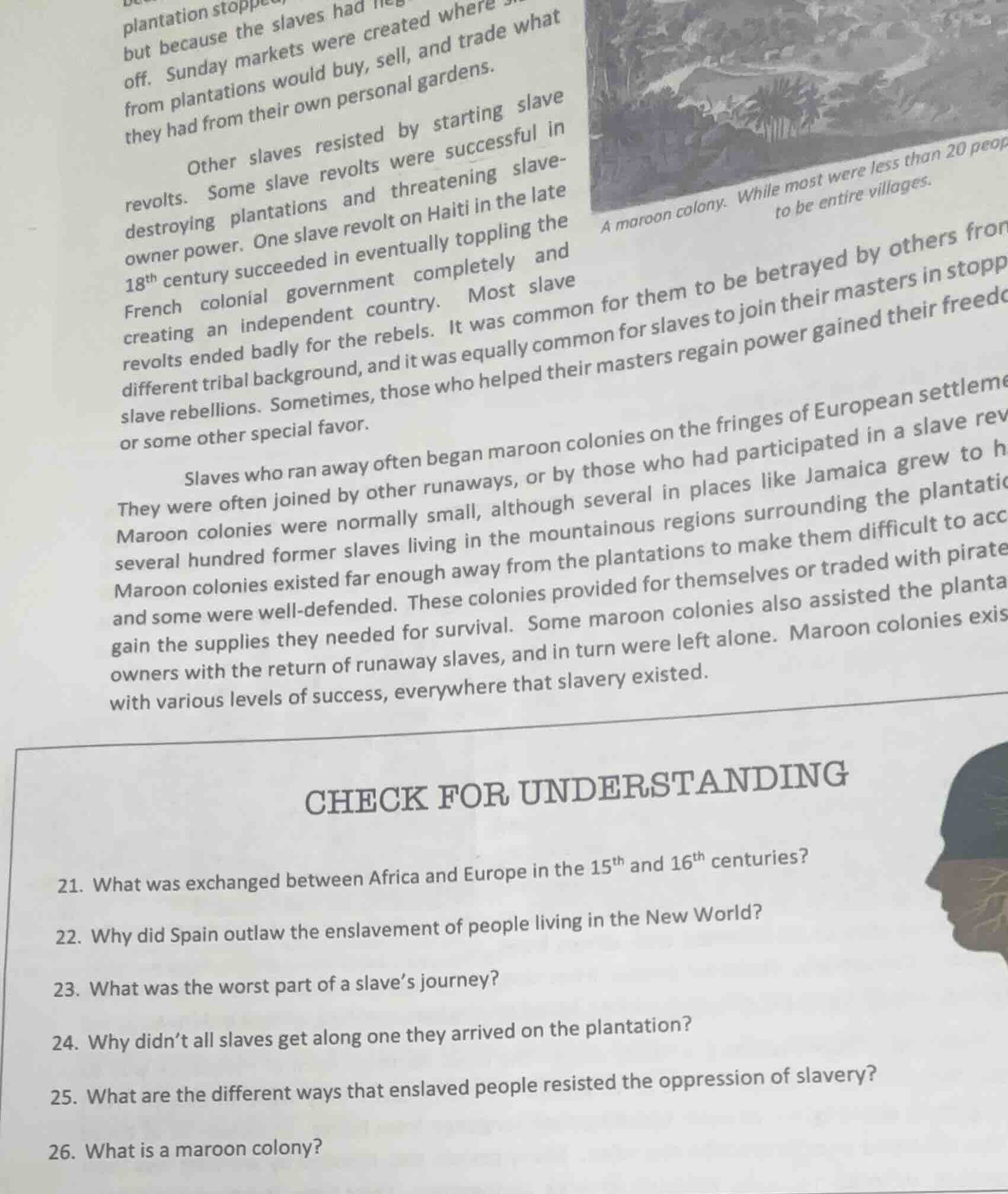
plantation stopped but because the slaves had neg off. sunday markets were created where from plantations would buy, sell, and trade what they had from their own personal gardens. other slaves resisted by starting slave revolts. some slave revolts were successful in destroying plantations and threatening slave- owner power. one slave revolt on haiti in the late 18th century succeeded in eventually toppling the french colonial government completely and creating an independent country. most slave revolts ended badly for the rebels. it was common for them to be betrayed by others from different tribal background, and it was equally common for slaves to join their masters in stopp slave rebellions. sometimes, those who helped their masters regain power gained their freedo or some other special favor. slaves who ran away often began maroon colonies on the fringes of european settleme they were often joined by other runaways, or by those who had participated in a slave rev maroon colonies were normally small, although several in places like jamaica grew to h several hundred former slaves living in the mountainous regions surrounding the plantati maroon colonies existed far enough away from the plantations to make them difficult to acc and some were well - defended. these colonies provided for themselves or traded with pirate gain the supplies they needed for survival. some maroon colonies also assisted the planta owners with the return of runaway slaves, and in turn were left alone. maroon colonies exis with various levels of success, everywhere that slavery existed. check for understanding 21. what was exchanged between africa and europe in the 15th and 16th centuries? 22. why did spain outlaw the enslavement of people living in the new world? 23. what was the worst part of a slave’s journey? 24. why didn’t all slaves get along one they arrived on the plantation? 25. what are the different ways that enslaved people resisted the oppression of slavery? 26. what is a maroon colony?
- Based on the context of transatlantic trade in this era, Europe sent manufactured goods (like textiles, weapons) to Africa, and Africa supplied enslaved people to European colonies in the Americas, with raw materials from the Americas also flowing to Europe, but the direct Africa-Europe exchange centered on European manufactured goods for enslaved people.
- Historical records show that due to pressure from religious figures (like Bartolomé de las Casas) who advocated for the rights of Indigenous peoples, and the high death rate of enslaved New World populations from disease and abuse, Spain shifted to enslaving African people instead.
- The Middle Passage (the ocean voyage from Africa to the Americas) was the worst part: enslaved people were packed in overcrowded, unsanitary ship holds, facing starvation, disease, physical abuse, and high mortality rates.
- Enslaved people came from diverse African tribal and cultural backgrounds, spoke different languages, and some were coerced or incentivized to collaborate with slave owners, creating divisions.
- From the provided text: 1) Passive resistance: participating in Sunday markets to trade goods from personal gardens; 2) Active resistance: organizing slave revolts to destroy plantations and challenge owner power; 3) Escaping to form or join maroon colonies; some also collaborated with owners to gain favor, though this is a complex form of survival.
- From the provided text: Maroon colonies are settlements established by runaway enslaved people on the edges of European colonial areas, joined by other runaways or revolt participants; they are usually small (some grew larger), located in remote, defensible areas, self-sufficient or trading for supplies, and some had agreements with plantation owners to return runaways in exchange for being left undisturbed.

Snap & solve any problem in the app
Get step-by-step solutions on Sovi AI
Photo-based solutions with guided steps
Explore more problems and detailed explanations
- Europe sent manufactured goods (textiles, weapons, etc.) to Africa, and Africa supplied enslaved people to European traders for transport to the Americas.
- Spain outlawed enslaving New World Indigenous peoples due to advocacy from religious reformers highlighting their mistreatment, and the catastrophic decline of Indigenous populations from disease and exploitation, leading to a shift to enslaving African people.
- The worst part was the Middle Passage: the brutal ocean voyage from Africa to the Americas, where enslaved people were confined to overcrowded, unsanitary ship holds, facing disease, starvation, violence, and high death rates.
- Enslaved people came from many distinct African tribal groups with different languages and cultures, and some were pressured or rewarded to work with slave owners, causing divisions among them.
- The different resistance methods include: trading goods from personal gardens in Sunday markets (passive resistance), organizing and participating in slave revolts to challenge plantation owners, and escaping to establish or join maroon colonies. Some also collaborated with owners to gain freedom or favors as a survival tactic.
- A maroon colony is a settlement founded by runaway enslaved people on the fringes of European colonial territories, often joined by other runaways or revolt participants. They are typically small (some grew to hundreds of people), located in remote, defensible areas, self-sufficient or trading for supplies, and some had arrangements with plantation owners to return runaways in exchange for being left undisturbed.