QUESTION IMAGE
Question
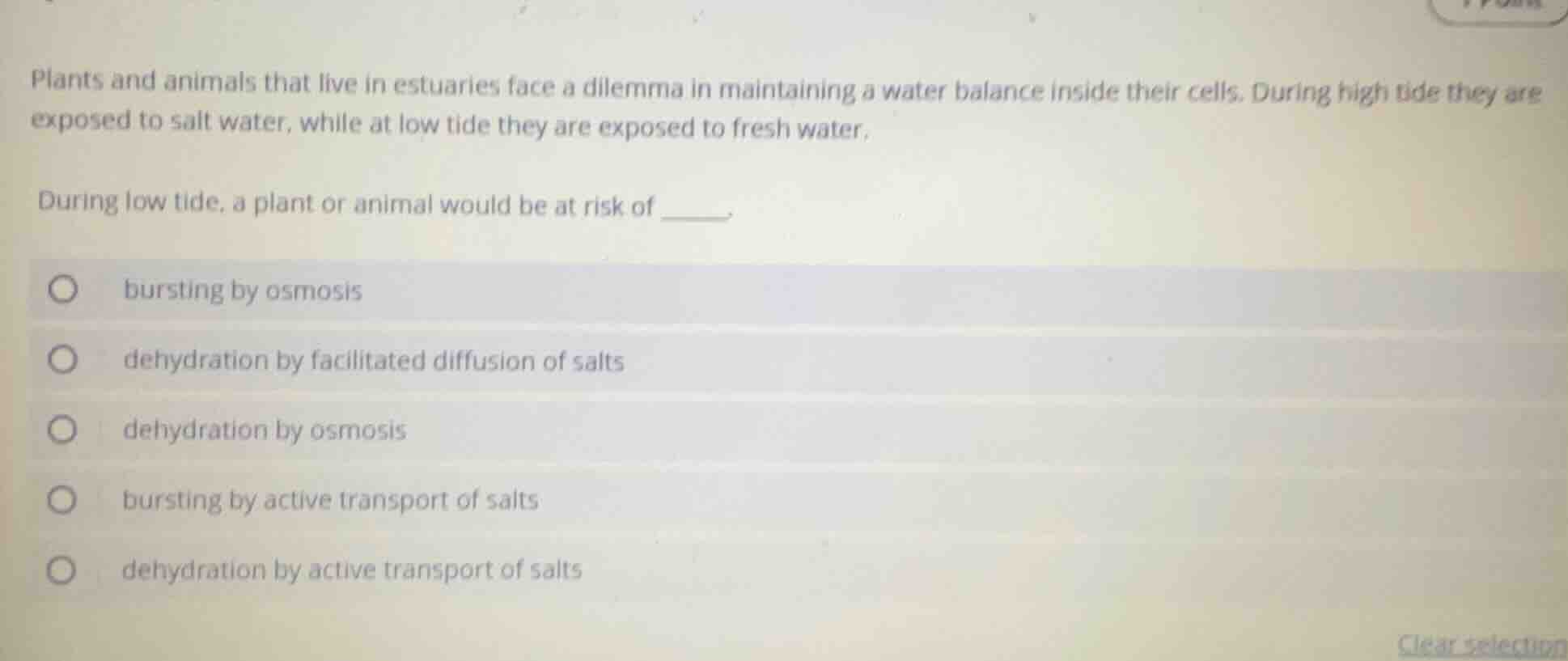
plants and animals that live in estuaries face a dilemma in maintaining a water balance inside their cells. during high tide they are exposed to salt water, while at low tide they are exposed to fresh water. during low tide, a plant or animal would be at risk of ______. options: bursting by osmosis; dehydration by facilitated diffusion of salts; dehydration by osmosis; bursting by active transport of salts; dehydration by active transport of salts
Brief Explanations
- Recall the concept of osmosis: water moves from an area of lower solute concentration (higher water potential) to higher solute concentration (lower water potential) across a semi - permeable membrane.
- During low tide, estuarine organisms are exposed to fresh water. The cells of these organisms have a higher solute (salt) concentration compared to the fresh water outside.
- Analyze each option:
- Option "bursting by osmosis": Since the cell has a higher solute concentration, water will move into the cell by osmosis. If the cell takes in too much water, it can burst. This is a possible risk during low tide when exposed to fresh water.
- Option "dehydration by facilitated diffusion of salts": Facilitated diffusion of salts would not cause dehydration. Dehydration would occur if water moves out, but in this case, with fresh water outside, water moves in. Also, facilitated diffusion of salts is not related to dehydration in this context.
- Option "dehydration by osmosis": Dehydration by osmosis would happen if water moves out of the cell, but here, because the cell has a higher solute concentration than the fresh water, water moves into the cell, not out. So this is incorrect.
- Option "bursting by active transport of salts": Active transport of salts is about moving salts against the concentration gradient, not directly related to the cell bursting due to water intake. The bursting is due to osmosis (water movement), not active transport of salts.
- Option "dehydration by active transport of salts": Active transport of salts does not cause dehydration. Dehydration is related to water movement, and in this case, water moves into the cell, not out.

Snap & solve any problem in the app
Get step-by-step solutions on Sovi AI
Photo-based solutions with guided steps
Explore more problems and detailed explanations
A. bursting by osmosis