QUESTION IMAGE
Question
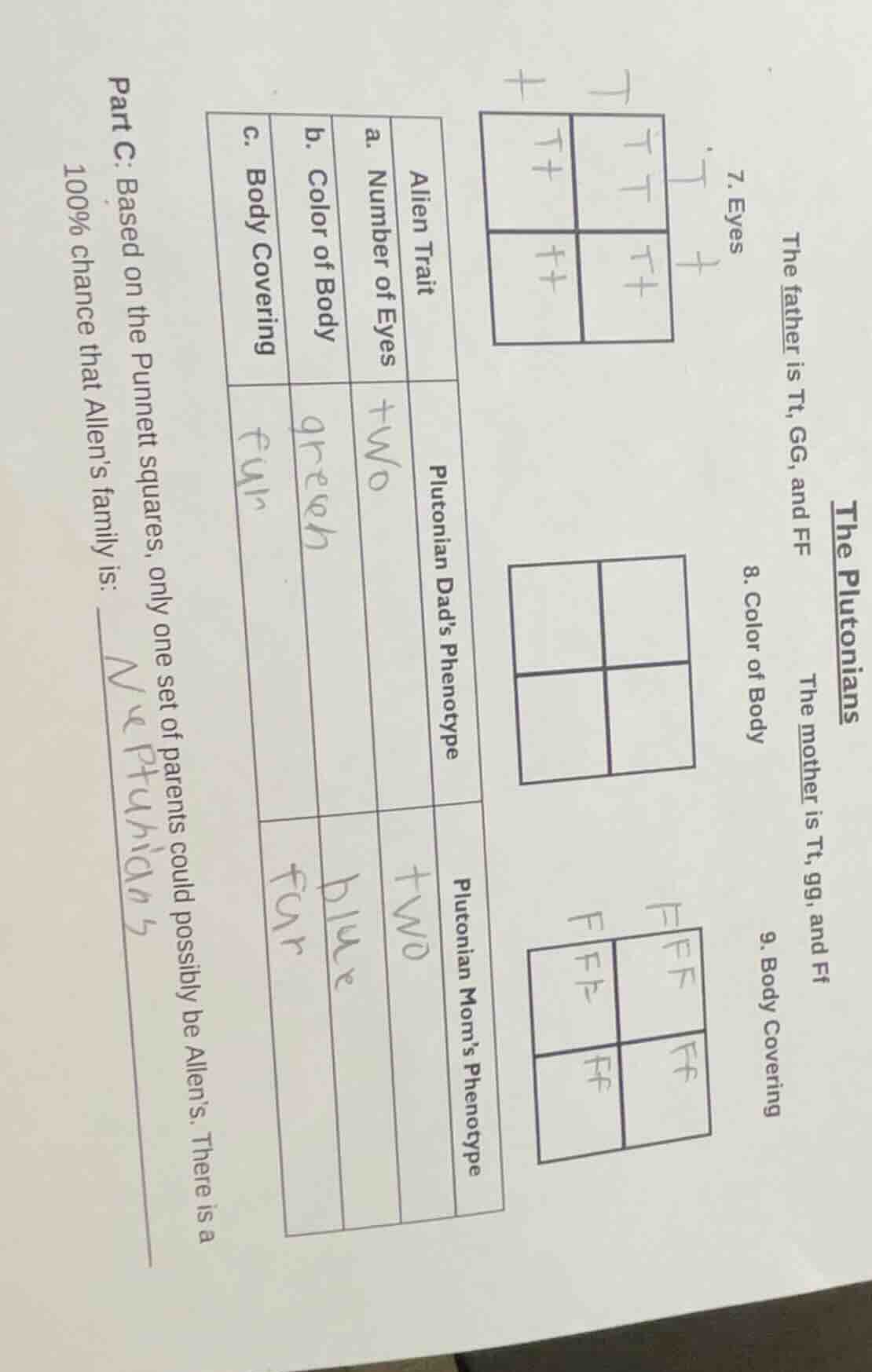
the plutonians
the father is tt, gg, and ff
the mother is tt, gg, and ff
- eyes
- color of body
- body covering
part c: based on the punnett squares, only one set of parents could possibly be allen’s. there is a 100% chance that allen’s family is:
table with columns alien trait, plutonian dad’s phenotype, plutonian mom’s phenotype and rows a. number of eyes (dad: two, mom: two), b. color of body (dad: green, mom: blue), c. body covering (dad: fur, mom: fur)
To solve this, we analyze each trait:
Trait a: Number of Eyes
Father: \( Tt \), Mother: \( Tt \). Punnett square for \( Tt \times Tt \) gives genotypes \( TT, Tt, Tt, tt \). But the given Punnett square for eyes (top) shows \( TT, Tt, Tt, tt \)? Wait, no—wait, the father and mother for eyes are both \( Tt \). But the Punnett square drawn has \( TT, Tt, Tt, tt \)? Wait, no, the first Punnett square (eyes) has rows/columns \( T, t \) and \( T, t \)? Wait, no, the father is \( Tt \), mother is \( Tt \). The Punnett square for eyes:
- Father’s alleles: \( T, t \)
- Mother’s alleles: \( T, t \)
- Offspring: \( TT, Tt, Tt, tt \). But the drawn square has \( TT, Tt, Tt, tt \)? Wait, no, the user’s drawn square for eyes has \( TT, Tt, Tt, tt \)? Wait, the first square (eyes) has four cells: \( TT, Tt, Tt, tt \)? Wait, no, the image shows the eyes Punnett square with \( TT, Tt, Tt, tt \)? Wait, maybe I misread. Wait, the father is \( Tt \), mother is \( Tt \). So the Punnett square for eyes would have \( T \) and \( t \) from each.
Trait b: Color of Body
Father: \( GG \), Mother: \( gg \). Punnett square for \( GG \times gg \) would be all \( Gg \). But the given square for color is empty? Wait, no, the second square (color) is empty. The father’s genotype for color is \( GG \), mother’s is \( gg \). So all offspring would be \( Gg \). But the table says Dad’s phenotype is “green”, Mom’s is “blue”. So if Dad is \( GG \) (green), Mom is \( gg \) (blue), offspring are \( Gg \) (probably green, if \( G \) is dominant). But the Punnett square for color is empty, so maybe not matching.
Trait c: Body Covering
Father: \( FF \), Mother: \( Ff \). Punnett square for \( FF \times Ff \):
- Father’s alleles: \( F, F \)
- Mother’s alleles: \( F, f \)
- Offspring: \( FF, FF, Ff, Ff \). The drawn square for body covering has \( FF, FF, Ff, Ff \) (matches the third square).
Now, Part C: “Based on the Punnett squares, only one set of parents could possibly be Allen’s. There is a 100% chance that Allen’s family is: ______”
Wait, the table has three traits:
- a. Number of Eyes: Dad (Plutonian) phenotype “two”, Mom phenotype “two” (both \( Tt \)? Wait, no, Dad’s genotype for eyes is \( Tt \), Mom’s is \( Tt \). So their phenotype for eyes is “two” (since \( T \) is dominant, assuming \( T \) = two eyes, \( t \) = maybe one? Wait, no, the phenotype for eyes is “two” for both. But if both are \( Tt \), offspring can have \( TT, Tt, Tt, tt \)—so phenotype “two” (if \( T \) is dominant) or “one” (if \( tt \)). So there’s a 25% chance of \( tt \) (one eye), so not 100% same as parents.
- b. Color of Body: Dad is \( GG \) (green), Mom is \( gg \) (blue). Offspring are \( Gg \) (green, if \( G \) is dominant). So Dad’s phenotype: green, Mom’s: blue, offspring: green. So phenotype doesn’t match Mom’s (blue), so not 100% same as parents.
- c. Body Covering: Dad is \( FF \) (fur? Wait, table says Dad’s phenotype “fur”? Wait, table: “Body Covering” row, Dad’s phenotype “fur”, Mom’s phenotype “fur”. Wait, Dad’s genotype \( FF \), Mom’s \( Ff \). So offspring are \( FF, FF, Ff, Ff \)—all with “fur” phenotype (since \( F \) is dominant, \( F \) = fur, \( f \) = maybe not? Wait, Dad’s phenotype “fur” (genotype \( FF \)), Mom’s phenotype “fur” (genotype \( Ff \)). So offspring: \( FF \) (fur), \( FF \) (fur), \( Ff \) (fur), \( Ff \) (fur). So all offspring have “fur” phenotype, same as both parents. Also, the Punnett square for body covering matches \( FF \times Ff \) (cells \( FF, FF, Ff, Ff \)).
For the other traits:
- Eyes: Parents \( Tt \times Tt \), of…
To determine Allen’s family, we analyze each trait’s Punnett square and phenotype consistency:
- Number of Eyes (Trait a): Parents (\( Tt \times Tt \)) can produce offspring with \( tt \) (one eye), so not 100% same as parents (two eyes).
- Color of Body (Trait b): Parents (\( GG \times gg \)) produce offspring (\( Gg \), green), but the mother’s phenotype is blue (not matched), so not 100%.
- Body Covering (Trait c): Parents (\( FF \times Ff \)) produce offspring (\( FF, FF, Ff, Ff \)), all with “fur” (same as both parents’ phenotype). This is the only trait with 100% offspring-phenotype match to both parents.
Since only the Plutonian parents (for Body Covering) have a 100% chance of offspring matching their phenotype, Allen’s family is Plutonian.

Snap & solve any problem in the app
Get step-by-step solutions on Sovi AI
Photo-based solutions with guided steps
Explore more problems and detailed explanations
Plutonian