QUESTION IMAGE
Question
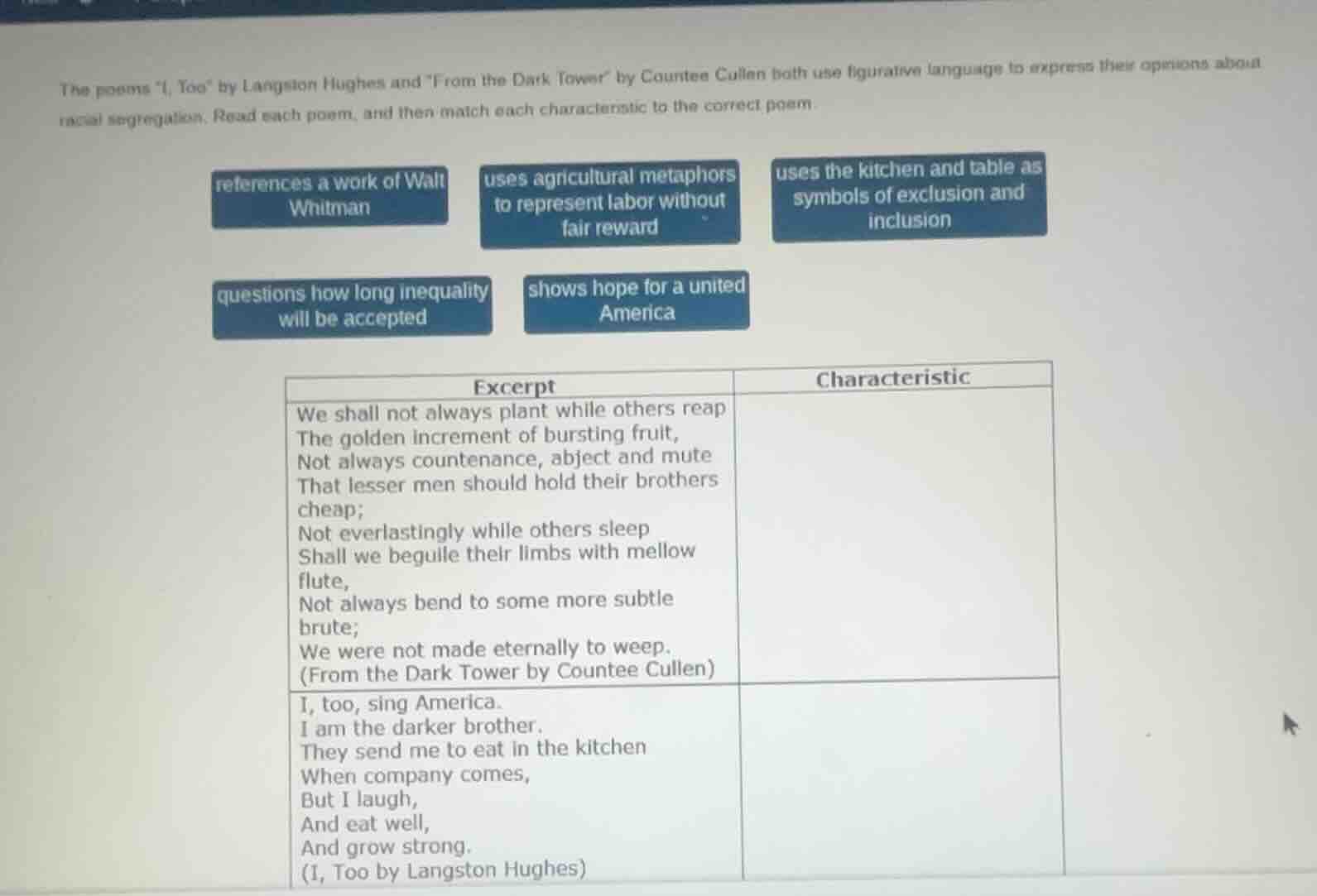
the poems \i, too\ by langston hughes and \from the dark tower\ by countee cullen both use figurative language to express their opinions about racial segregation. read each poem, and then match each characteristic to the correct poem.
references a work of walt whitman
uses agricultural metaphors to represent labor without fair reward
uses the kitchen and table as symbols of exclusion and inclusion
questions how long inequality will be accepted
shows hope for a united america
| excerpt | characteristic |
|---|
|we shall not always plant while others reap<br>the golden increment of bursting fruit,<br>not always countenance, abject and mute<br>that lesser men should hold their brothers cheap;<br>not everlastingly while others sleep<br>shall we beguile their limbs with mellow flute,<br>not always bend to some more subtle brute;<br>we were not made eternally to weep.<br>(from the dark tower by countee cullen)|
|i, too, sing america.<br>i am the darker brother.<br>they send me to eat in the kitchen<br>when company comes,<br>but i laugh,<br>and eat well,<br>and grow strong.<br>(i, too by langston hughes)|
- For From the Dark Tower: The excerpt uses agricultural imagery ("plant while others reap," "bursting fruit") to highlight uncompensated labor. It also questions how long this unfair dynamic will continue, and it carries an undercurrent of hope for a shift away from oppression.
- For I, Too: The poem opens with "I, too, sing America" which echoes Walt Whitman's celebration of America. It uses the kitchen/table as symbols of being excluded from mainstream society, while the speaker's growth and resolve show hope for a future where he is included in a united America.

Snap & solve any problem in the app
Get step-by-step solutions on Sovi AI
Photo-based solutions with guided steps
Explore more problems and detailed explanations
From the Dark Tower by Countee Cullen:
- uses agricultural metaphors to represent labor without fair reward
- questions how long inequality will be accepted
I, Too by Langston Hughes:
- references a work of Walt Whitman
- uses the kitchen and table as symbols of exclusion and inclusion
- shows hope for a united America