QUESTION IMAGE
Question
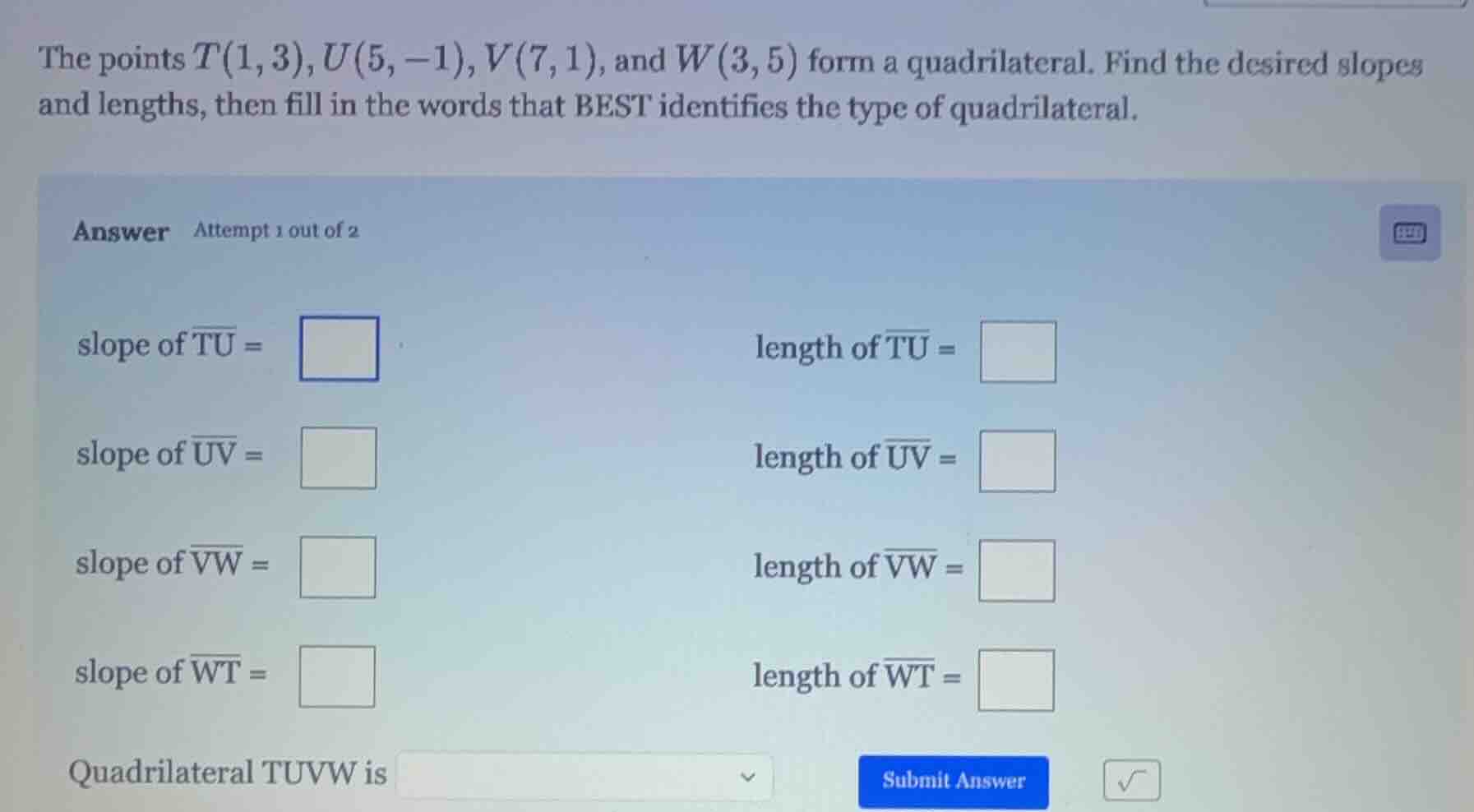
the points t(1, 3), u(5, -1), v(7, 1), and w(3, 5) form a quadrilateral. find the desired slopes and lengths, then fill in the words that best identifies the type of quadrilateral.
answer attempt 1 out of 2
slope of \\(\overline{tu}\\) =
length of \\(\overline{tu}\\) =
slope of \\(\overline{uv}\\) =
length of \\(\overline{uv}\\) =
slope of \\(\overline{vw}\\) =
length of \\(\overline{vw}\\) =
slope of \\(\overline{wt}\\) =
length of \\(\overline{wt}\\) =
quadrilateral tuvw is
Step1: Calculate slope of \( \overline{TU} \)
The slope formula is \( m = \frac{y_2 - y_1}{x_2 - x_1} \). For \( T(1,3) \) and \( U(5,-1) \), \( m_{TU} = \frac{-1 - 3}{5 - 1} = \frac{-4}{4} = -1 \).
Step2: Calculate length of \( \overline{TU} \)
The distance formula is \( d = \sqrt{(x_2 - x_1)^2 + (y_2 - y_1)^2} \). For \( T(1,3) \) and \( U(5,-1) \), \( d_{TU} = \sqrt{(5 - 1)^2 + (-1 - 3)^2} = \sqrt{16 + 16} = \sqrt{32} = 4\sqrt{2} \).
Step3: Calculate slope of \( \overline{UV} \)
For \( U(5,-1) \) and \( V(7,1) \), \( m_{UV} = \frac{1 - (-1)}{7 - 5} = \frac{2}{2} = 1 \).
Step4: Calculate length of \( \overline{UV} \)
For \( U(5,-1) \) and \( V(7,1) \), \( d_{UV} = \sqrt{(7 - 5)^2 + (1 - (-1))^2} = \sqrt{4 + 4} = \sqrt{8} = 2\sqrt{2} \).
Step5: Calculate slope of \( \overline{VW} \)
For \( V(7,1) \) and \( W(3,5) \), \( m_{VW} = \frac{5 - 1}{3 - 7} = \frac{4}{-4} = -1 \).
Step6: Calculate length of \( \overline{VW} \)
For \( V(7,1) \) and \( W(3,5) \), \( d_{VW} = \sqrt{(3 - 7)^2 + (5 - 1)^2} = \sqrt{16 + 16} = \sqrt{32} = 4\sqrt{2} \).
Step7: Calculate slope of \( \overline{WT} \)
For \( W(3,5) \) and \( T(1,3) \), \( m_{WT} = \frac{3 - 5}{1 - 3} = \frac{-2}{-2} = 1 \).
Step8: Calculate length of \( \overline{WT} \)
For \( W(3,5) \) and \( T(1,3) \), \( d_{WT} = \sqrt{(1 - 3)^2 + (3 - 5)^2} = \sqrt{4 + 4} = \sqrt{8} = 2\sqrt{2} \).
Step9: Identify the quadrilateral
Opposite sides have equal slopes (so parallel) and equal lengths. Also, adjacent slopes are negative reciprocals (so perpendicular). So it's a rectangle (also a parallelogram, but since angles are right, rectangle; also, since adjacent sides are not equal, it's a rectangle, but wait, actually, let's check: \( TU \) and \( VW \) are length \( 4\sqrt{2} \), \( UV \) and \( WT \) are \( 2\sqrt{2} \). And slopes: \( TU \) slope -1, \( UV \) slope 1 (perpendicular), \( VW \) slope -1 (parallel to \( TU \)), \( WT \) slope 1 (parallel to \( UV \)). So it's a rectangle (also a parallelogram with right angles, so rectangle; also, since it's a parallelogram with equal opposite sides and right angles, rectangle. Alternatively, since adjacent sides are perpendicular and opposite sides equal, it's a rectangle. But also, since the lengths of \( TU = VW = 4\sqrt{2} \) and \( UV = WT = 2\sqrt{2} \), and adjacent sides are perpendicular, it's a rectangle (or a parallelogram with right angles, which is a rectangle). Wait, but also, let's check if it's a rhombus? No, because sides are not equal. So it's a rectangle (or a parallelogram with right angles, which is a rectangle; also, since it's a quadrilateral with opposite sides parallel and equal, and adjacent sides perpendicular, it's a rectangle).

Snap & solve any problem in the app
Get step-by-step solutions on Sovi AI
Photo-based solutions with guided steps
Explore more problems and detailed explanations
slope of \( \overline{TU} = -1 \), length of \( \overline{TU} = 4\sqrt{2} \)
slope of \( \overline{UV} = 1 \), length of \( \overline{UV} = 2\sqrt{2} \)
slope of \( \overline{VW} = -1 \), length of \( \overline{VW} = 4\sqrt{2} \)
slope of \( \overline{WT} = 1 \), length of \( \overline{WT} = 2\sqrt{2} \)
Quadrilateral TUVW is a rectangle (or parallelogram with right angles, but rectangle is more precise as adjacent sides are perpendicular and opposite sides equal).