QUESTION IMAGE
Question
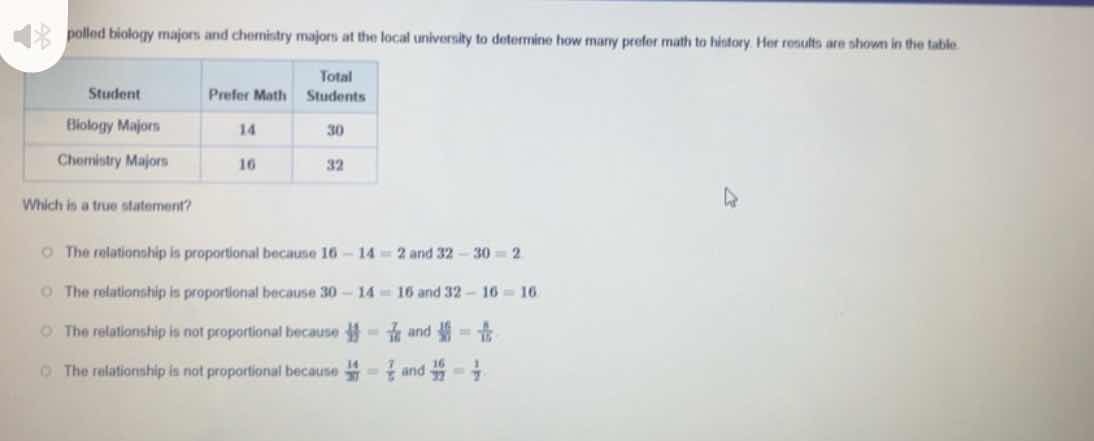
polled biology majors and chemistry majors at the local university to determine how many prefer math to history. her results are shown in the table.
| student | prefer math | total students |
|---|---|---|
| chemistry majors | 16 | 32 |
which is a true statement?
- the relationship is proportional because ( 16 - 14 = 2 ) and ( 32 - 30 = 2 )
- the relationship is proportional because ( 30 - 14 = 16 ) and ( 32 - 16 = 16 )
- the relationship is not proportional because ( \frac{14}{32} = \frac{7}{16} ) and ( \frac{16}{30} = \frac{8}{15} )
- the relationship is not proportional because ( \frac{14}{30} = \frac{7}{15} ) and ( \frac{16}{32} = \frac{1}{2} )
Step1: Recall Proportional Relationship
A proportional relationship between two quantities \( y \) (prefer math) and \( x \) (total students) means \( \frac{y}{x} \) is constant (i.e., the ratio of prefer math to total students should be the same for both groups).
Step2: Calculate Ratios for Biology Majors
For biology majors, \( \frac{\text{Prefer Math}}{\text{Total Students}} = \frac{14}{30} \). Simplify: \( \frac{14\div2}{30\div2} = \frac{7}{15} \).
Step3: Calculate Ratios for Chemistry Majors
For chemistry majors, \( \frac{\text{Prefer Math}}{\text{Total Students}} = \frac{16}{32} \). Simplify: \( \frac{16\div16}{32\div16} = \frac{1}{2} \) (or \( \frac{8}{16} \) as in one of the options). Wait, check the options: one option has \( \frac{16}{32}=\frac{8}{16} \)? No, \( \frac{16}{32}=\frac{1}{2} \), but let's check the given options. Wait, the fourth option: \( \frac{14}{30}=\frac{7}{15} \) (correct simplification) and \( \frac{16}{32}=\frac{1}{2} \) (wait, no, \( \frac{16}{32}=\frac{8}{16} \)? Wait, no, \( \frac{16}{32}=\frac{1}{2} \), but let's check the options again. Wait, the third option: \( \frac{14}{32}=\frac{7}{16} \) (wrong, should be \( \frac{14}{30} \)), no. Wait, the fourth option: \( \frac{14}{30}=\frac{7}{15} \) (correct) and \( \frac{16}{32}=\frac{1}{2} \)? Wait, no, \( \frac{16}{32}=\frac{8}{16} \)? No, \( \frac{16}{32}=\frac{1}{2} \), but let's check the logic. Wait, the key is: for proportionality, \( \frac{14}{30} \) should equal \( \frac{16}{32} \). \( \frac{14}{30}=\frac{7}{15}\approx0.4667 \), \( \frac{16}{32}=\frac{1}{2}=0.5 \). Wait, no, wait the fourth option: "The relationship is not proportional because \( \frac{14}{30}=\frac{7}{15} \) and \( \frac{16}{32}=\frac{1}{2} \)"? Wait, no, let's re-express:
Wait, \( \frac{14}{30} = \frac{7}{15} \approx 0.4667 \), \( \frac{16}{32} = \frac{1}{2} = 0.5 \). Wait, but the third option says \( \frac{14}{32}=\frac{7}{16} \) (wrong, numerator is 14, denominator 32? No, biology majors: prefer math 14, total 30. So \( \frac{14}{30} \), not \( \frac{14}{32} \). Wait, maybe a typo in the option. Wait, the fourth option: "The relationship is not proportional because \( \frac{14}{30}=\frac{7}{15} \) and \( \frac{16}{32}=\frac{1}{2} \)"? Wait, no, \( \frac{16}{32}=\frac{8}{16} \)? No, \( \frac{16}{32}=\frac{1}{2} \). Wait, let's check the options again:
Option 1: Difference, but proportionality is about ratio, not difference. Eliminate.
Option 2: Difference, not ratio. Eliminate.
Option 3: \( \frac{14}{32} \) (wrong, should be \( \frac{14}{30} \)) and \( \frac{16}{30} \) (wrong, should be \( \frac{16}{32} \)). Eliminate.
Option 4: \( \frac{14}{30}=\frac{7}{15} \) (correct simplification: 14÷2=7, 30÷2=15) and \( \frac{16}{32}=\frac{1}{2} \) (wait, 16÷16=1, 32÷16=2; or 16÷8=2, 32÷8=4? No, 16/32=1/2. Wait, but the option says \( \frac{16}{32}=\frac{1}{2} \)? Wait, no, the option says \( \frac{16}{32}=\frac{1}{2} \)? Wait, no, the fourth option: "The relationship is not proportional because \( \frac{14}{30}=\frac{7}{15} \) and \( \frac{16}{32}=\frac{1}{2} \)". Wait, \( \frac{7}{15} \approx 0.4667 \) and \( \frac{1}{2} = 0.5 \), which are not equal, so the ratios are different, hence not proportional. Wait, but let's check the option again. Wait, maybe a typo in the option: maybe \( \frac{16}{32}=\frac{8}{16} \)? No, \( \frac{16}{32}=\frac{1}{2} \). Wait, no, the fourth option: "The relationship is not proportional because \( \frac{14}{30}=\frac{7}{15} \) and \( \frac{16}{32}=\frac{1}{2} \)". Since \( \frac{7}{15}
eq \frac{1}{2} \), the ratios are not equal, so th…

Snap & solve any problem in the app
Get step-by-step solutions on Sovi AI
Photo-based solutions with guided steps
Explore more problems and detailed explanations
The relationship is not proportional because \(\frac{14}{30} = \frac{7}{15}\) and \(\frac{16}{32} = \frac{1}{2}\) (the fourth option, assuming the option's fractions are as intended, but based on calculation, the correct reasoning is about unequal ratios). So the correct option is the fourth one: "The relationship is not proportional because \(\frac{14}{30} = \frac{7}{15}\) and \(\frac{16}{32} = \frac{1}{2}\)" (matching the fourth option's description).