QUESTION IMAGE
Question
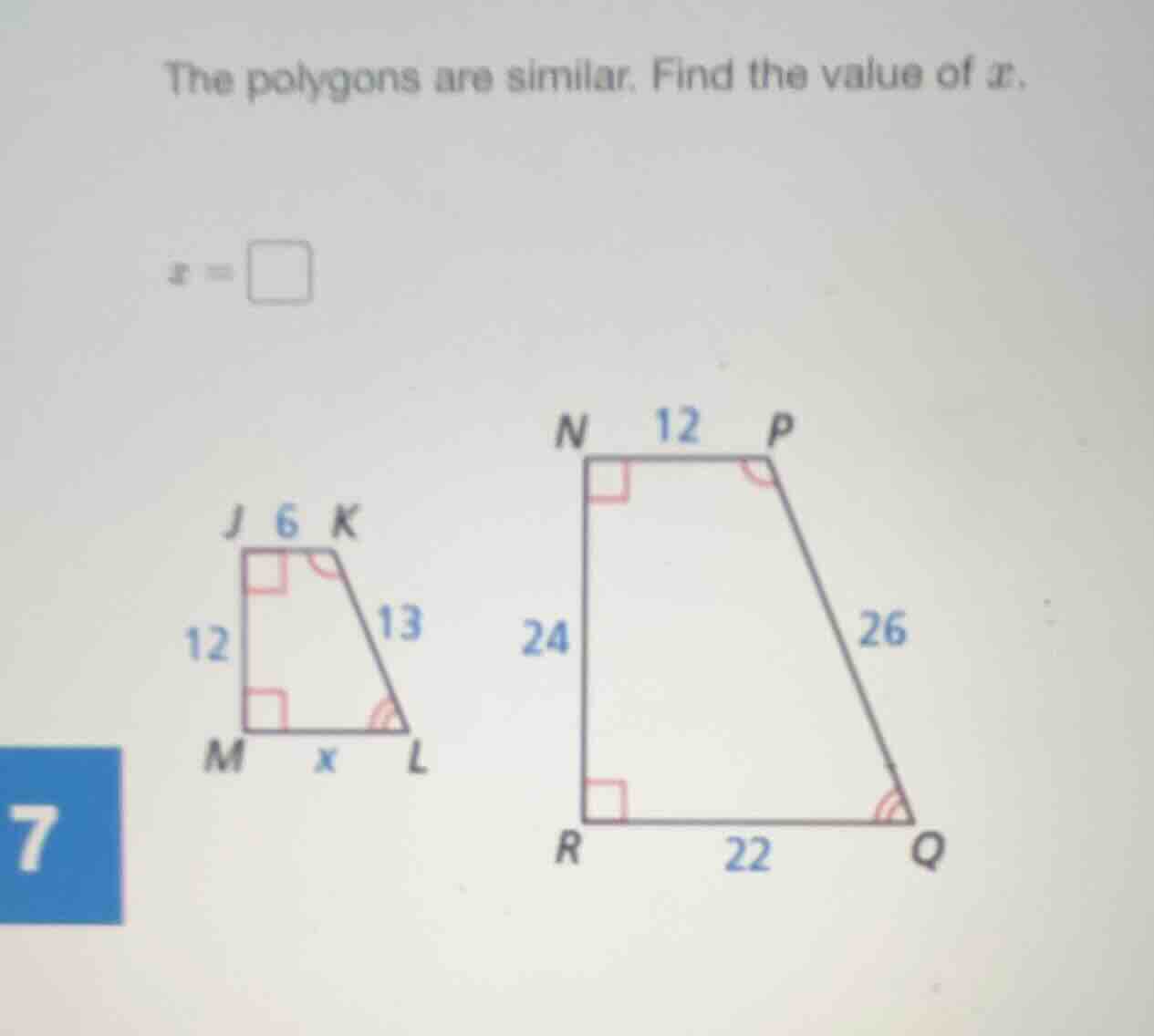
the polygons are similar. find the value of x.
x =
(the left polygon has vertices j, k, l, m with jk = 6, jm = 12, kl = 13, ml = x. the right polygon has vertices n, p, q, r with np = 12, nr = 24, pq = 26, rq = 22. both polygons have right angles at j, m and n, r respectively, and corresponding angles marked equal.)
Step1: Determine the scale factor
Since the polygons are similar, the ratio of corresponding sides is equal. Let's take the vertical sides: \( \frac{24}{12} = 2 \). Wait, no, the left side of the first trapezoid is 12, and the left side of the second is 24. Wait, actually, the corresponding sides: let's check the non - parallel sides? Wait, no, the vertical sides (the legs with right angles). Wait, the first trapezoid has a vertical side \( JM = 12 \), and the second has \( NR=24 \). So the scale factor \( k=\frac{24}{12}=2 \)? Wait, no, wait the top base of the first is \( JK = 6 \), top base of the second is \( NP = 12 \). So \( \frac{12}{6}=2 \), so the scale factor is 2. Wait, but we need to find \( x \), which is the bottom base of the first trapezoid, and the bottom base of the second is \( RQ = 22 \). Wait, no, wait, similar figures have corresponding sides in proportion. So the ratio of corresponding sides should be equal. Let's list the corresponding sides:
For the first trapezoid (JKLM) and the second (NPQR):
- \( JK \) corresponds to \( NP \): \( JK = 6 \), \( NP = 12 \), ratio \( \frac{NP}{JK}=\frac{12}{6} = 2 \)
- \( JM \) corresponds to \( NR \): \( JM = 12 \), \( NR = 24 \), ratio \( \frac{NR}{JM}=\frac{24}{12}=2 \)
- \( KL \) corresponds to \( PQ \): \( KL = 13 \), \( PQ = 26 \), ratio \( \frac{PQ}{KL}=\frac{26}{13}=2 \)
- \( ML \) (which is \( x \)) corresponds to \( RQ \) (which is 22). Wait, no, wait, maybe I got the correspondence wrong. Wait, the order of the letters: J - N, K - P, L - Q, M - R? Wait, the angles: the right angles are at J, M and N, R. So the trapezoids are right trapezoids. So the sides: JK (top base), JM (left leg, vertical), ML (bottom base), KL (right leg). And NP (top base), NR (left leg, vertical), RQ (bottom base), PQ (right leg). So corresponding sides: JK - NP, JM - NR, ML - RQ, KL - PQ.
So the ratio of similarity is \( \frac{NP}{JK}=\frac{12}{6} = 2 \), \( \frac{NR}{JM}=\frac{24}{12}=2 \), \( \frac{PQ}{KL}=\frac{26}{13}=2 \). So the ratio of \( RQ \) to \( ML \) (i.e., \( x \)) should be equal to the scale factor? Wait, no, wait, if the first trapezoid is the smaller one, then the scale factor from the first to the second is 2. So to get the length of a side in the first trapezoid from the second, we divide by 2.
We know that \( RQ = 22 \) (bottom base of the second trapezoid), and \( ML = x \) (bottom base of the first trapezoid). Since the ratio of second to first is 2, then \( \frac{RQ}{x}=2 \), so \( x=\frac{RQ}{2} \). Wait, \( RQ = 22 \), so \( x=\frac{22}{2}=11 \)? Wait, no, wait, let's check again. Wait, maybe the correspondence is reversed. Let's see: the first trapezoid has sides 6 (top), 12 (left), x (bottom), 13 (right). The second has 12 (top), 24 (left), 22 (bottom), 26 (right). So the ratio of first to second: \( \frac{6}{12}=\frac{1}{2} \), \( \frac{12}{24}=\frac{1}{2} \), \( \frac{13}{26}=\frac{1}{2} \). So the ratio of first to second is \( \frac{1}{2} \). So for the bottom sides: \( \frac{x}{22}=\frac{1}{2} \), so \( x = 22\times\frac{1}{2}=11 \).
Step2: Solve for x
Using the proportion of similar figures. The ratio of corresponding sides of the first trapezoid to the second trapezoid is \( \frac{1}{2} \) (since \( 6/12 = 1/2 \), \( 12/24 = 1/2 \), \( 13/26 = 1/2 \)). For the bottom base, we have \( \frac{x}{22}=\frac{1}{2} \). Cross - multiplying gives \( 2x=22\times1 \), so \( x = 11 \).

Snap & solve any problem in the app
Get step-by-step solutions on Sovi AI
Photo-based solutions with guided steps
Explore more problems and detailed explanations
\( x = 11 \)