QUESTION IMAGE
Question
polynomials are expressions that are mainly combinations of terms with both addition and subtraction that can have only constants and positive integer powers. they are truly just an extension of our base - 10 number system.
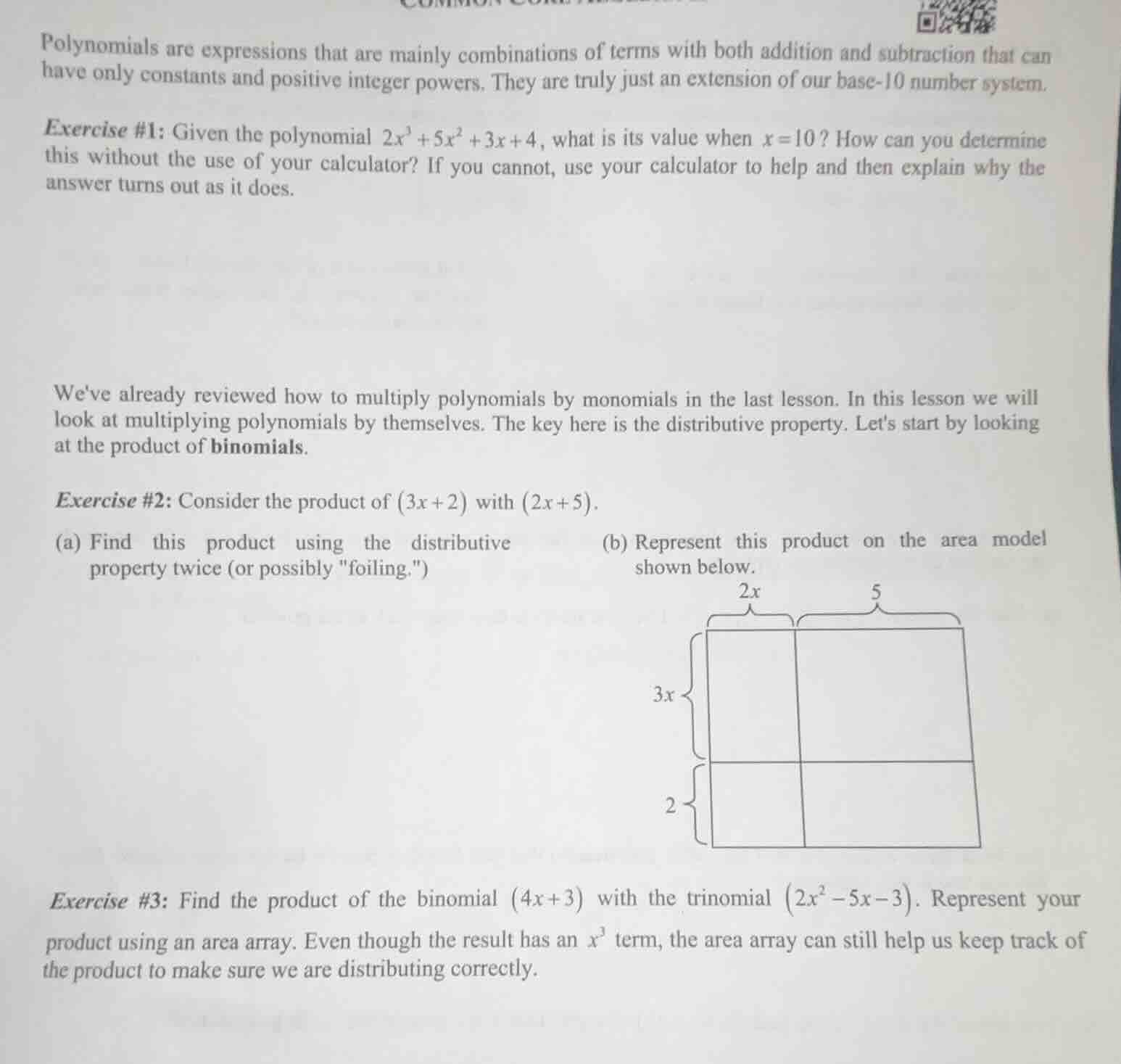
exercise #1: given the polynomial $2x^{3}+5x^{2}+3x + 4$, what is its value when $x = 10$? how can you determine this without the use of your calculator? if you cannot, use your calculator to help and then explain why the answer turns out as it does.
weve already reviewed how to multiply polynomials by monomials in the last lesson. in this lesson we will look at multiplying polynomials by themselves. the key here is the distributive property. lets start by looking at the product of binomials.
exercise #2: consider the product of $(3x + 2)$ with $(2x + 5)$.
(a) find this product using the distributive property twice (or possibly \foiling.\)
(b) represent this product on the area model shown below.
exercise #3: find the product of the binomial $(4x + 3)$ with the trinomial $(2x^{2}-5x - 3)$. represent your product using an area array. even though the result has an $x^{3}$ term, the area array can still help us keep track of the product to make sure we are distributing correctly.
Exercise #1
Step1: Substitute \( x = 10 \) into the polynomial
We have the polynomial \( 2x^{3}+5x^{2}+3x + 4 \). Substitute \( x=10 \):
\( 2\times(10)^{3}+5\times(10)^{2}+3\times(10)+4 \)
Step2: Calculate each term
- For \( 2\times(10)^{3} \): \( (10)^{3}=1000 \), so \( 2\times1000 = 2000 \)
- For \( 5\times(10)^{2} \): \( (10)^{2}=100 \), so \( 5\times100=500 \)
- For \( 3\times(10) \): \( 3\times10 = 30 \)
- The constant term is \( 4 \)
Step3: Sum the terms
Add all the calculated terms together: \( 2000 + 500+30 + 4 \)
\( 2000+500=2500 \); \( 2500 + 30=2530 \); \( 2530+4 = 2534 \)
The polynomial represents a number in base - 10 expanded form. For example, a number like \( 2534 \) in base - 10 can be written as \( 2\times10^{3}+5\times10^{2}+3\times10 + 4 \), which is exactly the form of our polynomial when \( x = 10 \). So the value of the polynomial at \( x = 10 \) is just the number formed by the coefficients as digits in their respective place values (thousands, hundreds, tens, ones).
Step1: Apply the distributive property (FOIL method)
We need to find the product of \( (3x + 2)(2x+5) \). Using the distributive property (FOIL: First, Outer, Inner, Last):
First: \( 3x\times2x=6x^{2} \)
Outer: \( 3x\times5 = 15x \)
Inner: \( 2\times2x=4x \)
Last: \( 2\times5 = 10 \)
Step2: Combine like terms
Now, combine the like terms (the terms with \( x \)): \( 15x+4x=19x \)
So the product is \( 6x^{2}+19x + 10 \)
The area model is a rectangle with length \( (2x + 5) \) and width \( (3x + 2) \). We divide the rectangle into four smaller rectangles:
- The top - left rectangle: length \( 2x \), width \( 3x \), area \( 3x\times2x = 6x^{2} \)
- The top - right rectangle: length \( 5 \), width \( 3x \), area \( 3x\times5=15x \)
- The bottom - left rectangle: length \( 2x \), width \( 2 \), area \( 2\times2x = 4x \)
- The bottom - right rectangle: length \( 5 \), width \( 2 \), area \( 2\times5 = 10 \)
To find the area of the large rectangle, we sum the areas of the four smaller rectangles: \( 6x^{2}+15x + 4x+10=6x^{2}+19x + 10 \), which matches the result from part (a).
| \( 2x \) | \( 5 \) | |
|---|---|---|
| \( 2 \) | \( 4x \) | \( 10 \) |
Exercise #3

Snap & solve any problem in the app
Get step-by-step solutions on Sovi AI
Photo-based solutions with guided steps
Explore more problems and detailed explanations
The value of the polynomial \( 2x^{3}+5x^{2}+3x + 4 \) when \( x = 10 \) is \( 2534 \).