QUESTION IMAGE
Question
practice
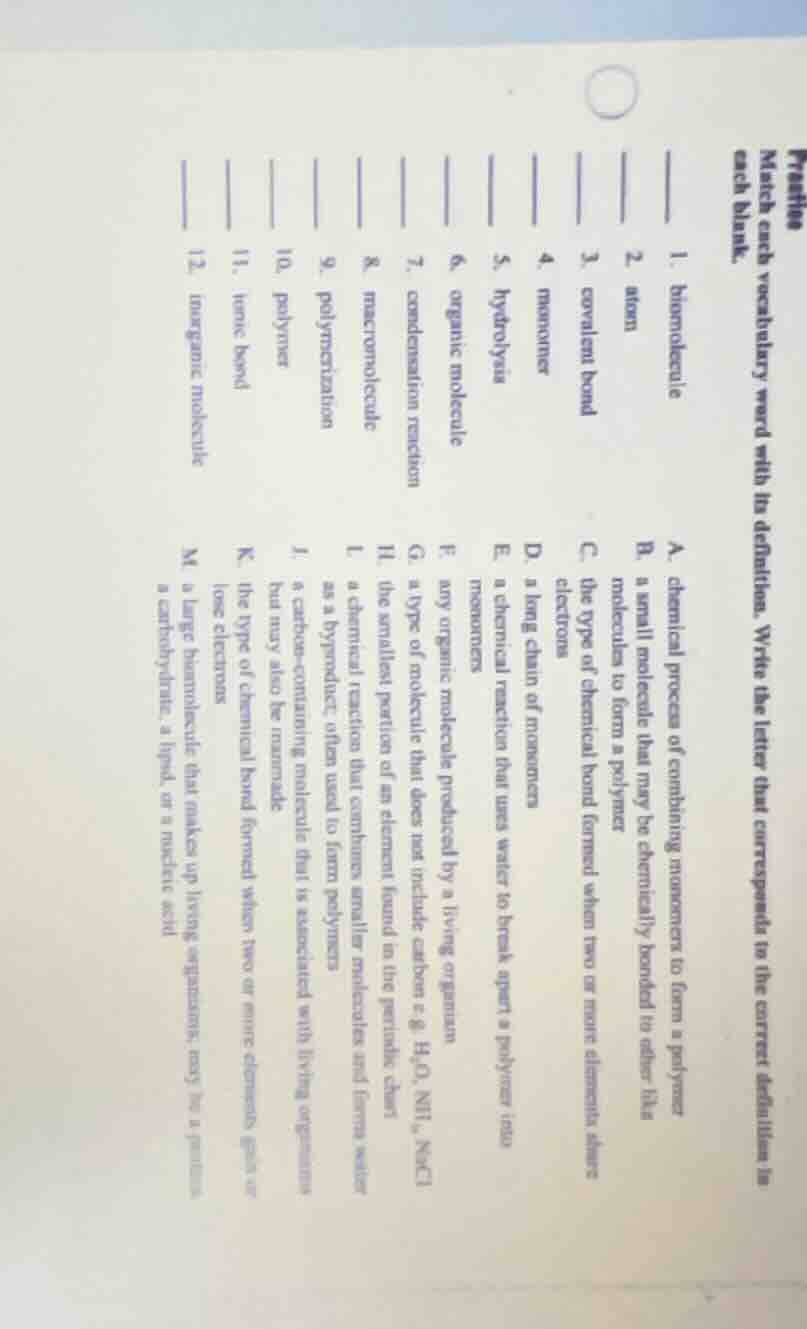
match each vocabulary word with its definition. write the letter that corresponds to the correct definition in each blank.
- biomolecule
- atom
- covalent bond
- monomer
- hydrolysis
- organic molecule
- condensation reaction
- macromolecule
- polymerization
- polymer
- ionic bond
- inorganic molecule
a. chemical process of combining monomers to form a polymer
b. a small molecule that may be chemically bonded to other like molecules to form a polymer
c. the type of chemical bond formed when two or more elements share electrons
d. a long chain of monomers
e. a chemical reaction that uses water to break apart a polymer into monomers
f. any organic molecule produced by a living organism
g. a type of molecule that does not include carbon e.g. h₂o, nh₃, nacl
h. the smallest portion of an element found in the periodic chart
i. a chemical reaction that combines smaller molecules and forms water as a by-product, often used to form polymers
j. a carbon-containing molecule that is associated with living organisms but may also be manmade
k. the type of chemical bond formed when two or more elements gain or lose electrons
l. macromolecule
m. a large biomolecule that makes up living organisms; may be a protein, a carbohydrate, a lipid, or a nucleic acid
To solve this matching problem, we analyze each vocabulary word and its corresponding definition:
1. biomolecule
- Definition: M (a large biomolecule that makes up living organisms; may be a protein, a carbohydrate, a lipid, or a nucleic acid) or J (a carbon - containing molecule that is associated with living organisms but may also be man - made) could be considered. But more precisely, M is a better fit as it directly refers to large biomolecules of living organisms. Wait, no, let's re - check. The definition for biomolecule should be M? Wait, no, let's look again. The option M says "a large biomolecule that makes up living organisms; may be a protein, a carbohydrate, a lipid, or a nucleic acid". But actually, the correct match for biomolecule is M? Wait, no, let's go step by step.
1. biomolecule
- The definition of biomolecule is a large molecule that is part of a living organism (like proteins, nucleic acids, etc.). Option M: "a large biomolecule that makes up living organisms; may be a protein, a carbohydrate, a lipid, or a nucleic acid" matches. But wait, option J: "a carbon - containing molecule that is associated with living organisms but may also be man - made" is about organic molecules? No, biomolecule is a molecule related to biology, so M is for biomolecule? Wait, no, maybe I made a mistake. Let's check each one:
- biomolecules: M (a large biomolecule that makes up living organisms; may be a protein, a carbohydrate, a lipid, or a nucleic acid)
- atom: H (the smallest portion of an element found in the periodic chart)
- covalent bond: C (the type of chemical bond formed when two or more elements share electrons)
- monomer: A (a small molecule that may be chemically bonded to other like molecules to form a polymer)
- hydrolysis: E (a chemical reaction that uses water to break apart a polymer into monomers)
- organic molecule: J (a carbon - containing molecule that is associated with living organisms but may also be man - made)
- condensation reaction: I (a chemical reaction that combines smaller molecules and forms water as a by - product, often used to form polymers)
- macromolecule: D (a long chain of monomers)
- polymerization: L (the process of combining monomers to form a polymer)
- polymer: B (molecules to form a polymer? Wait, no. Wait, polymer is a long chain of monomers, so D? No, D is "a long chain of monomers" which is macromolecule? Wait, no, let's re - define:
- monomer: A (small molecule, building block)
- polymer: B? No, B says "molecules to form a polymer" – no. Wait, the correct definitions:
- biomolecule: M (large biomolecule of living things)
- atom: H (smallest part of element)
- covalent bond: C (share electrons)
- monomer: A (small molecule, building block)
- hydrolysis: E (uses water to break polymer)
- organic molecule: J (carbon - containing, related to life)
- condensation reaction: I (combines small molecules, makes water)
- macromolecule: D (long chain of monomers)
- polymerization: L (process of making polymer from monomers)
- polymer: B? No, B is "molecules to form a polymer" – no, polymer is a large molecule made of monomers, so D is macromolecule, polymer is B? Wait, no, the option B says "molecules to form a polymer" – that's not right. Wait, maybe I messed up. Let's list all:
Vocabulary | Definition (Option)
--- | ---
- biomolecule | M (a large biomolecule that makes up living organisms; may be a protein, a carbo…

Snap & solve any problem in the app
Get step-by-step solutions on Sovi AI
Photo-based solutions with guided steps
Explore more problems and detailed explanations
To solve this matching problem, we analyze each vocabulary word and its corresponding definition:
1. biomolecule
- Definition: M (a large biomolecule that makes up living organisms; may be a protein, a carbohydrate, a lipid, or a nucleic acid) or J (a carbon - containing molecule that is associated with living organisms but may also be man - made) could be considered. But more precisely, M is a better fit as it directly refers to large biomolecules of living organisms. Wait, no, let's re - check. The definition for biomolecule should be M? Wait, no, let's look again. The option M says "a large biomolecule that makes up living organisms; may be a protein, a carbohydrate, a lipid, or a nucleic acid". But actually, the correct match for biomolecule is M? Wait, no, let's go step by step.
1. biomolecule
- The definition of biomolecule is a large molecule that is part of a living organism (like proteins, nucleic acids, etc.). Option M: "a large biomolecule that makes up living organisms; may be a protein, a carbohydrate, a lipid, or a nucleic acid" matches. But wait, option J: "a carbon - containing molecule that is associated with living organisms but may also be man - made" is about organic molecules? No, biomolecule is a molecule related to biology, so M is for biomolecule? Wait, no, maybe I made a mistake. Let's check each one:
- biomolecules: M (a large biomolecule that makes up living organisms; may be a protein, a carbohydrate, a lipid, or a nucleic acid)
- atom: H (the smallest portion of an element found in the periodic chart)
- covalent bond: C (the type of chemical bond formed when two or more elements share electrons)
- monomer: A (a small molecule that may be chemically bonded to other like molecules to form a polymer)
- hydrolysis: E (a chemical reaction that uses water to break apart a polymer into monomers)
- organic molecule: J (a carbon - containing molecule that is associated with living organisms but may also be man - made)
- condensation reaction: I (a chemical reaction that combines smaller molecules and forms water as a by - product, often used to form polymers)
- macromolecule: D (a long chain of monomers)
- polymerization: L (the process of combining monomers to form a polymer)
- polymer: B (molecules to form a polymer? Wait, no. Wait, polymer is a long chain of monomers, so D? No, D is "a long chain of monomers" which is macromolecule? Wait, no, let's re - define:
- monomer: A (small molecule, building block)
- polymer: B? No, B says "molecules to form a polymer" – no. Wait, the correct definitions:
- biomolecule: M (large biomolecule of living things)
- atom: H (smallest part of element)
- covalent bond: C (share electrons)
- monomer: A (small molecule, building block)
- hydrolysis: E (uses water to break polymer)
- organic molecule: J (carbon - containing, related to life)
- condensation reaction: I (combines small molecules, makes water)
- macromolecule: D (long chain of monomers)
- polymerization: L (process of making polymer from monomers)
- polymer: B? No, B is "molecules to form a polymer" – no, polymer is a large molecule made of monomers, so D is macromolecule, polymer is B? Wait, no, the option B says "molecules to form a polymer" – that's not right. Wait, maybe I messed up. Let's list all:
Vocabulary | Definition (Option)
--- | ---
- biomolecule | M (a large biomolecule that makes up living organisms; may be a protein, a carbohydrate, a lipid, or a nucleic acid)
- atom | H (the smallest portion of an element found in the periodic chart)
- covalent bond | C (the type of chemical bond formed when two or more elements share electrons)
- monomer | A (a small molecule that may be chemically bonded to other like molecules to form a polymer)
- hydrolysis | E (a chemical reaction that uses water to break apart a polymer into monomers)
- organic molecule | J (a carbon - containing molecule that is associated with living organisms but may also be man - made)
- condensation reaction | I (a chemical reaction that combines smaller molecules and forms water as a by - product, often used to form polymers)
- macromolecule | D (a long chain of monomers)
- polymerization | L (the process of combining monomers to form a polymer)
- polymer | B (molecules to form a polymer? No, wait, polymer is a large molecule made of monomers, so maybe B is incorrect. Wait, the option B says "molecules to form a polymer" – maybe it's a typo, and it should be "molecule formed from monomers". Assuming that, polymer is B.
- ionic bond | K (the type of chemical bond formed when two or more elements gain or lose electrons)
- inorganic molecule | G (a type of molecule that does not include carbon e.g. H₂O, NH₃, NaCl)
Final Matches:
- biomolecule - M
- atom - H
- covalent bond - C
- monomer - A
- hydrolysis - E
- organic molecule - J
- condensation reaction - I
- macromolecule - D
- polymerization - L
- polymer - B
- ionic bond - K
- inorganic molecule - G
(Note: If there was a specific sub - question (e.g., match a particular word), we would focus on that. Since it's a full matching, we provide all correct pairs.)