QUESTION IMAGE
Question
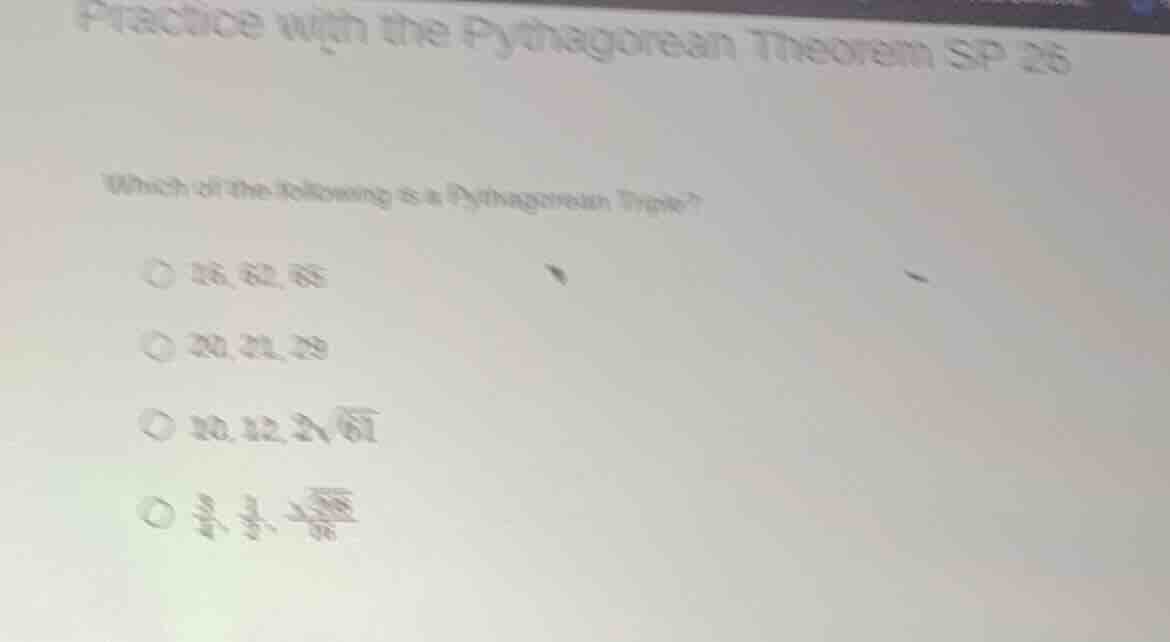
practice with the pythagorean theorem sp 26
which of the following is a pythagorean triple?
○ 16, 62, 65
○ 20, 21, 29
○ 10, 12, $2\sqrt{61}$
○ $\frac{3}{4}$, $\frac{1}{2}$, $\frac{\sqrt{265}}{16}$
Step1: Recall Pythagorean triple rule
A Pythagorean triple consists of three positive integers \(a, b, c\) where \(a^2 + b^2 = c^2\), with \(c\) being the largest number.
Step2: Test first option (16,62,65)
Calculate \(16^2 + 62^2 = 256 + 3844 = 4100\), \(65^2 = 4225\). Since \(4100
eq 4225\), this is not a triple.
Step3: Test second option (20,21,29)
Calculate \(20^2 + 21^2 = 400 + 441 = 841\), \(29^2 = 841\). Since \(841 = 841\), this is a triple.
Step4: Eliminate non-integer options
Options 3 and 4 contain non-integers, so they cannot be Pythagorean triples (which require all values to be positive integers).

Snap & solve any problem in the app
Get step-by-step solutions on Sovi AI
Photo-based solutions with guided steps
Explore more problems and detailed explanations
20, 21, 29