QUESTION IMAGE
Question
practice 9 (from unit 2, lesson 6)
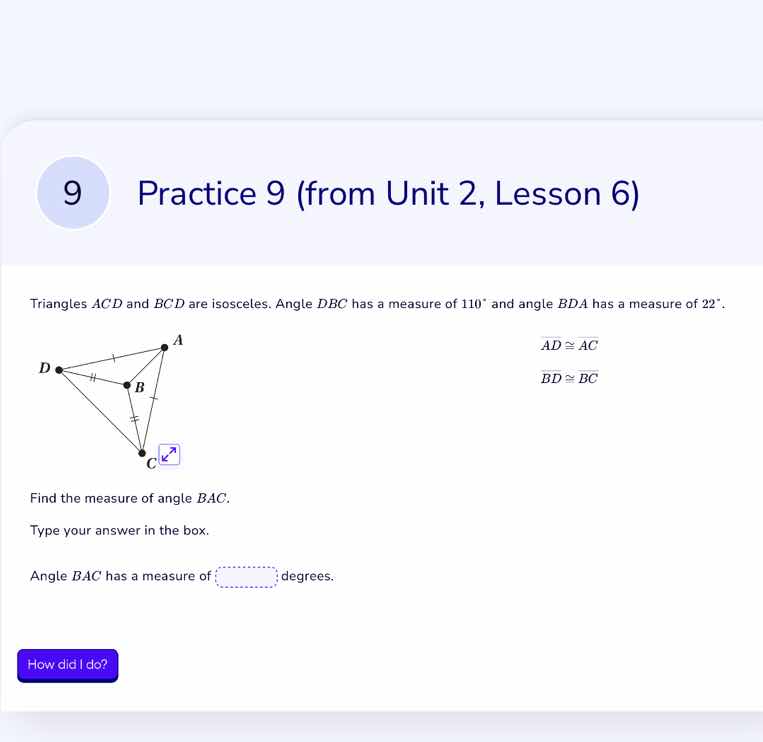
triangles acd and bcd are isosceles. angle dbc has a measure of 110° and angle bda has a measure of 22°.
$\overline{ad} \cong \overline{ac}$
$\overline{bd} \cong \overline{bc}$
find the measure of angle bac.
type your answer in the box.
angle bac has a measure of degrees.
Step1: Find angle BDC in triangle DBC
In isosceles triangle \(DBC\) (since \(BD\cong BC\)), the base angles are equal. The sum of angles in a triangle is \(180^\circ\). Given \(\angle DBC = 110^\circ\), let \(\angle BDC=\angle BCD = x\). Then \(x + x+ 110^\circ=180^\circ\), so \(2x = 70^\circ\), and \(x = 35^\circ\). So \(\angle BDC = 35^\circ\).
Step2: Find angle ADC
We know \(\angle BDA = 22^\circ\) and \(\angle BDC = 35^\circ\), so \(\angle ADC=\angle BDA+\angle BDC = 22^\circ + 35^\circ=57^\circ\).
Step3: Find angle ACD in isosceles triangle ACD
In isosceles triangle \(ACD\) (since \(AD\cong AC\)), \(\angle ADC=\angle ACD = 57^\circ\) (base angles of isosceles triangle are equal).
Step4: Find angle DAC in triangle ACD
The sum of angles in triangle \(ACD\) is \(180^\circ\). Let \(\angle DAC = y\). Then \(y+57^\circ + 57^\circ=180^\circ\), so \(y = 180^\circ- 114^\circ = 66^\circ\). Wait, no, wait. Wait, actually, we need to find \(\angle BAC\). Wait, maybe a better way: Let's find \(\angle ACB\) first. Wait, \(\angle ACB=\angle ACD-\angle BCD\). We know \(\angle ACD = 57^\circ\) and \(\angle BCD = 35^\circ\), so \(\angle ACB = 57^\circ - 35^\circ=22^\circ\). Wait, no, maybe I made a mistake. Wait, let's re - evaluate.
Wait, in triangle \(DBC\), \(BD = BC\), so \(\angle BDC=\angle BCD=(180 - 110)/2 = 35^\circ\). Then \(\angle ADC=\angle ADB+\angle BDC = 22 + 35=57^\circ\). In triangle \(ADC\), \(AD = AC\), so \(\angle ADC=\angle ACD = 57^\circ\). Then \(\angle DAC=180 - 57 - 57 = 66^\circ\). Now, let's look at triangle \(ABC\) and \(ABD\). Wait, maybe we can use the fact that \(AD = AC\) and \(BD = BC\), and \(AB\) is common? Wait, no. Wait, let's find \(\angle DAB\) first. In triangle \(ABD\), we know \(\angle ADB = 22^\circ\), and we can find \(\angle ABD\). \(\angle ABD = 180^\circ-\angle DBC=180 - 110 = 70^\circ\) (since \(\angle DBC\) and \(\angle ABD\) are supplementary). Then in triangle \(ABD\), \(\angle DAB=180 - 22 - 70 = 88^\circ\). Then \(\angle BAC=\angle DAC-\angle DAB\)? No, that's not right. Wait, no, \(\angle DAC\) is the angle at \(A\) in triangle \(ADC\), and \(\angle DAB\) is the angle at \(A\) in triangle \(ABD\). Wait, maybe the correct approach is:
Since \(AD = AC\) and \(BD = BC\), and \(AB\) is common. Wait, let's find \(\angle ABC\). \(\angle ABC = 180^\circ-\angle DBC = 70^\circ\) (linear pair). In triangle \(ABC\), \(BC = BD\), \(AC = AD\), and \(AB\) is common? Wait, no. Wait, let's find \(\angle BAC\) by considering triangle \(ABC\) and triangle \(ABD\).
Wait, another way: We know \(\angle ADC = 57^\circ\), \(AD = AC\), so \(\angle DAC=180 - 2\times57 = 66^\circ\). Now, let's find \(\angle DAB\). In triangle \(ABD\), angles are \(\angle ADB = 22^\circ\), \(\angle ABD = 180 - 110 = 70^\circ\), so \(\angle DAB=180-(22 + 70)=88^\circ\). Wait, that can't be, because \(88>66\). So I must have messed up.
Wait, no, \(\angle ABD\) is not \(180 - 110\). Wait, \(\angle DBC = 110^\circ\), so \(\angle ABD = 180^\circ - 110^\circ=70^\circ\) is correct (since they are adjacent angles on a straight line? Wait, no, the points are \(D - B - A\)? Wait, looking at the diagram, \(B\) is inside the triangle. So \(\angle ABD\) and \(\angle DBC\) are not supplementary. Oh! That's my mistake. So \(\angle DBC = 110^\circ\), so in triangle \(DBC\), \(BD = BC\), so \(\angle BDC=\angle BCD = 35^\circ\) as before. Then \(\angle ADB = 22^\circ\), so \(\angle ADC=\angle ADB+\angle BDC = 22 + 35 = 57^\circ\). In triangle \(ADC\), \(AD = AC\), so \(\angle ACD=\angle ADC = 57^\circ\). Now, let's find \(\angle ACB\).…

Snap & solve any problem in the app
Get step-by-step solutions on Sovi AI
Photo-based solutions with guided steps
Explore more problems and detailed explanations
33