QUESTION IMAGE
Question
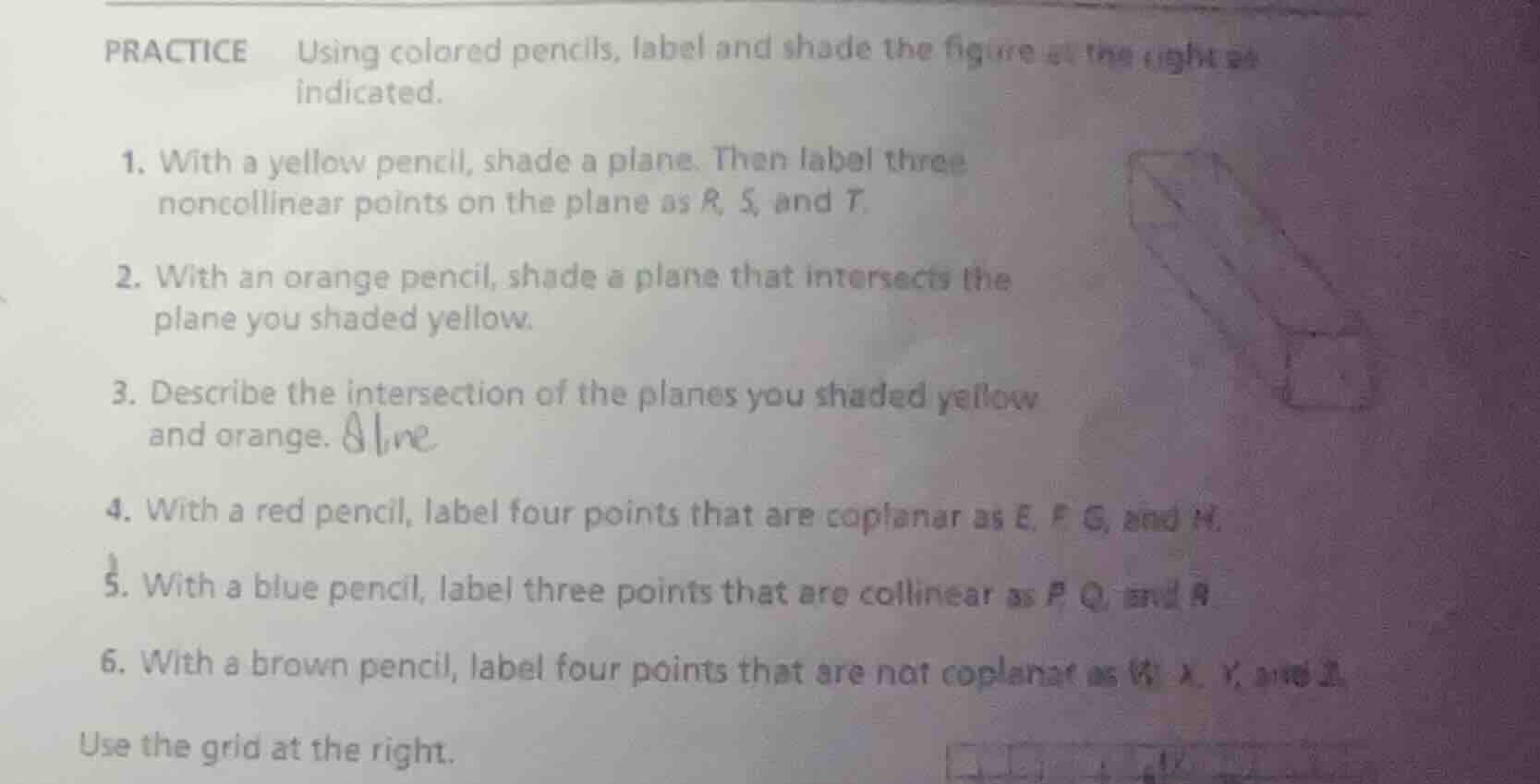
practice using colored pencils, label and shade the figure at the right as indicated.
- with a yellow pencil, shade a plane. then label three noncollinear points on the plane as r, s, and t.
- with an orange pencil, shade a plane that intersects the plane you shaded yellow.
- describe the intersection of the planes you shaded yellow and orange.
- with a red pencil, label four points that are coplanar as e, f, g, and h.
- with a blue pencil, label three points that are collinear as p, q, and r
- with a brown pencil, label four points that are not coplanar as v, x, y, and z.
use the grid at the right.
Response
1. Solution for Question 3 (Describing Plane Intersection)
Step1: Recall Plane Intersection Postulate
In geometry, the postulate states that if two planes intersect, their intersection is a line.
Step2: Apply to Shaded Planes
The yellow and orange shaded planes are two distinct planes. By the plane - intersection postulate, their intersection must be a line.

Snap & solve any problem in the app
Get step-by-step solutions on Sovi AI
Photo-based solutions with guided steps
Explore more problems and detailed explanations
The intersection of the yellow - shaded plane and the orange - shaded plane is a line.
2. General Guidance for Labeling Points (Questions 1,4,5,6)
For questions 1,4,5,6, these are practical - geometric labeling tasks:
- Question 1: On the yellow - shaded plane (a flat, two - dimensional surface in the figure), pick three points that do not lie on the same straight line (non - collinear) and label them \(R\), \(S\), \(T\). For example, if the yellow - shaded plane is a face of a rectangular prism, pick three vertices of that face that are not colinear.
- Question 4: For coplanar points (points lying on the same plane), use the red pencil to label four points on one of the planes (either the yellow, orange, or another plane in the figure). For instance, if the yellow plane is a rectangular face, label four vertices of that face as \(E\), \(F\), \(G\), \(H\).
- Question 5: For collinear points (points lying on the same straight line), find a line segment or a line in the figure (e.g., an edge of the rectangular prism) and label three points on that line as \(P\), \(Q\), \(R\).
- Question 6: For non - coplanar points (points not lying on the same plane), pick points from different planes. For example, if the figure is a rectangular prism, pick one point from the yellow plane, one from the orange plane, and two from other non - parallel planes, and label them \(V\), \(X\), \(Y\), \(Z\).
3. Guidance for Shading Planes (Questions 1 and 2)
- Question 1: Identify a flat, two - dimensional region (a plane) in the given figure (likely a face of a 3 - D shape like a rectangular prism) and shade it yellow. Then mark the three non - collinear points on this shaded area.
- Question 2: Find another plane (a different face of the 3 - D shape) that intersects the yellow - shaded plane (shares a common line with it) and shade this plane orange.