QUESTION IMAGE
Question
b practising
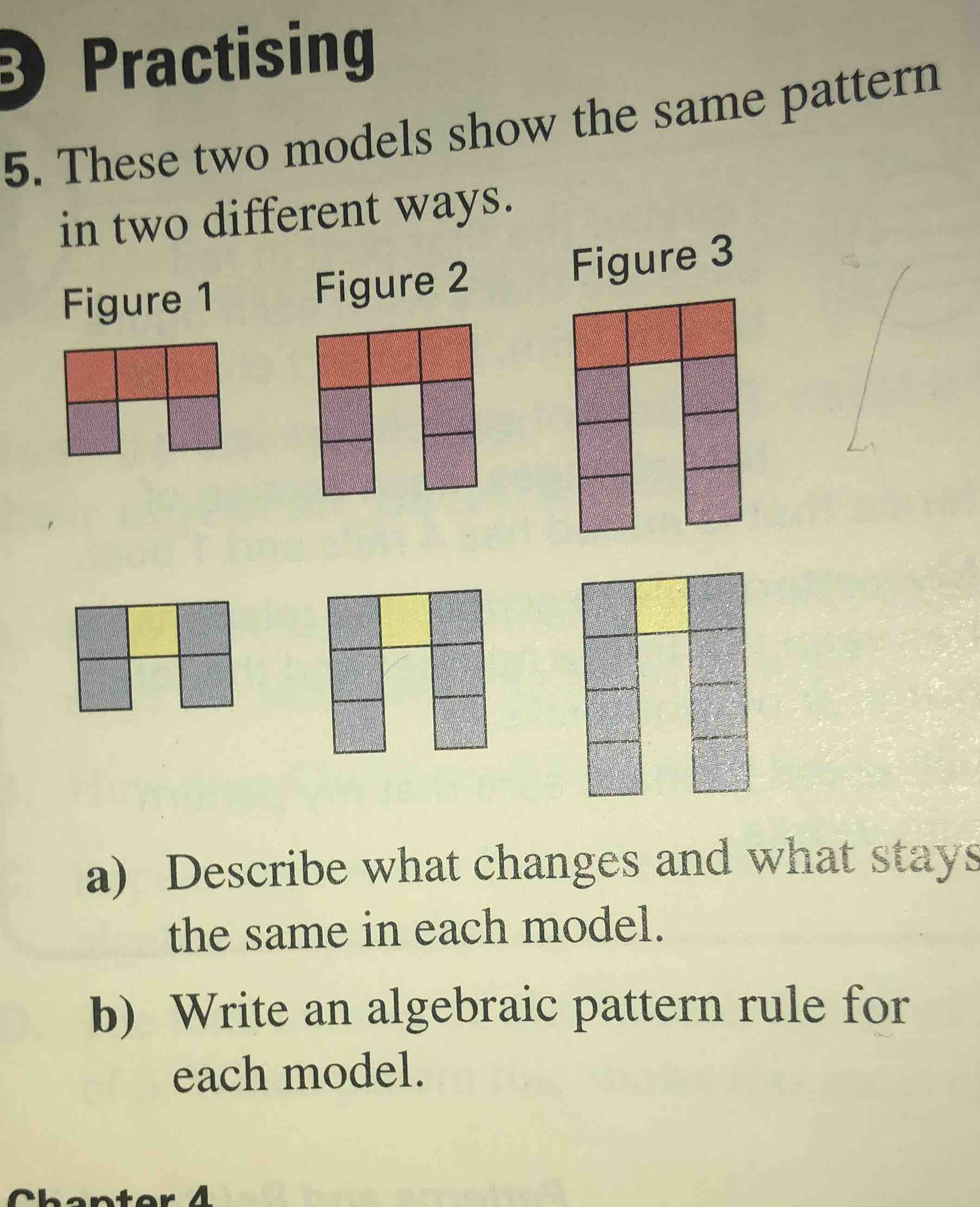
- these two models show the same pattern in two different ways.
figure 1 figure 2 figure 3
a) describe what changes and what stays the same in each model.
b) write an algebraic pattern rule for each model.
Part (a)
- What stays the same: The overall shape structure (a "U" or "notch" - like shape with a top row of 3 blocks, a middle empty space, and side columns) and the position of the empty/middle block (1 block in the center of the top row's level) are constant. Also, the number of blocks in the top row (3) remains the same across all figures.
- What changes: The number of blocks in the side columns (vertical columns on the left and right) increases. In Figure 1, each side column has 1 block (below the top row), in Figure 2, each side column has 2 blocks, and in Figure 3, each side column has 3 blocks. So the height (number of vertical blocks) of the side columns increases as we move from Figure 1 to Figure 3.
Step 1: Define variables
Let \( n \) be the figure number (where \( n = 1,2,3,\dots \)) and \( T \) be the total number of blocks.
Step 2: Analyze block count
- Top row: 3 blocks (constant for all \( n \)).
- Side columns: Each side column has \( n \) blocks (since in Figure 1 (\( n = 1 \)) each side column has 1 block, Figure 2 (\( n = 2 \)) each has 2, Figure 3 (\( n = 3 \)) each has 3). There are 2 side columns.
Step 3: Formulate the formula
The total number of blocks \( T=3 + 2\times n\).
For the second (colored: gray - yellow) model:
Step 1: Define variables
Let \( n \) be the figure number (where \( n = 1,2,3,\dots \)) and \( T \) be the total number of blocks.
Step 2: Analyze block count
- Top row: 3 blocks (but 1 is yellow (empty - space - like) and 2 are gray, but the count of non - empty top - row blocks is 2? Wait, no. Wait, the structure: top row has 3 blocks (1 yellow (empty) and 2 gray? No, looking at the gray - yellow model: in Figure 1, each side column has 2 blocks (top row + 1 below), Figure 2 each side column has 3 blocks (top row + 2 below), Figure 3 each side column has 4 blocks (top row + 3 below). Wait, re - evaluating:
Wait, in the gray - yellow model:
- Figure 1: Top row (3 blocks: 2 gray, 1 yellow), and each side column has 1 block below the top row. So total blocks: \( 3+2\times1 = 5\)
- Figure 2: Top row (3 blocks: 2 gray, 1 yellow), and each side column has 2 blocks below the top row. So total blocks: \( 3 + 2\times2=7\)
- Figure 3: Top row (3 blocks: 2 gray, 1 yellow), and each side column has 3 blocks below the top row. So total blocks: \( 3+2\times3 = 9\)
Wait, actually, for the gray - yellow model, the number of blocks in each side column (including the top - row block) is \( n + 1\)? Wait, no. Let's re - do:
For the gray - yellow model:
- In Figure 1 (\( n = 1 \)):
- Top row: 3 blocks (2 gray, 1 yellow).
- Side columns: each side column has 2 blocks (top row block + 1 below). So total blocks: \( 3+2\times1=5\)
- In Figure 2 (\( n = 2 \)):
- Top row: 3 blocks (2 gray, 1 yellow).
- Side columns: each side column has 3 blocks (top row block + 2 below). So total blocks: \( 3+2\times2 = 7\)
- In Figure 3 (\( n = 3 \)):
- Top row: 3 blocks (2 gray, 1 yellow).
- Side columns: each side column has 4 blocks (top row block + 3 below). Wait, this is inconsistent with the first model. Wait, no, maybe the first model (red - purple) has the top row as 3 (all filled) and side columns as \( n \) blocks below, and the second model (gray - yellow) has the top row as 3 (with 1 empty) and side columns as \( n + 1\) blocks (including the top - row block).
Wait, let's start over for the gray - yellow model:
Let \( n \) be the figure number.
- Top row: 3 blocks (1 yellow, 2 gray).
- Side columns: Each side column has \( n + 1\) blocks? No, in Figure 1, side columns (gray) have 2 blocks (top row + 1 below), Figure 2: 3 blocks (top row + 2 below), Figure 3: 4 blocks (top row + 3 below). So the number of blocks in each side column (gray) is \( n + 1\), and there are 2 side columns.
So total blocks \( T=3+2\times(n)\)? No, Figure 1: \( 3 + 2\times1=5\) (matches: 2 gray top, 1 yellow top, 2 gray side (1 each column)), Figure 2: \( 3+2\times2 = 7\) (2 gray top, 1 yellow top, 4 gray side (2 each column)), Figure 3: \( 3+2\times3=9\) (2 gray top, 1 yellow top, 6 gray side (3 each column)). Yes, so for the gray - yellow model, the formula is also \( T = 3+2n\), but the interpretation of the blocks (yellow as a "space" and gray as the filled side and partial top) is slightly different, but the count formula is the same in terms of arithmetic.

Snap & solve any problem in the app
Get step-by-step solutions on Sovi AI
Photo-based solutions with guided steps
Explore more problems and detailed explanations
- Stays the same: The top - row block count (3), the central empty - space position, and the overall "notched" shape structure.
- Changes: The number of blocks in each vertical side column (increases by 1 per figure: 1 in Figure 1, 2 in Figure 2, 3 in Figure 3).