QUESTION IMAGE
Question
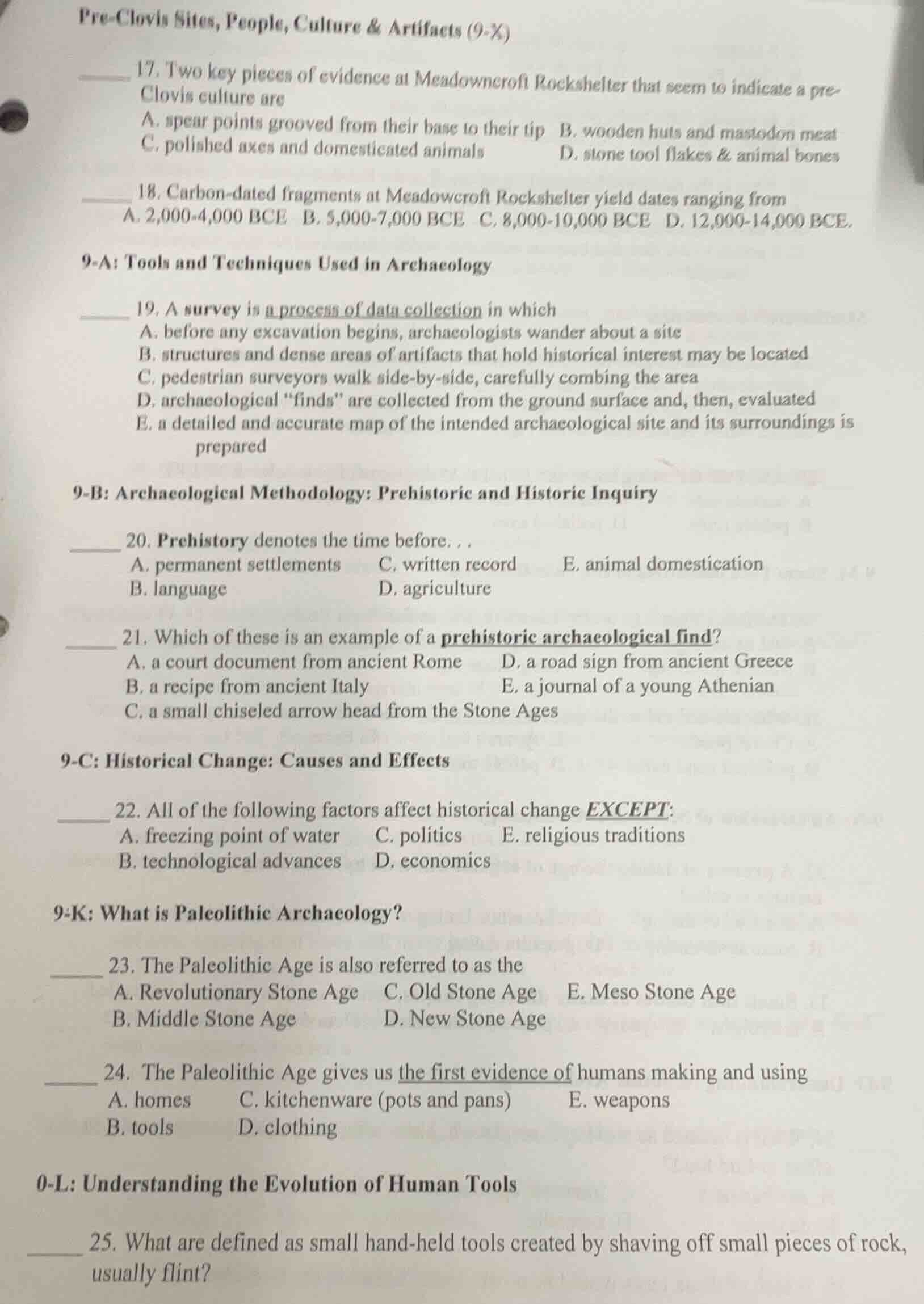
pre - clovis sites, people, culture & artifacts (9 - x)
- two key pieces of evidence at meadowcroft rockshelter that seem to indicate a pre - clovis culture are
a. spear points grooved from their base to their tip b. wooden huts and mastodon meat
c. polished axes and domesticated animals d. stone tool flakes & animal bones
- carbon - dated fragments at meadowcroft rockshelter yield dates ranging from
a. 2,000 - 4,000 bce b. 5,000 - 7,000 bce c. 8,000 - 10,000 bce d. 12,000 - 14,000 bce.
9 - a: tools and techniques used in archaeology
- a survey is a process of data collection in which
a. before any excavation begins, archaeologists wander about a site
b. structures and dense areas of artifacts that hold historical interest may be located
c. pedestrian surveyors walk side - by - side, carefully combing the area
d. archaeological \finds\ are collected from the ground surface and, then, evaluated
e. a detailed and accurate map of the intended archaeological site and its surroundings is prepared
9 - b: archaeological methodology: prehistoric and historic inquiry
- prehistory denotes the time before...
a. permanent settlements c. written record e. animal domestication
b. language d. agriculture
- which of these is an example of a prehistoric archaeological find?
a. a court document from ancient rome d. a road sign from ancient greece
b. a recipe from ancient italy e. a journal of a young athenian
c. a small chiseled arrow head from the stone ages
9 - c: historical change: causes and effects
- all of the following factors affect historical change except:
a. freezing point of water c. politics e. religious traditions
b. technological advances d. economics
9 - k: what is paleolithic archaeology?
- the paleolithic age is also referred to as the
a. revolutionary stone age c. old stone age e. meso stone age
b. middle stone age d. new stone age
- the paleolithic age gives us the first evidence of humans making and using
a. homes c. kitchenware (pots and pans) e. weapons
b. tools d. clothing
0 - l: understanding the evolution of human tools
- what are defined as small hand - held tools created by shaving off small pieces of rock, usually flint?
- Meadowcroft Rockshelter's pre-Clovis evidence includes stone tool flakes and modified animal bones, as characteristic pre-Clovis material culture lacks the distinct fluted spear points of Clovis, and the other options do not match the site's pre-Clovis artifacts.
- Carbon dating of Meadowcroft Rockshelter materials has yielded dates ranging from 12,000-14,000 BCE, which supports its status as an early pre-Clovis site.
- An archaeological survey is a surface data collection method where archaeologists gather and evaluate finds from the ground surface before excavation, and the other options describe partial or related but not core survey actions.
- Prehistory is defined as the period before the development of written records, as written documentation is the marker for the start of "history" in archaeological/historical terms.
- A Stone Age arrowhead is a prehistoric find because it dates to a time before written records, while the other options are written or historic-era objects.
- The freezing point of water is a constant physical property and does not drive historical change, unlike politics, technology, economics, and religious traditions which are human/cultural factors shaping history.
- The Paleolithic Age is commonly known as the Old Stone Age, corresponding to the earliest period of human stone tool use.
- The Paleolithic Age provides the first evidence of humans intentionally making and using stone tools, which is a defining feature of this era.
- These small, flint hand-held tools shaped by shaving rock flakes are defined as blades (or more specifically, flake tools; the standard term here is flake tools, which fit this description).

Snap & solve any problem in the app
Get step-by-step solutions on Sovi AI
Photo-based solutions with guided steps
Explore more problems and detailed explanations
- D. stone tool flakes & animal bones
- D. 12,000-14,000 BCE.
- D. archaeological "finds" are collected from the ground surface and, then, evaluated
- C. written record
- C. a small chiseled arrow head from the Stone Ages
- A. freezing point of water
- C. Old Stone Age
- B. tools
- Flake tools (or blades; the precise term is flake tools, small flint hand-held tools shaped by shaving rock flakes)