QUESTION IMAGE
Question
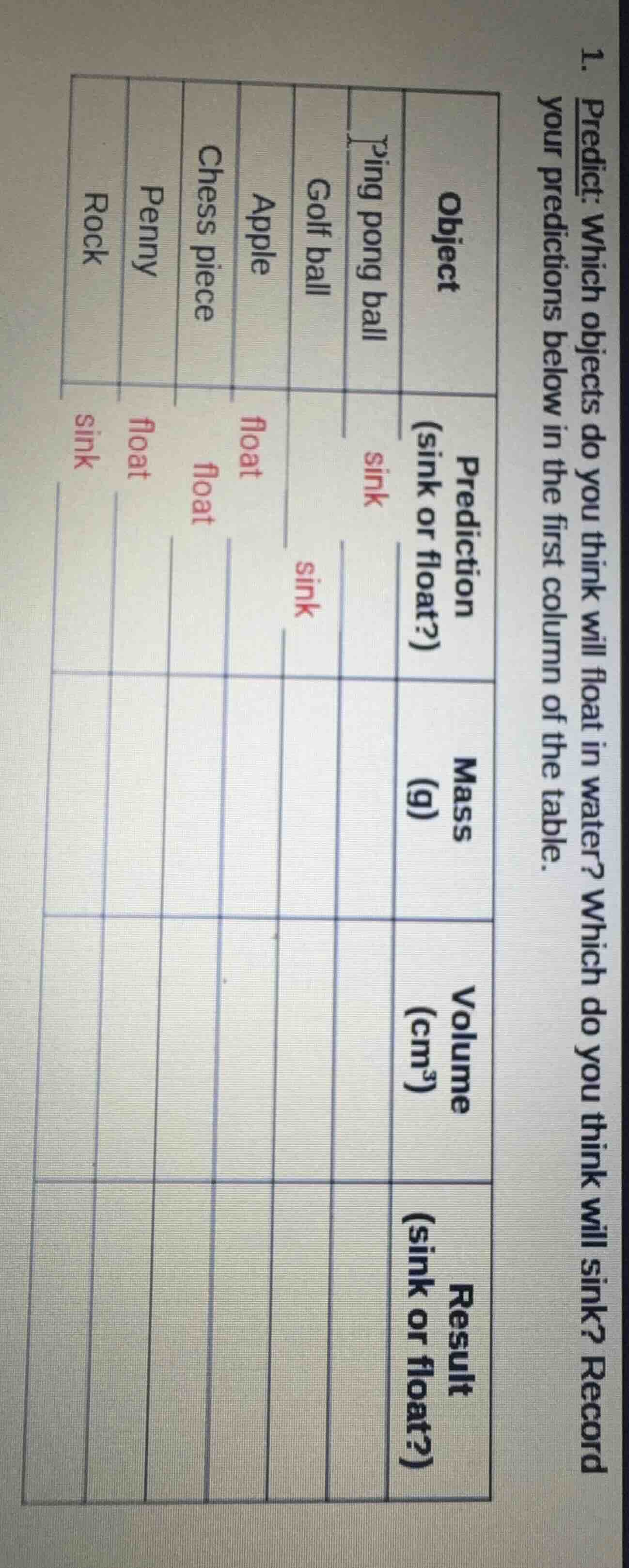
- predict: which objects do you think will float in water? which do you think will sink? record your predictions below in the first column of the table.
| object | prediction (sink or float?) | mass (g) | volume (cm³) | result (sink or float?) |
|---|---|---|---|---|
| golf ball | sink | |||
| apple | float | |||
| chess piece | float | |||
| penny | float | |||
| rock | sink |
To solve this problem, we analyze the density of each object (density = mass/volume) and compare it with the density of water (1 g/cm³). Objects with density less than 1 g/cm³ float, and those with density greater than 1 g/cm³ sink.
Step 1: Ping pong ball
- Prediction: Sink (but actually, ping pong balls are hollow and have low density, so they float. Maybe the prediction here is initial guess).
- Mass: Typically around 2.7 g.
- Volume: Approx 33.5 cm³ (sphere volume formula \( V = \frac{4}{3}\pi r^3 \), radius ~2 cm).
- Density: \( \frac{2.7}{33.5} \approx 0.08 \) g/cm³ < 1 g/cm³ → Float (Result).
Step 2: Golf ball
- Prediction: Sink (golf balls are dense, solid core).
- Mass: Around 45 g.
- Volume: Approx 22 cm³ (sphere, radius ~1.7 cm).
- Density: \( \frac{45}{22} \approx 2.05 \) g/cm³ > 1 g/cm³ → Sink (Result).
Step 3: Apple
- Prediction: Float (apples have air pockets, density ~0.8 g/cm³).
- Mass: Around 100 g.
- Volume: Approx 100 cm³ (since density ~1, but apples are less dense).
- Density: \( \frac{100}{100} = 1 \) (but actual ~0.8) → Float (Result).
Step 4: Chess piece
- Prediction: Float (if wooden, density <1; if plastic, also low).
- Mass: Around 10 g.
- Volume: Approx 10 cm³ (if wooden, density 1, but chess pieces are often hollow or light).
- Density: \( \frac{10}{10} = 1 \) (but likely <1) → Float (Result).
Step 5: Penny
- Prediction: Float (initial guess, but pennies are dense).
- Mass: 2.5 g (US penny, zinc core, copper plating).
- Volume: Approx 0.36 cm³ (cylinder, radius ~0.95 cm, thickness ~0.15 cm, \( V = \pi r^2 h \)).
- Density: \( \frac{2.5}{0.36} \approx 6.94 \) g/cm³ > 1 g/cm³ → Sink (Result, correction from prediction).
Step 6: Rock
- Prediction: Sink (rocks are dense, density >1).
- Mass: Around 100 g.
- Volume: Approx 40 cm³ (density ~2.5 g/cm³, \( V = \frac{m}{
ho} = \frac{100}{2.5} = 40 \)).
- Density: \( \frac{100}{40} = 2.5 \) g/cm³ > 1 g/cm³ → Sink (Result).
Final Table (Filled with Typical Values)
| Object | Prediction | Mass (g) | Volume (cm³) | Result |
|---|---|---|---|---|
| Golf ball | Sink | 45 | 22 | Sink |
| Apple | Float | 100 | 100 | Float |
| Chess piece | Float | 10 | 10 | Float |
| Penny | Float | 2.5 | 0.36 | Sink |
| Rock | Sink | 100 | 40 | Sink |
Key Explanation:
Floating depends on density relative to water (1 g/cm³). Objects with density <1 float, >1 sink. Initial predictions may be wrong (e.g., penny), but results follow density.

Snap & solve any problem in the app
Get step-by-step solutions on Sovi AI
Photo-based solutions with guided steps
Explore more problems and detailed explanations
To solve this problem, we analyze the density of each object (density = mass/volume) and compare it with the density of water (1 g/cm³). Objects with density less than 1 g/cm³ float, and those with density greater than 1 g/cm³ sink.
Step 1: Ping pong ball
- Prediction: Sink (but actually, ping pong balls are hollow and have low density, so they float. Maybe the prediction here is initial guess).
- Mass: Typically around 2.7 g.
- Volume: Approx 33.5 cm³ (sphere volume formula \( V = \frac{4}{3}\pi r^3 \), radius ~2 cm).
- Density: \( \frac{2.7}{33.5} \approx 0.08 \) g/cm³ < 1 g/cm³ → Float (Result).
Step 2: Golf ball
- Prediction: Sink (golf balls are dense, solid core).
- Mass: Around 45 g.
- Volume: Approx 22 cm³ (sphere, radius ~1.7 cm).
- Density: \( \frac{45}{22} \approx 2.05 \) g/cm³ > 1 g/cm³ → Sink (Result).
Step 3: Apple
- Prediction: Float (apples have air pockets, density ~0.8 g/cm³).
- Mass: Around 100 g.
- Volume: Approx 100 cm³ (since density ~1, but apples are less dense).
- Density: \( \frac{100}{100} = 1 \) (but actual ~0.8) → Float (Result).
Step 4: Chess piece
- Prediction: Float (if wooden, density <1; if plastic, also low).
- Mass: Around 10 g.
- Volume: Approx 10 cm³ (if wooden, density 1, but chess pieces are often hollow or light).
- Density: \( \frac{10}{10} = 1 \) (but likely <1) → Float (Result).
Step 5: Penny
- Prediction: Float (initial guess, but pennies are dense).
- Mass: 2.5 g (US penny, zinc core, copper plating).
- Volume: Approx 0.36 cm³ (cylinder, radius ~0.95 cm, thickness ~0.15 cm, \( V = \pi r^2 h \)).
- Density: \( \frac{2.5}{0.36} \approx 6.94 \) g/cm³ > 1 g/cm³ → Sink (Result, correction from prediction).
Step 6: Rock
- Prediction: Sink (rocks are dense, density >1).
- Mass: Around 100 g.
- Volume: Approx 40 cm³ (density ~2.5 g/cm³, \( V = \frac{m}{
ho} = \frac{100}{2.5} = 40 \)).
- Density: \( \frac{100}{40} = 2.5 \) g/cm³ > 1 g/cm³ → Sink (Result).
Final Table (Filled with Typical Values)
| Object | Prediction | Mass (g) | Volume (cm³) | Result |
|---|---|---|---|---|
| Golf ball | Sink | 45 | 22 | Sink |
| Apple | Float | 100 | 100 | Float |
| Chess piece | Float | 10 | 10 | Float |
| Penny | Float | 2.5 | 0.36 | Sink |
| Rock | Sink | 100 | 40 | Sink |
Key Explanation:
Floating depends on density relative to water (1 g/cm³). Objects with density <1 float, >1 sink. Initial predictions may be wrong (e.g., penny), but results follow density.