QUESTION IMAGE
Question
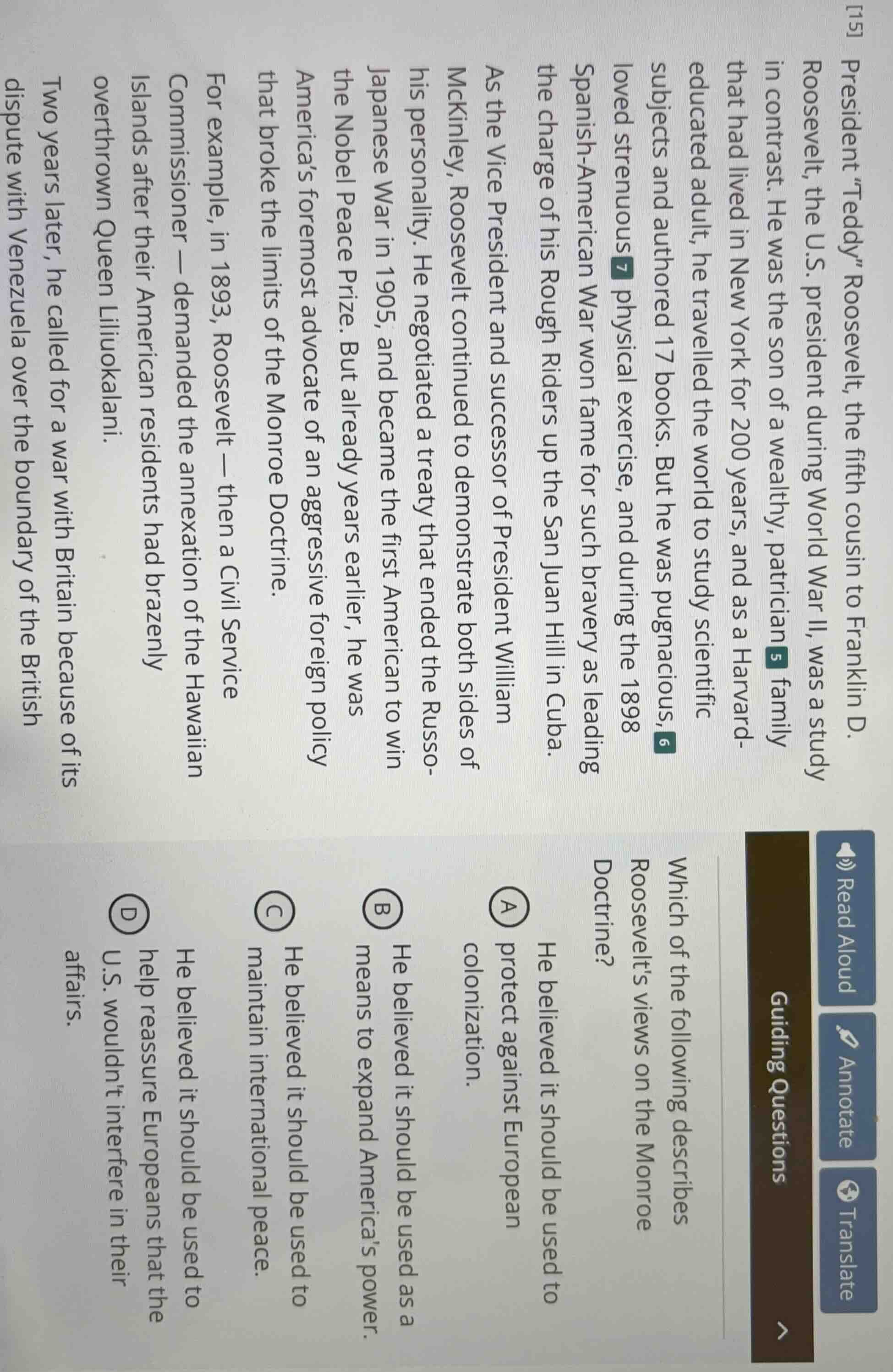
president \teddy\ roosevelt, the fifth cousin to franklin d. roosevelt, the u.s. president during world war ii, was a study in contrast. he was the son of a wealthy, patrician family that had lived in new york for 200 years, and as a harvard - educated adult, he travelled the world to study scientific subjects and authored 17 books. but he was pugnacious, loved strenuous physical exercise, and during the 1898 spanish - american war won fame for such bravery as leading the charge of his rough riders up the san juan hill in cuba. as the vice president and successor of president william mckinley, roosevelt continued to demonstrate both sides of his personality. he negotiated a treaty that ended the russo - japanese war in 1905, and became the first american to win the nobel peace prize. but already years earlier, he was america’s foremost advocate of an aggressive foreign policy that broke the limits of the monroe doctrine. for example, in 1893, roosevelt — then a civil service commissioner — demanded the annexation of the hawaiian islands after their american residents had brazenly overthrown queen liliuokalani. two years later, he called for a war with britain because of its dispute with venezuela over the boundary of the british guiding questions which of the following describes roosevelt’s views on the monroe doctrine? a he believed it should be used to protect against european colonization. b he believed it should be used as a means to expand america’s power. c he believed it should be used to maintain international peace. d he believed it should be used to help reassure europeans that the u.s. wouldn’t interfere in their affairs.
To determine Roosevelt's view on the Monroe Doctrine, we analyze the text: "he was America’s foremost advocate of an aggressive foreign policy that broke the limits of the Monroe Doctrine". An aggressive foreign policy to expand power aligns with option B. Option A is incorrect as the Monroe Doctrine was about U.S. influence, not just protection. Option C (maintaining peace) and D (not interfering) don't match the "aggressive" approach described.

Snap & solve any problem in the app
Get step-by-step solutions on Sovi AI
Photo-based solutions with guided steps
Explore more problems and detailed explanations
B. He believed it should be used as a means to expand America’s power.