QUESTION IMAGE
Question
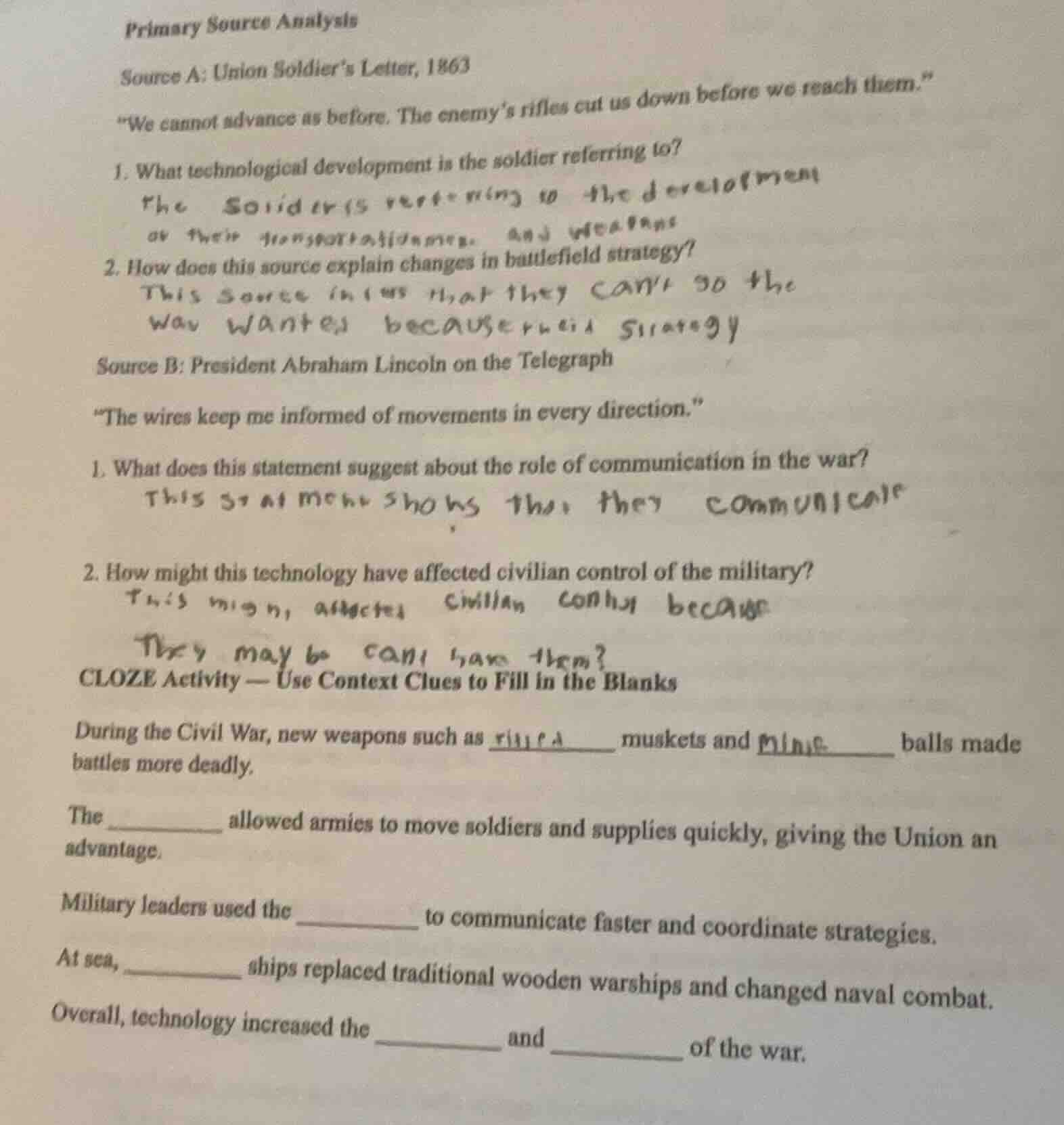
primary source analysis
source a: union soldiers letter, 1863
\we cannot advance as before. the enemys rifles cut us down before we reach them.\
- what technological development is the soldier referring to?
- how does this source explain changes in battlefield strategy?
source b: president abraham lincoln on the telegraph
\the wires keep me informed of movements in every direction.\
- what does this statement suggest about the role of communication in the war?
- how might this technology have affected civilian control of the military?
cloze activity — use context clues to fill in the blanks
during the civil war, new weapons such as ____ muskets and ____ balls made battles more deadly.
the ______ allowed armies to move soldiers and supplies quickly, giving the union an advantage.
military leaders used the ______ to communicate faster and coordinate strategies.
at sea, ______ ships replaced traditional wooden warships and changed naval combat.
overall, technology increased the ____ and ____ of the war.
Source A Analysis
- The soldier refers to rifled muskets, a new weapon with far greater accuracy and range than older smoothbore muskets, which could hit Union soldiers before they closed in for attacks.
- The new long-range rifles made traditional frontal assaults (marching directly toward enemy lines) suicidal, forcing armies to abandon open charges and adopt more defensive strategies like trench warfare.
Source B Analysis
- The statement shows that the telegraph provided real-time, widespread military movement updates, making communication faster and more comprehensive than ever before, which was critical for coordinating large-scale military operations.
- The telegraph let civilian leaders like Lincoln directly and quickly communicate with military commanders far from the capital, giving civilians more immediate oversight and control over military decisions and strategy.
CLOZE Activity

Snap & solve any problem in the app
Get step-by-step solutions on Sovi AI
Photo-based solutions with guided steps
Explore more problems and detailed explanations
s are based on key Civil War technological advancements and their impacts:
- Rifled muskets were the new accurate long-range firearms; minie balls were the conical bullets that improved their performance.
- Railroads enabled fast, large-scale transport of troops and supplies, a major Union advantage.
- The telegraph was the primary new tool for long-distance, fast military communication.
- Ironclad ships replaced wooden warships, revolutionizing naval combat.
- New technologies made battles far more deadly and increased the overall scale/scope of the war, raising its brutality and complexity.