QUESTION IMAGE
Question
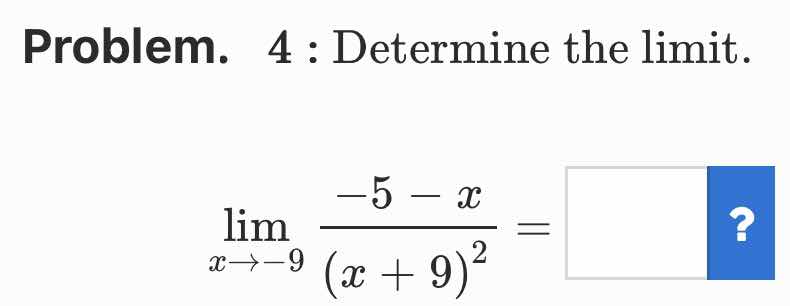
problem. 4 : determine the limit. \\(\lim\limits_{x\to -9} \frac{-5 - x}{(x + 9)^2} =\\)
Step 1: Analyze the numerator and denominator as \(x\to -9\)
First, let's find the value of the numerator and the denominator as \(x\) approaches \(-9\).
For the numerator: \(f(x)=-5 - x\), when \(x = -9\), we substitute \(x=-9\) into the numerator: \(-5-(-9)=-5 + 9=4\).
For the denominator: \(g(x)=(x + 9)^2\), when \(x=-9\), we substitute \(x = -9\) into the denominator: \((-9 + 9)^2=0^2 = 0\).
So we have a limit of the form \(\frac{4}{0}\) (since the numerator approaches \(4\) and the denominator approaches \(0\) as \(x\to -9\)).
Step 2: Analyze the sign of the denominator and the behavior of the function
Now, let's consider the behavior of the denominator \((x + 9)^2\) for \(x\) near \(-9\) (but not equal to \(-9\)). Since it's a square, \((x + 9)^2>0\) for all \(x
eq -9\) (because any real number squared is non - negative, and it's zero only when \(x=-9\)).
The numerator approaches \(4\) (a positive number) as \(x\to -9\), and the denominator approaches \(0\) from the positive side (because \((x + 9)^2>0\) for \(x
eq -9\)).
When we have a function \(y=\frac{\text{positive number}}{\text{positive number approaching }0}\), as the denominator gets closer and closer to \(0\) (while remaining positive), the value of the fraction will increase without bound (tend to \(+\infty\)).
Mathematically, we can also do a substitution \(t=x + 9\). When \(x\to -9\), \(t\to 0\). And \(x=-9 + t\), so the numerator \(-5-x=-5-(-9 + t)=4 - t\). Then the function becomes \(\lim_{t\to 0}\frac{4 - t}{t^2}\). As \(t\to 0\), the numerator \(4 - t\to 4\) and the denominator \(t^2\to 0^+\) (since \(t^2>0\) for \(t
eq 0\)). So \(\lim_{t\to 0}\frac{4 - t}{t^2}=+\infty\) (because we have a positive number divided by a positive number that is getting arbitrarily small).

Snap & solve any problem in the app
Get step-by-step solutions on Sovi AI
Photo-based solutions with guided steps
Explore more problems and detailed explanations
\(+\infty\) (or we can say the limit does not exist (DNE) in the set of real numbers, but in the context of limits involving infinity, we can say it approaches \(+\infty\))