QUESTION IMAGE
Question
problem 4
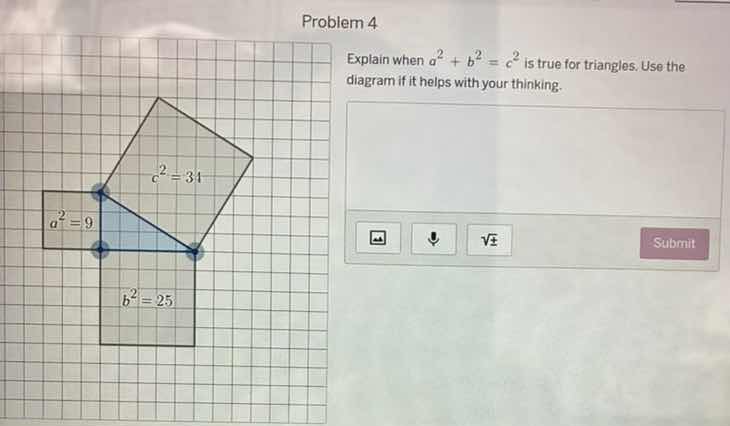
explain when ( a^2 + b^2 = c^2 ) is true for triangles. use the diagram if it helps with your thinking.
( a^2 = 9 )
( b^2 = 25 )
( c^2 = 34 )
The equation $a^2 + b^2 = c^2$ is the Pythagorean theorem. Looking at the diagram, the sides $a$, $b$, and $c$ form a right triangle (the shaded triangle), where $a$ and $b$ are the sides forming the right angle, and $c$ is the longest side (hypotenuse) opposite the right angle. The squares on each side of the triangle have areas equal to the square of the side length, and the sum of the areas of the squares on the two shorter sides equals the area of the square on the longest side, which only holds for right triangles.

Snap & solve any problem in the app
Get step-by-step solutions on Sovi AI
Photo-based solutions with guided steps
Explore more problems and detailed explanations
The equation $a^2 + b^2 = c^2$ (the Pythagorean theorem) is true if and only if the triangle is a right triangle, where $a$ and $b$ are the lengths of the two legs (the sides that form the 90° right angle), and $c$ is the length of the hypotenuse (the longest side opposite the right angle).