QUESTION IMAGE
Question
problem 2
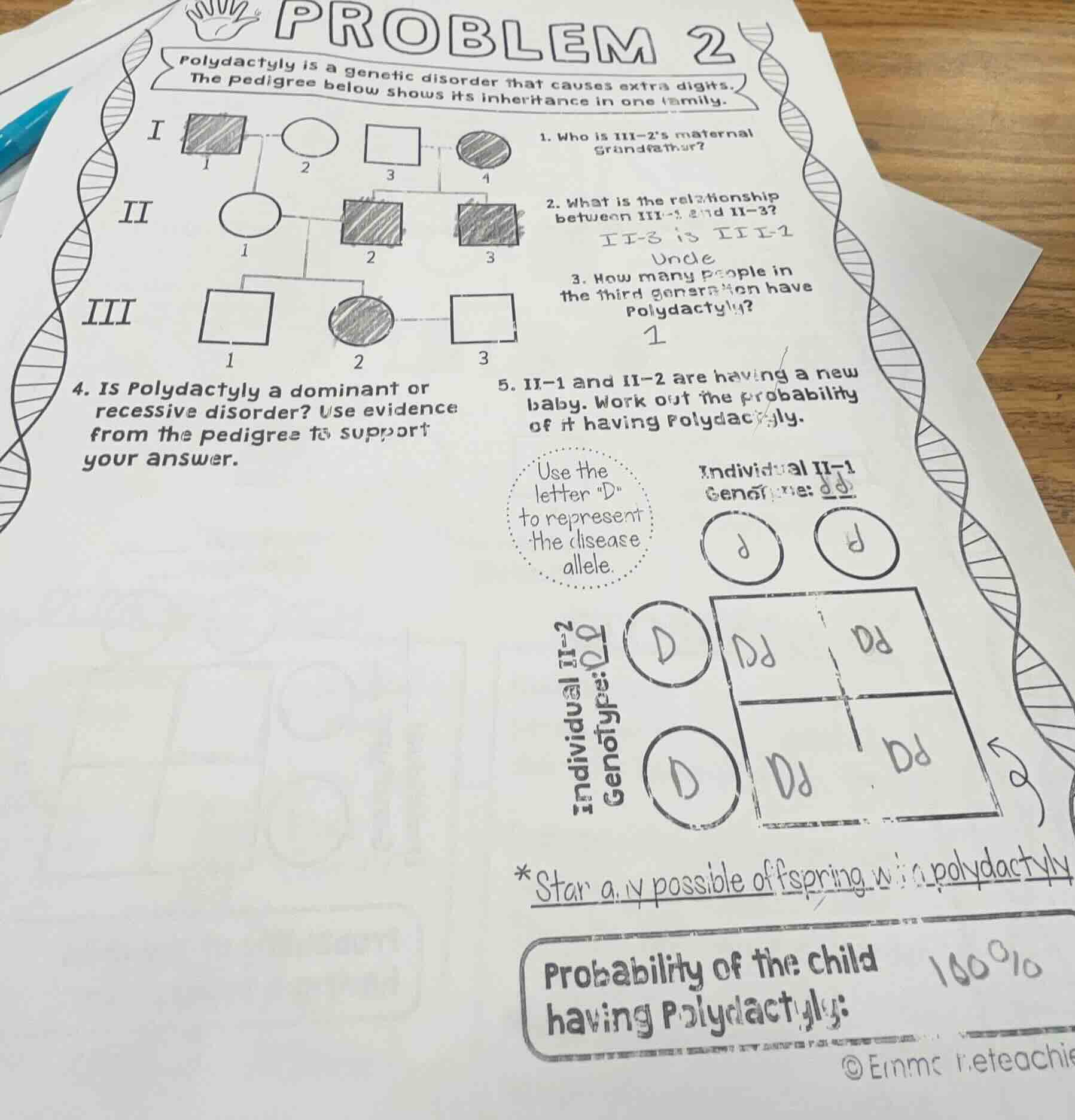
polydactyly is a genetic disorder that causes extra digits.
the pedigree below shows its inheritance in one family.
- who is iii-2’s maternal grandfather?
- what is the relationship between iii-? and ii-3?
ii-3 is iii-1 uncle
- how many people in the third generation have polydactyly?
1
- is polydactyly a dominant or recessive disorder? use evidence from the pedigree to support your answer.
- ii-1 and ii-2 are having a new baby. work out the probability of it having polydactyly.
use the letter “d” to represent the disease allele.
individual ii-1 genotype: dd
- star any possible offspring with polydactyly
probability of the child having polydactyly: 100%
Step1: Identify maternal grandfather
III-2's mother is II-1. II-1's father is I-1.
Step2: Confirm uncle-nephew relationship
II-3 is the brother of III-1's father (II-2), so he is III-1's uncle.
Step3: Count affected in generation III
Only III-2 (shaded) has polydactyly.
Step4: Determine dominance type
Affected individuals appear in every generation, and unaffected parents (none here) would not have affected offspring if recessive. I-1 (affected) has affected child II-2; I-4 (affected) has affected children II-2/II-3. Dominant alleles express in heterozygotes, so it is dominant.
Step5: Calculate offspring probability
II-1 genotype: $dd$ (unaffected), II-2 genotype: $Dd$ (since he has an unaffected child III-1, so he must carry a recessive allele). Punnett square:
Affected offspring are $Dd$, 2 out of 4. Probability = $\frac{2}{4} = 50\%$.

Snap & solve any problem in the app
Get step-by-step solutions on Sovi AI
Photo-based solutions with guided steps
Explore more problems and detailed explanations
- I-1
- II-3 is III-1's uncle
- 1
- Polydactyly is dominant. Evidence: Affected individuals are present in each generation, and an affected parent (e.g., I-1) has affected offspring, which aligns with dominant inheritance (dominant alleles are expressed in heterozygotes and passed to offspring).
- 50%