QUESTION IMAGE
Question
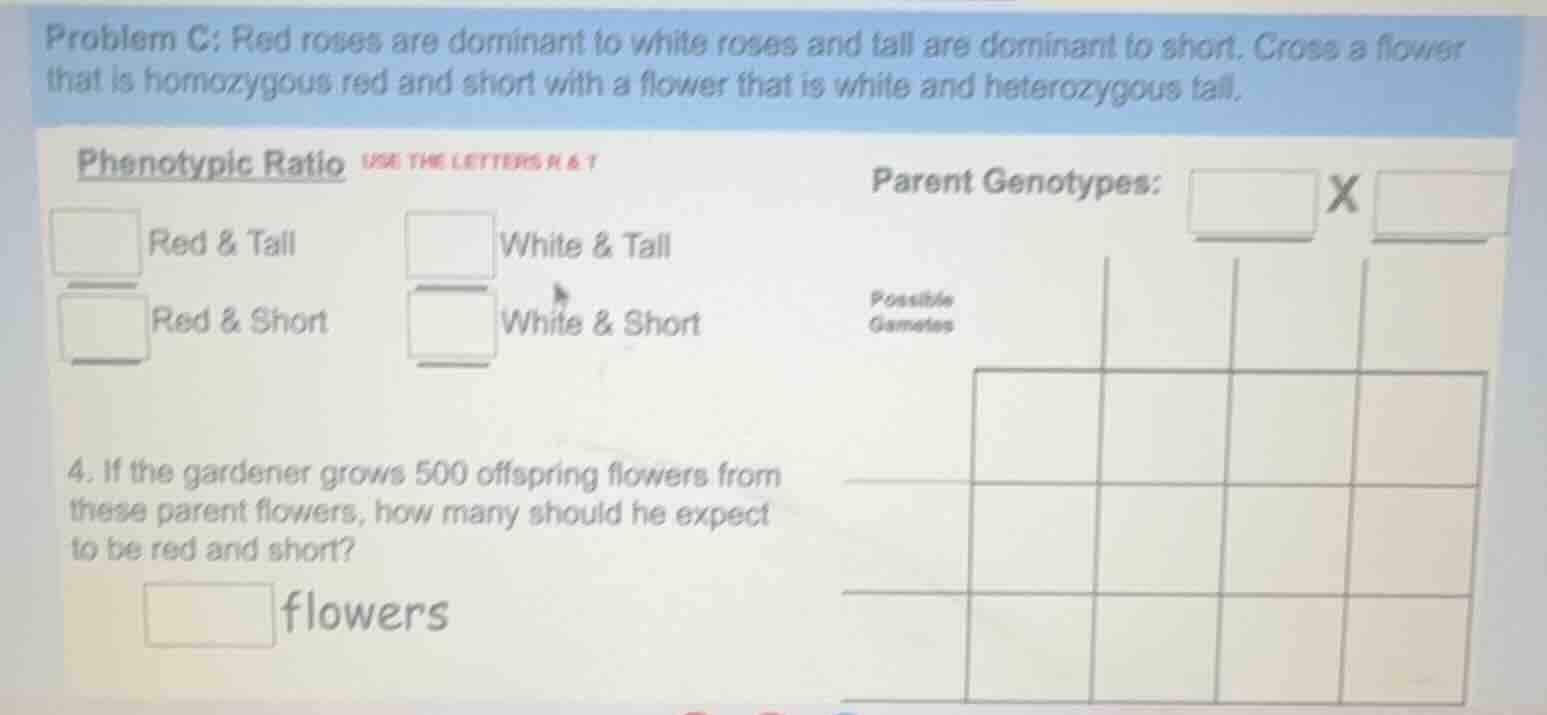
problem c: red roses are dominant to white roses and tall are dominant to short. cross a flower that is homozygous red and short with a flower that is white and heterozygous tall.
phenotypic ratio use the letters r & t
red & tall white & tall
red & short white & short
parent genotypes: x
possible gametes
- if the gardener grows 500 offspring flowers from these parent flowers, how many should he expect to be red and short?
flowers
Step1: Determine Parent Genotypes
Let \( R \) be the allele for red (dominant), \( r \) for white (recessive), \( T \) for tall (dominant), \( t \) for short (recessive). The first parent is homozygous red (\( RR \)) and short (\( tt \)), so genotype \( RRtt \). The second parent is white (\( rr \)) and heterozygous tall (\( Tt \)), so genotype \( rrTt \).
Step2: Find Possible Gametes
For \( RRtt \), gametes are all \( Rt \) (since \( RR \) gives \( R \), \( tt \) gives \( t \)). For \( rrTt \), gametes are \( rT \) and \( rt \) (from \( rr \) giving \( r \), \( Tt \) giving \( T \) or \( t \)).
Step3: Create Punnett Square
| \( Rt \) | \( Rt \) | \( Rt \) | \( Rt \) | |
|---|---|---|---|---|
| \( rt \) | \( Rrtt \) | \( Rrtt \) | \( Rrtt \) | \( Rrtt \) |
Step4: Determine Phenotypes
- \( RrTt \): Red & Tall
- \( Rrtt \): Red & Short
From the Punnett square, 4 out of 8 (or 1/2) of the offspring are \( Rrtt \) (Red & Short) when considering the two rows (since \( rrTt \) produces two types of gametes, and \( RRtt \) produces one, so total 2×4? Wait, no, the Punnett square here: \( RRtt \) has gametes \( Rt \) (all), \( rrTt \) has gametes \( rT \) and \( rt \). So the square is 2 columns (from \( RRtt \)) and 2 rows (from \( rrTt \))? Wait, no, correction: \( RRtt \) is \( RR \) (homozygous) so only \( R \) gametes, and \( tt \) (homozygous) so only \( t \) gametes. So gametes from \( RRtt \): \( Rt \) (only one type). Gametes from \( rrTt \): \( rT \) and \( rt \) (two types). So Punnett square is 2 rows (rT, rt) and 1 column (Rt)? No, wait, no—each parent contributes one gamete. So \( RRtt \) can only give \( Rt \), \( rrTt \) can give \( rT \) or \( rt \). So the cross is \( Rt \times rT \) and \( Rt \times rt \). So the offspring are \( RrTt \) (Red, Tall) and \( Rrtt \) (Red, Short), each with probability 1/2. So the phenotypic ratio of Red & Tall : Red & Short is 1:1 (since \( RrTt \) and \( Rrtt \) are the only possibilities, as white is \( rr \) which can't happen here because one parent is \( RR \)).
Step5: Calculate Expected Number
Total offspring: 500. The probability of Red & Short is 1/2 (since ratio is 1:1 for Red & Tall : Red & Short). So number of Red & Short = \( 500 \times \frac{1}{2} = 250 \).

Snap & solve any problem in the app
Get step-by-step solutions on Sovi AI
Photo-based solutions with guided steps
Explore more problems and detailed explanations
250