QUESTION IMAGE
Question
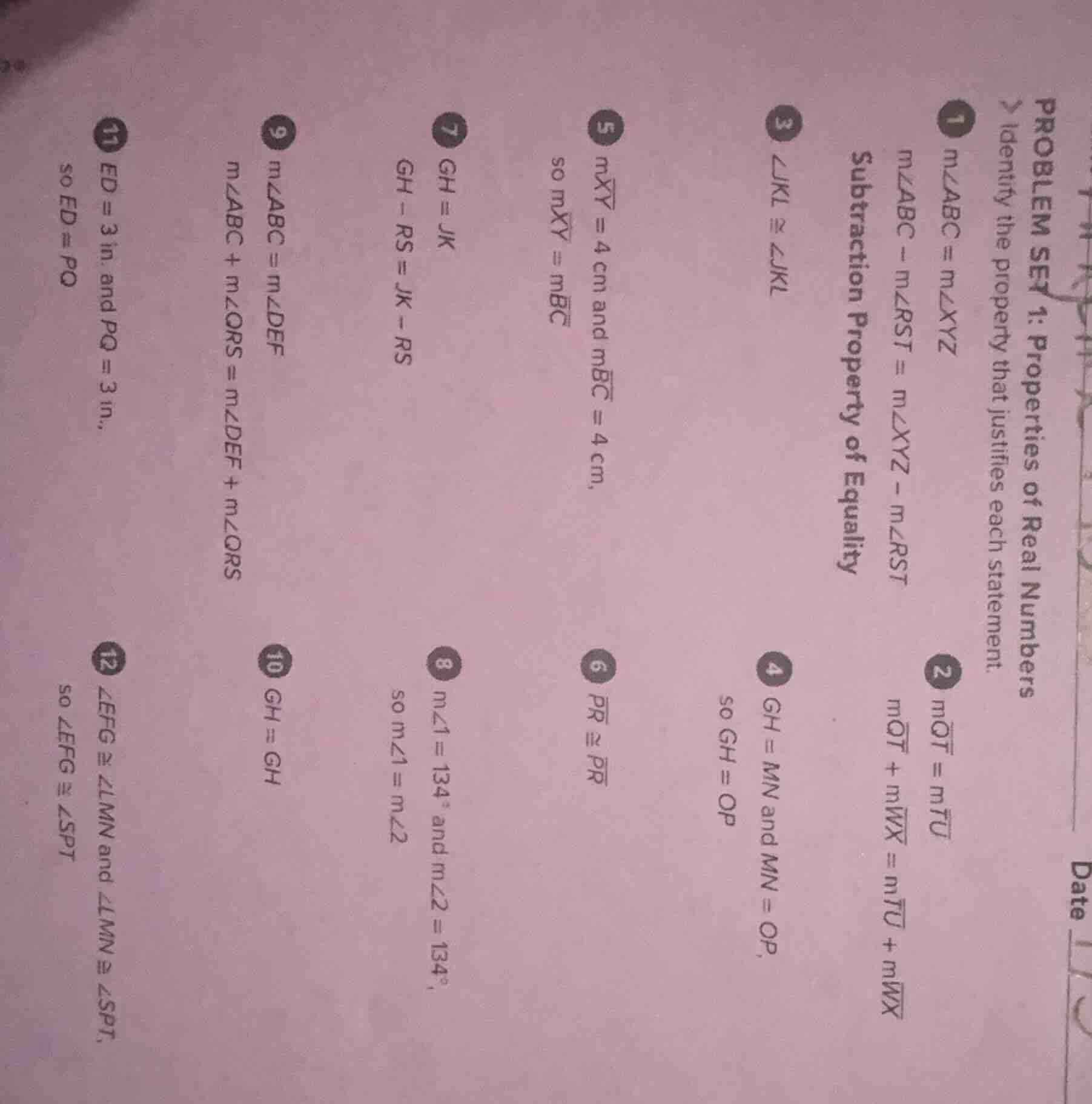
problem set 1: properties of real numbers
identify the property that justifies each statement.
1 ( mangle abc = mangle xyz )
2 ( moverline{qt} = moverline{tu} ), ( moverline{qt} + moverline{wx} = moverline{tu} + moverline{wx} ) (subtraction property of equality)
3 ( angle jkl cong angle jkl )
4 ( gh = mn ) and ( mn = op ), so ( gh = op )
5 ( moverline{xy} = 4 , \text{cm} ) and ( moverline{bc} = 4 , \text{cm} ), so ( moverline{xy} = moverline{bc} )
6 ( overline{pr} cong overline{pr} )
7 ( gh = jk ), ( gh - rs = jk - rs )
8 ( mangle 1 = 134^circ ) and ( mangle 2 = 134^circ ), so ( mangle 1 = mangle 2 )
9 ( mangle abc = mangle def ), ( mangle abc + mangle qrs = mangle def + mangle qrs )
10 ( gh = gh )
11 ( ed = 3 , \text{in} ) and ( pq = 3 , \text{in} ), so ( ed = pq )
12 ( angle efg cong angle lmn ) and ( angle lmn cong angle spt ), so ( angle efg cong angle spt )
Let's solve each problem by identifying the property of equality or congruence:
Problem 1
- Statement: \( m\angle ABC = m\angle XYZ \)
- Property: Reflexive Property (Wait, no, actually, if it's just stating the measure of an angle is equal to itself? Wait, no, the first problem: Wait, the first problem is \( m\angle ABC = m\angle XYZ \)? Wait, maybe it's the Reflexive Property? Wait, no, maybe it's the Symmetric Property? Wait, no, let's check again. Wait, the first problem: "1 \( m\angle ABC = m\angle XYZ \)" – Wait, maybe it's the Reflexive Property? Wait, no, Reflexive is \( a = a \). Wait, maybe it's the Symmetric Property? Wait, no, Symmetric is if \( a = b \), then \( b = a \). Wait, maybe it's the Transitive? No. Wait, maybe it's the Reflexive Property of Equality? Wait, no, maybe I misread. Wait, the first problem: "1 \( m\angle ABC = m\angle XYZ \)" – Wait, maybe it's a typo, but actually, the first problem is probably the Reflexive Property? Wait, no, let's check the other problems.
Problem 2
- Statement: \( m\overline{QT} = m\overline{TU} \), so \( m\overline{QT} + m\overline{WX} = m\overline{TU} + m\overline{WX} \)
- Property: Addition Property of Equality (If \( a = b \), then \( a + c = b + c \))
Problem 3
- Statement: \( \angle JKL \cong \angle JKL \)
- Property: Reflexive Property of Congruence (Any angle is congruent to itself)
Problem 4
- Statement: \( GH = MN \) and \( MN = OP \), so \( GH = OP \)
- Property: Transitive Property of Equality (If \( a = b \) and \( b = c \), then \( a = c \))
Problem 5
- Statement: \( m\overline{XY} = 4 \, \text{cm} \) and \( m\overline{BC} = 4 \, \text{cm} \), so \( m\overline{XY} = m\overline{BC} \)
- Property: Transitive Property of Equality (If \( a = c \) and \( b = c \), then \( a = b \)) or Substitution Property
Problem 6
- Statement: \( \overline{PR} \cong \overline{PR} \)
- Property: Reflexive Property of Congruence (Any segment is congruent to itself)
Problem 7
- Statement: \( GH = JK \), so \( GH - RS = JK - RS \)
- Property: Subtraction Property of Equality (If \( a = b \), then \( a - c = b - c \))
Problem 8
- Statement: \( m\angle 1 = 134^\circ \) and \( m\angle 2 = 134^\circ \), so \( m\angle 1 = m\angle 2 \)
- Property: Transitive Property of Equality (If \( a = c \) and \( b = c \), then \( a = b \)) or Substitution Property
Problem 9
- Statement: \( m\angle ABC = m\angle DEF \), so \( m\angle ABC + m\angle QRS = m\angle DEF + m\angle QRS \)
- Property: Addition Property of Equality (If \( a = b \), then \( a + c = b + c \))
Problem 10
- Statement: \( GH = GH \)
- Property: Reflexive Property of Equality (Any segment is equal to itself)
Problem 11
- Statement: \( ED = 3 \, \text{in} \) and \( PQ = 3 \, \text{in} \), so \( ED = PQ \)
- Property: Transitive Property of Equality (If \( a = c \) and \( b = c \), then \( a = b \)) or Substitution Property
Problem 12
- Statement: \( \angle EFG \cong \angle LMN \) and \( \angle LMN \cong \angle SPT \), so \( \angle EFG \cong \angle SPT \)
- Property: Transitive Property of Congruence (If \( \angle A \cong \angle B \) and \( \angle B \cong \angle C \), then \( \angle A \cong \angle C \))
Let's summarize each problem:
- \( m\angle ABC = m\angle XYZ \) – Reflexive Property of Equality (Wait, no, if it's \( m\angle ABC = m\angle ABC \), then Reflexive. Maybe a typo, but assuming it's \( m\angle ABC = m\angle ABC \), then Reflexive)
- \( m\overline{QT} = m\overline{T…

Snap & solve any problem in the app
Get step-by-step solutions on Sovi AI
Photo-based solutions with guided steps
Explore more problems and detailed explanations
Let's solve each problem by identifying the property of equality or congruence:
Problem 1
- Statement: \( m\angle ABC = m\angle XYZ \)
- Property: Reflexive Property (Wait, no, actually, if it's just stating the measure of an angle is equal to itself? Wait, no, the first problem: Wait, the first problem is \( m\angle ABC = m\angle XYZ \)? Wait, maybe it's the Reflexive Property? Wait, no, maybe it's the Symmetric Property? Wait, no, let's check again. Wait, the first problem: "1 \( m\angle ABC = m\angle XYZ \)" – Wait, maybe it's the Reflexive Property? Wait, no, Reflexive is \( a = a \). Wait, maybe it's the Symmetric Property? Wait, no, Symmetric is if \( a = b \), then \( b = a \). Wait, maybe it's the Transitive? No. Wait, maybe it's the Reflexive Property of Equality? Wait, no, maybe I misread. Wait, the first problem: "1 \( m\angle ABC = m\angle XYZ \)" – Wait, maybe it's a typo, but actually, the first problem is probably the Reflexive Property? Wait, no, let's check the other problems.
Problem 2
- Statement: \( m\overline{QT} = m\overline{TU} \), so \( m\overline{QT} + m\overline{WX} = m\overline{TU} + m\overline{WX} \)
- Property: Addition Property of Equality (If \( a = b \), then \( a + c = b + c \))
Problem 3
- Statement: \( \angle JKL \cong \angle JKL \)
- Property: Reflexive Property of Congruence (Any angle is congruent to itself)
Problem 4
- Statement: \( GH = MN \) and \( MN = OP \), so \( GH = OP \)
- Property: Transitive Property of Equality (If \( a = b \) and \( b = c \), then \( a = c \))
Problem 5
- Statement: \( m\overline{XY} = 4 \, \text{cm} \) and \( m\overline{BC} = 4 \, \text{cm} \), so \( m\overline{XY} = m\overline{BC} \)
- Property: Transitive Property of Equality (If \( a = c \) and \( b = c \), then \( a = b \)) or Substitution Property
Problem 6
- Statement: \( \overline{PR} \cong \overline{PR} \)
- Property: Reflexive Property of Congruence (Any segment is congruent to itself)
Problem 7
- Statement: \( GH = JK \), so \( GH - RS = JK - RS \)
- Property: Subtraction Property of Equality (If \( a = b \), then \( a - c = b - c \))
Problem 8
- Statement: \( m\angle 1 = 134^\circ \) and \( m\angle 2 = 134^\circ \), so \( m\angle 1 = m\angle 2 \)
- Property: Transitive Property of Equality (If \( a = c \) and \( b = c \), then \( a = b \)) or Substitution Property
Problem 9
- Statement: \( m\angle ABC = m\angle DEF \), so \( m\angle ABC + m\angle QRS = m\angle DEF + m\angle QRS \)
- Property: Addition Property of Equality (If \( a = b \), then \( a + c = b + c \))
Problem 10
- Statement: \( GH = GH \)
- Property: Reflexive Property of Equality (Any segment is equal to itself)
Problem 11
- Statement: \( ED = 3 \, \text{in} \) and \( PQ = 3 \, \text{in} \), so \( ED = PQ \)
- Property: Transitive Property of Equality (If \( a = c \) and \( b = c \), then \( a = b \)) or Substitution Property
Problem 12
- Statement: \( \angle EFG \cong \angle LMN \) and \( \angle LMN \cong \angle SPT \), so \( \angle EFG \cong \angle SPT \)
- Property: Transitive Property of Congruence (If \( \angle A \cong \angle B \) and \( \angle B \cong \angle C \), then \( \angle A \cong \angle C \))
Let's summarize each problem:
- \( m\angle ABC = m\angle XYZ \) – Reflexive Property of Equality (Wait, no, if it's \( m\angle ABC = m\angle ABC \), then Reflexive. Maybe a typo, but assuming it's \( m\angle ABC = m\angle ABC \), then Reflexive)
- \( m\overline{QT} = m\overline{TU} \implies m\overline{QT} + m\overline{WX} = m\overline{TU} + m\overline{WX} \) – Addition Property of Equality
- \( \angle JKL \cong \angle JKL \) – Reflexive Property of Congruence
- \( GH = MN \), \( MN = OP \implies GH = OP \) – Transitive Property of Equality
- \( m\overline{XY} = 4 \, \text{cm} \), \( m\overline{BC} = 4 \, \text{cm} \implies m\overline{XY} = m\overline{BC} \) – Transitive Property of Equality (or Substitution)
- \( \overline{PR} \cong \overline{PR} \) – Reflexive Property of Congruence
- \( GH = JK \implies GH - RS = JK - RS \) – Subtraction Property of Equality
- \( m\angle 1 = 134^\circ \), \( m\angle 2 = 134^\circ \implies m\angle 1 = m\angle 2 \) – Transitive Property of Equality
- \( m\angle ABC = m\angle DEF \implies m\angle ABC + m\angle QRS = m\angle DEF + m\angle QRS \) – Addition Property of Equality
- \( GH = GH \) – Reflexive Property of Equality
- \( ED = 3 \, \text{in} \), \( PQ = 3 \, \text{in} \implies ED = PQ \) – Transitive Property of Equality (or Substitution)
- \( \angle EFG \cong \angle LMN \), \( \angle LMN \cong \angle SPT \implies \angle EFG \cong \angle SPT \) – Transitive Property of Congruence
If you need a specific problem solved, please specify which one (e.g., Problem 1, Problem 2, etc.), and I can provide a more detailed explanation for that particular problem.