QUESTION IMAGE
Question
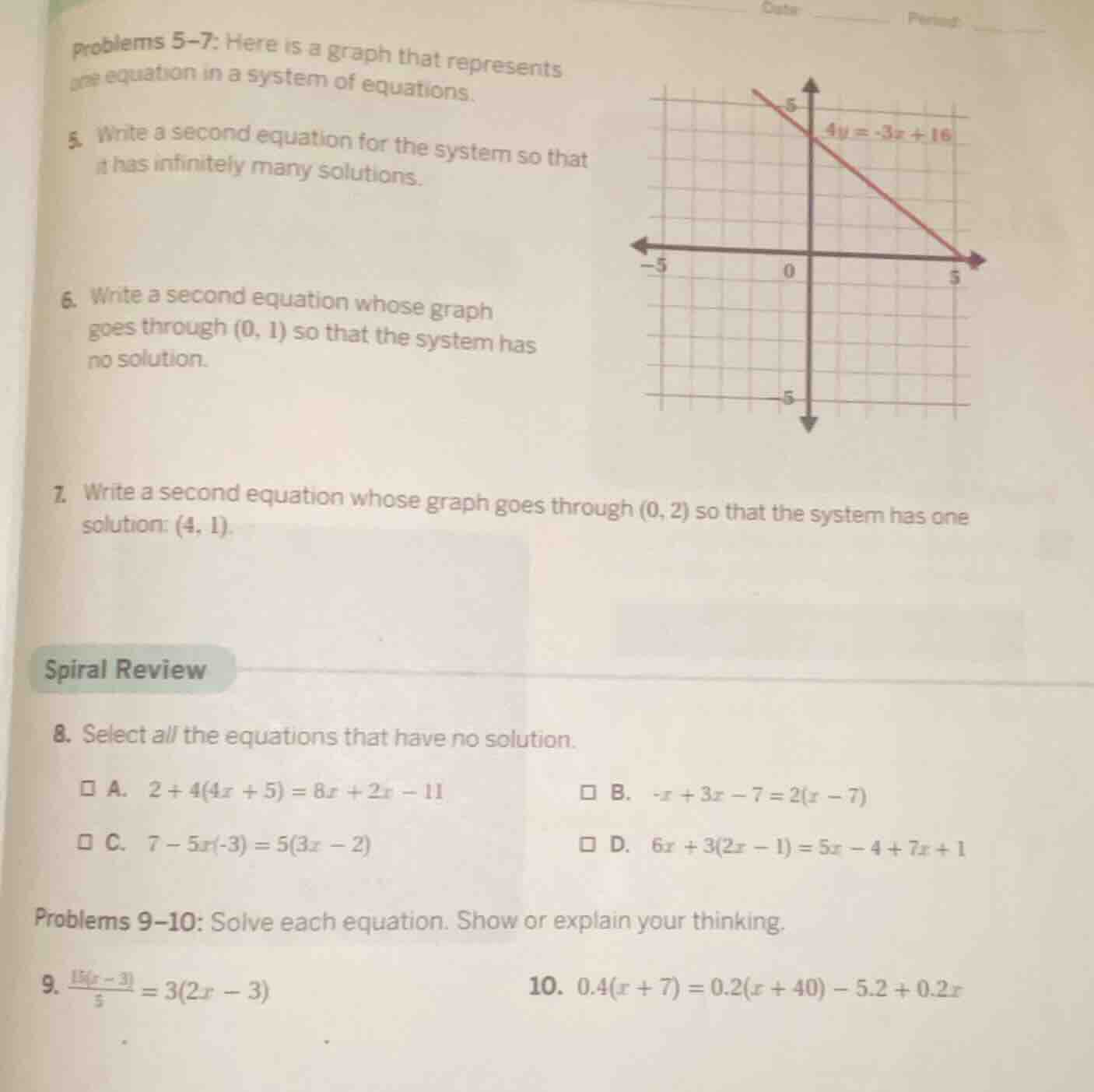
problems 5–7: here is a graph that represents one equation in a system of equations.
- write a second equation for the system so that it has infinitely many solutions.
- write a second equation whose graph goes through (0, 1) so that the system has no solution.
- write a second equation whose graph goes through (0, 2) so that the system has one solution: (4, 1).
spiral review
- select all the equations that have no solution.
□ a. $2 + 4(4x + 5) = 8x + 2x - 11$
□ b. $-x + 3x - 7 = 2(x - 7)$
□ c. $7 - 5x(-3) = 5(3x - 2)$
□ d. $6x + 3(2x - 1) = 5x - 4 + 7x + 1$
problems 9–10: solve each equation. show or explain your thinking.
- $\frac{15(x - 3)}{5} = 3(2x - 3)$
- $0.4(x + 7) = 0.2(x + 40) - 5.2 + 0.2x$
Problems 5-7
Step1: Rewrite given equation in slope-intercept
First, rewrite $4y=-3x+16$ to $y=mx+b$ form:
$$y = -\frac{3}{4}x + 4$$
---
Problem 5 Step1: Scale original equation
A system has infinitely many solutions if equations are scalar multiples. Multiply original equation by 2:
$$2(4y) = 2(-3x+16) \implies 8y = -6x + 32$$
Problem 6 Step1: Set same slope, new y-intercept
No solution means parallel lines (same slope, different y-intercept). Use $m=-\frac{3}{4}$, $b=1$:
$$y = -\frac{3}{4}x + 1$$
Rearrange to standard form: $3x + 4y = 4$
Problem 7 Step1: Find slope of new line
New line passes through $(0,2)$ and $(4,1)$. Calculate slope:
$$m = \frac{1-2}{4-0} = -\frac{1}{4}$$
Problem 7 Step2: Write line equation
Use $b=2$ (y-intercept) in $y=mx+b$:
$$y = -\frac{1}{4}x + 2$$
Rearrange to standard form: $x + 4y = 8$
---
Problem 8
Step1: Simplify Option A
Expand and combine like terms:
$$2 + 16x + 20 = 10x - 11 \implies 16x + 22 = 10x - 11 \implies 6x = -33$$
This has one solution.
Step2: Simplify Option B
Expand and combine like terms:
$$2x - 7 = 2x - 14 \implies -7 = -14$$
This is a false statement (no solution).
Step3: Simplify Option C
Expand and combine like terms:
$$7 + 15x = 15x - 10 \implies 7 = -10$$
This is a false statement (no solution).
Step4: Simplify Option D
Expand and combine like terms:
$$6x + 6x - 3 = 12x - 3 \implies 12x - 3 = 12x - 3$$
This is always true (infinitely many solutions).
---
Problem 9
Step1: Eliminate denominator
Multiply both sides by 5:
$$15(x-3) = 15(2x-3)$$
Step2: Divide both sides by 15
Simplify the equation:
$$x - 3 = 2x - 3$$
Step3: Solve for $x$
Isolate $x$ terms:
$$-3 + 3 = 2x - x \implies x=0$$
---
Problem 10

Snap & solve any problem in the app
Get step-by-step solutions on Sovi AI
Photo-based solutions with guided steps
Explore more problems and detailed explanations
s:
- Problem 5: $\boldsymbol{8y = -6x + 32}$ (or any non-zero scalar multiple of $4y=-3x+16$)
- Problem 6: $\boldsymbol{3x + 4y = 4}$ (or $y=-\frac{3}{4}x+1$)
- Problem 7: $\boldsymbol{x + 4y = 8}$ (or $y=-\frac{1}{4}x+2$)
- Problem 8: $\boldsymbol{B. -x + 3x - 7 = 2(x - 7)}$, $\boldsymbol{C. 7 - 5x(-3) = 5(3x - 2)}$
- Problem 9: $\boldsymbol{x=0}$
- Problem 10: $\boldsymbol{\text{Infinitely many solutions}}$ (all real numbers)