QUESTION IMAGE
Question
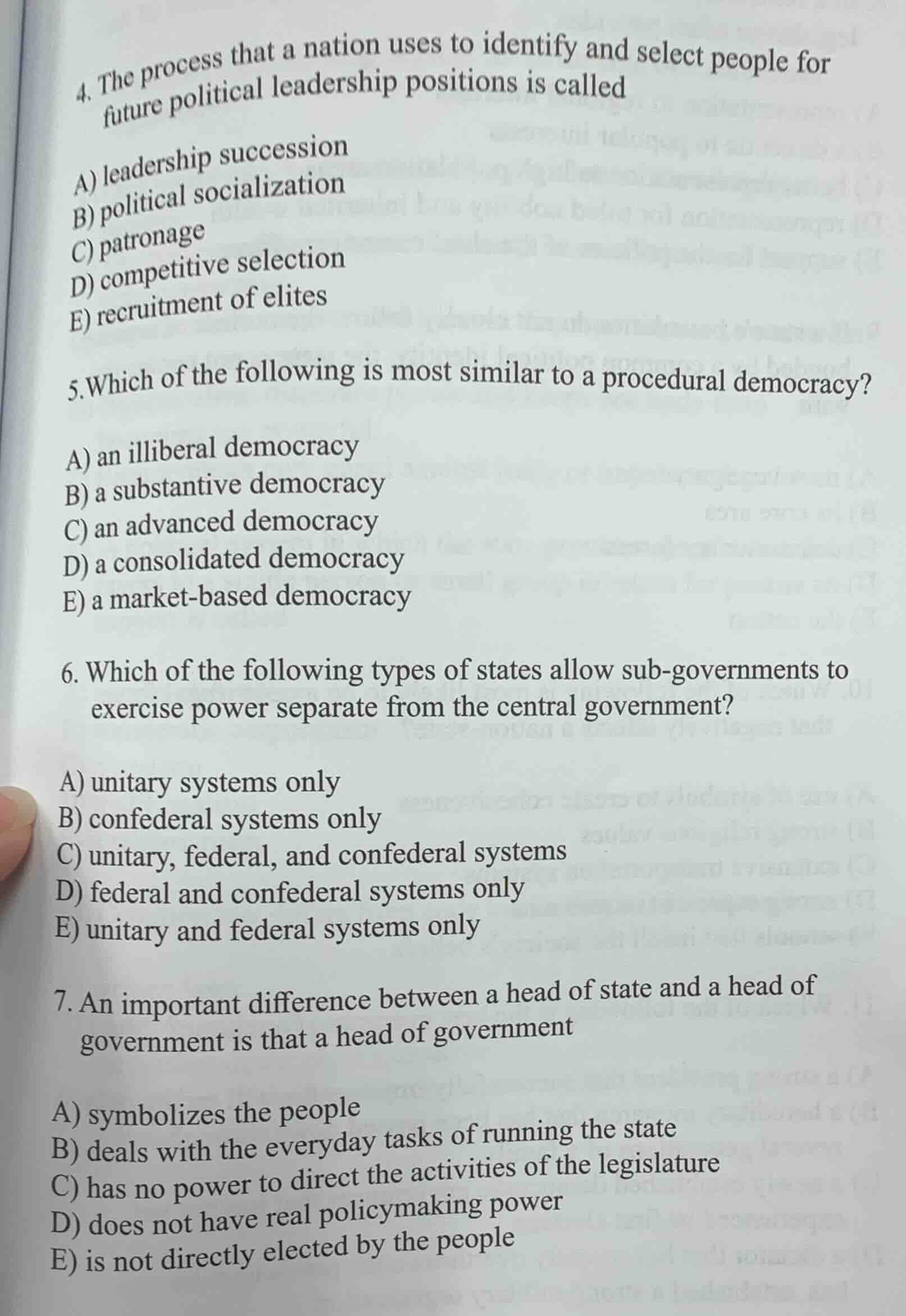
- the process that a nation uses to identify and select people for future political leadership positions is called
a) leadership succession
b) political socialization
c) patronage
d) competitive selection
e) recruitment of elites
- which of the following is most similar to a procedural democracy?
a) an illiberal democracy
b) a substantive democracy
c) an advanced democracy
d) a consolidated democracy
e) a market - based democracy
- which of the following types of states allow sub - governments to exercise power separate from the central government?
a) unitary systems only
b) confederal systems only
c) unitary, federal, and confederal systems
d) federal and confederal systems only
e) unitary and federal systems only
- an important difference between a head of state and a head of government is that a head of government
a) symbolizes the people
b) deals with the everyday tasks of running the state
c) has no power to direct the activities of the legislature
d) does not have real policymaking power
e) is not directly elected by the people
Question 4
To solve this, we analyze each option:
- A) Leadership succession: Focuses on the transfer of leadership (e.g., after a leader’s term ends), not on identifying/selecting future leaders.
- B) Political socialization: Involves how people learn political norms/values, not selection for leadership.
- C) Patronage: Involves giving jobs/privileges to supporters, not systematic selection for future leadership.
- D) Competitive selection: Implies a competitive process, but the term for identifying/selecting future political leaders is “recruitment of elites.”
- E) Recruitment of elites: Defined as a nation’s process to identify and select people for future political leadership positions.
Procedural democracy emphasizes the process of democracy (e.g., elections, rules), while substantive democracy emphasizes outcomes (e.g., rights, equality). However, “illiberal democracy” prioritizes procedural elements (elections) but restricts liberal rights, making it most similar to procedural democracy.
- A) Illiberal democracy: Prioritizes procedural democracy (elections) but limits liberal freedoms, aligning with procedural democracy’s focus on process.
- B) Substantive democracy: Focuses on outcomes (rights, equality), contrasting with procedural.
- C) Advanced democracy: Refers to mature democratic systems, not a type similar to procedural.
- D) Consolidated democracy: Refers to a stable democratic system, not a type similar to procedural.
- E) Market - based democracy: Links democracy to market economics, not related to procedural democracy.
- Unitary systems: Central government holds most power, but sub - governments (e.g., local governments) can have limited independent power (e.g., administrative tasks).
- Federal systems: Sub - governments (states/provinces) share power with the central government, exercising independent power.
- Confederal systems: Sub - governments (member states) have more power than the central government, exercising independent power.
Thus, unitary, federal, and confederal systems all allow sub - governments some independent power.
- A) Unitary systems only: Incorrect, as federal/confederal also do.
- B) Confederal systems only: Incorrect, as unitary/federal also do.
- C) Unitary, federal, and confederal systems: Correct, as all three systems can grant sub - governments independent power (to varying degrees).
- D) Federal and confederal systems only: Incorrect, as unitary systems can too.
- E) Unitary and federal systems only: Incorrect, as confederal systems also do.

Snap & solve any problem in the app
Get step-by-step solutions on Sovi AI
Photo-based solutions with guided steps
Explore more problems and detailed explanations
E) recruitment of elites