QUESTION IMAGE
Question
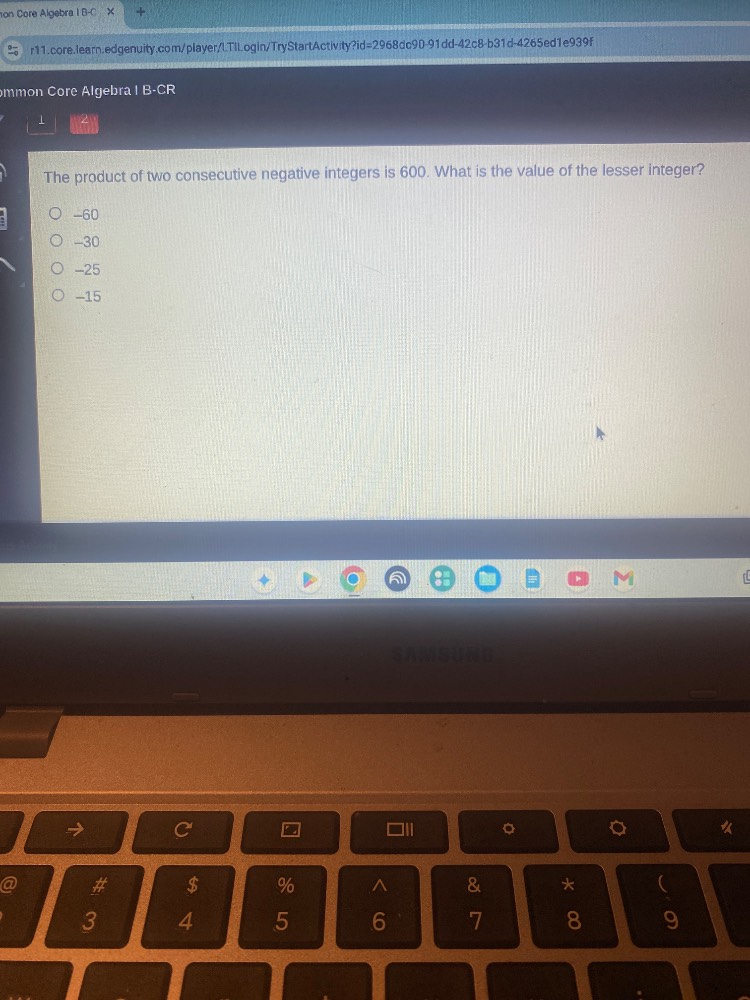
the product of two consecutive negative integers is 600. what is the value of the lesser integer?
-60
-30
-25
-15
Step1: Define the variables
Let the lesser negative integer be \( x \). Then the next consecutive negative integer is \( x + 1 \) (since consecutive integers differ by 1).
Step2: Set up the equation
The product of the two consecutive negative integers is 600, so we have the equation:
\( x(x + 1) = 600 \)
Expanding the left side gives:
\( x^2 + x - 600 = 0 \)
Step3: Solve the quadratic equation
We can solve the quadratic equation \( x^2 + x - 600 = 0 \) by factoring. We need two numbers that multiply to -600 and add up to 1. The numbers are 25 and -24 (since \( 25 \times (-24) = -600 \) and \( 25 + (-24) = 1 \)). Wait, no, actually, let's check again. Wait, we need two numbers that multiply to -600 and add to 1. Wait, maybe factoring isn't the best here. Let's use the quadratic formula. For a quadratic equation \( ax^2 + bx + c = 0 \), the solutions are \( x = \frac{-b \pm \sqrt{b^2 - 4ac}}{2a} \). Here, \( a = 1 \), \( b = 1 \), and \( c = -600 \). So:
\( x = \frac{-1 \pm \sqrt{1^2 - 4(1)(-600)}}{2(1)} \)
\( x = \frac{-1 \pm \sqrt{1 + 2400}}{2} \)
\( x = \frac{-1 \pm \sqrt{2401}}{2} \)
\( \sqrt{2401} = 49 \), so:
\( x = \frac{-1 \pm 49}{2} \)
We have two solutions:
\( x = \frac{-1 + 49}{2} = \frac{48}{2} = 24 \)
\( x = \frac{-1 - 49}{2} = \frac{-50}{2} = -25 \)
But we are looking for negative integers, so we discard \( x = 24 \). So the lesser integer is -25? Wait, no, wait. Wait, let's check. If \( x = -25 \), then the next integer is \( -25 + 1 = -24 \). Then the product is \( (-25)(-24) = 600 \), which is correct. Wait, but let's check the options. The options are -60, -30, -25, -15. So -25 is an option. Wait, but let's check again. Wait, maybe I made a mistake in the sign. Wait, consecutive negative integers: if the lesser one is \( x \), then the next one is \( x - 1 \)? Wait, no. Wait, for example, -5 and -4: -5 is less than -4, so if \( x = -5 \), then the next consecutive integer is \( x + 1 = -4 \). So that part was correct. So \( x = -25 \), next is -24, product is 600. Correct. So the lesser integer is -25.

Snap & solve any problem in the app
Get step-by-step solutions on Sovi AI
Photo-based solutions with guided steps
Explore more problems and detailed explanations
-25 (corresponding to the option: -25)