QUESTION IMAGE
Question
prokaryotic cells
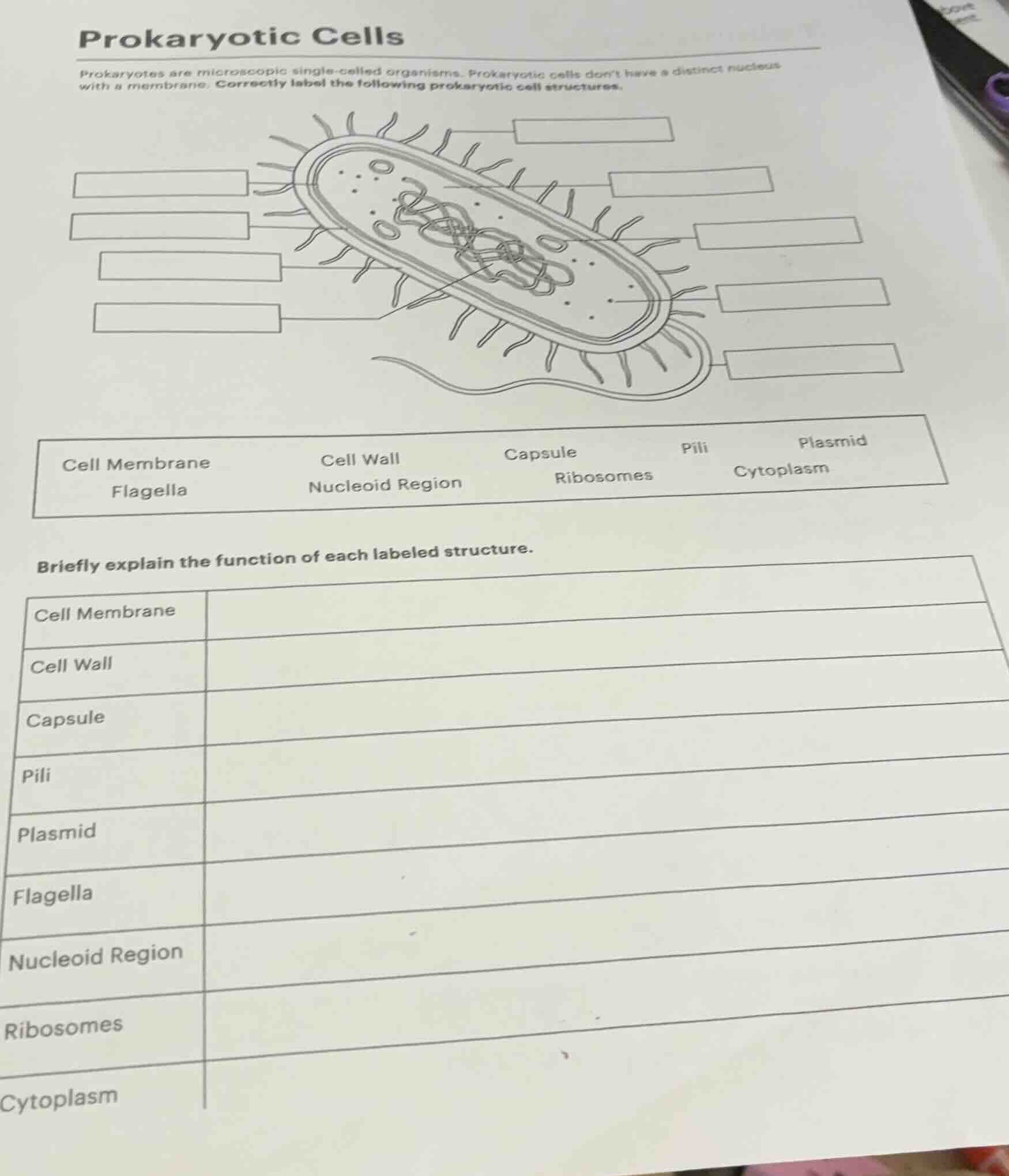
prokaryotes are microscopic single - celled organisms. prokaryotic cells dont have a distinct nucleus with a membrane. correctly label the following prokaryotic cell structures.
diagram of prokaryotic cell with blank labels
cell membrane cell wall capsule pili plasmid
flagella nucleoid region ribosomes cytoplasm
briefly explain the function of each labeled structure.
|cell membrane|
|cell wall|
|capsule|
|pili|
|plasmid|
|flagella|
|nucleoid region|
|ribosomes|
|cytoplasm|
First, the diagram labels are matched to the correct structures, then each structure's core function is explained concisely based on prokaryotic cell biology.

Snap & solve any problem in the app
Get step-by-step solutions on Sovi AI
Photo-based solutions with guided steps
Explore more problems and detailed explanations
Diagram Labeling (from top/outer to inner/bottom):
- Topmost (outer hair-like structures): Pili
- Leftmost (outer layer): Capsule
- Second left (layer under capsule): Cell Wall
- Third left (layer under cell wall): Cell Membrane
- Center coiled structure: Nucleoid Region
- Right top (inner small dots): Ribosomes
- Right middle (inner gel-like area): Cytoplasm
- Right bottom (small circular loops): Plasmid
- Bottom long tail-like structure: Flagella
Structure Functions:
| Structure | Function |
|---|---|
| Cell Wall | Provides structural support, shape, and protection for the cell. |
| Capsule | Acts as a protective layer; aids in adhesion and evading host immune systems. |
| Pili | Facilitate cell-to-cell attachment and genetic material transfer (conjugation). |
| Plasmid | Carries non-essential, extra genetic information; can confer traits like antibiotic resistance. |
| Flagella | Enables locomotion/movement of the prokaryotic cell through its environment. |
| Nucleoid Region | Houses the cell's main circular DNA, which controls cellular functions and heredity. |
| Ribosomes | Synthesizes proteins by translating genetic information. |
| Cytoplasm | Gel-like matrix that suspends cell structures; hosts metabolic reactions. |