QUESTION IMAGE
Question
prompt
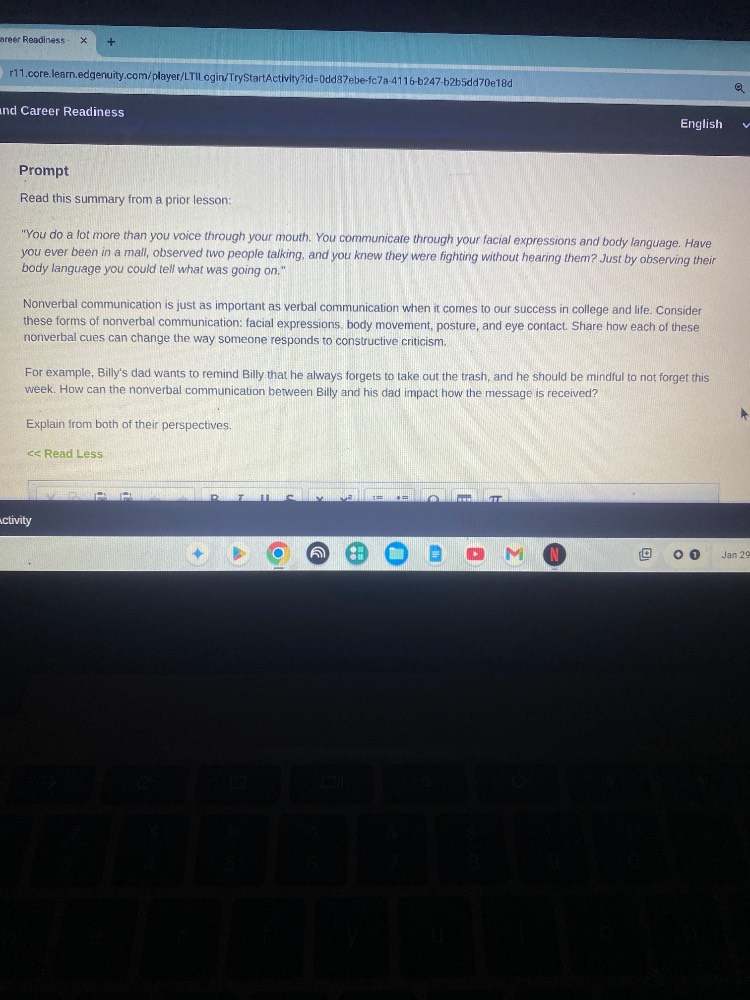
read this summary from a prior lesson:
\you do a lot more than you voice through your mouth. you communicate through your facial expressions and body language. have you ever been in a mall, observed two people talking, and you knew they were fighting without hearing them? just by observing their body language you could tell what was going on.\
nonverbal communication is just as important as verbal communication when it comes to our success in college and life. consider these forms of nonverbal communication: facial expressions, body movement, posture, and eye contact. share how each of these nonverbal cues can change the way someone responds to constructive criticism.
for example, billys dad wants to remind billy that he always forgets to take out the trash, and he should be mindful to not forget this week. how can the nonverbal communication between billy and his dad impact how the message is received?
explain from both of their perspectives.
To solve this, we analyze nonverbal communication (facial expressions, body movement, posture, eye contact) from both Billy's and his dad's perspectives.
Dad's Perspective (Sending the Message):
- Facial Expressions: If Dad has a stern or frustrated expression, Billy may feel scolded, making him defensive. A neutral or slightly concerned expression can show he's reminding out of care, not anger.
- Body Movement/Posture: Leaning forward aggressively might intimidate Billy, while standing relaxed (e.g., hands by sides) conveys a calmer reminder. Slouching could make Dad seem uninterested, but upright posture shows he's serious about the task.
- Eye Contact: Intense, unbroken eye contact can feel confrontational. Brief, gentle eye contact shows he's serious but respectful, helping Billy feel the reminder is constructive.
Billy's Perspective (Receiving the Message):
- Facial Expressions: If Billy rolls his eyes or frowns, Dad may think he's defiant, leading Dad to emphasize the reminder more. A guilty or apologetic expression (e.g., downcast eyes, slight smile of regret) shows Billy acknowledges the mistake, making Dad's tone softer.
- Body Movement/Posture: Crossed arms or turning away makes Billy seem resistant, so Dad might repeat the reminder firmly. Standing with shoulders relaxed and facing Dad shows he's listening, encouraging Dad to be more understanding.
- Eye Contact: Avoiding eye contact makes Billy seem evasive, so Dad may insist. Maintaining gentle eye contact shows Billy is engaged and receptive, prompting Dad to deliver the reminder in a more positive way.
For example, if Dad uses a neutral face, relaxed posture, and gentle eye contact, Billy is more likely to feel the reminder is helpful (not accusatory) and respond with a guilty expression, relaxed posture, and eye contact—leading to a constructive exchange. If Dad is stern (frown, forward lean, intense eye contact), Billy may react with defensiveness (frown, crossed arms, avoiding eye contact), escalating tension.

Snap & solve any problem in the app
Get step-by-step solutions on Sovi AI
Photo-based solutions with guided steps
Explore more problems and detailed explanations
Dad's Perspective (Sending the Message):
- Facial Expressions: A stern/frustrated face makes Billy defensive; a neutral/concerned face feels caring.
- Body Movement/Posture: Aggressive leaning intimidates; relaxed posture (hands by sides) calms. Upright posture shows seriousness.
- Eye Contact: Intense contact feels confrontational; brief, gentle contact is respectful.
Billy's Perspective (Receiving the Message):
- Facial Expressions: Defiant expressions (eye - roll, frown) make Dad firm; guilty/apologetic (downcast eyes, regretful smile) softens Dad’s tone.
- Body Movement/Posture: Resistant postures (crossed arms, turning away) prompt Dad to repeat; relaxed, facing posture encourages understanding.
- Eye Contact: Avoidance seems evasive (Dad insists); gentle contact shows engagement (Dad is positive).
In short, Dad’s calm, respectful nonverbal cues (neutral face, relaxed posture, gentle eye contact) and Billy’s receptive cues (guilty expression, relaxed posture, eye contact) create a constructive exchange. Hostile cues from either escalate tension.