QUESTION IMAGE
Question
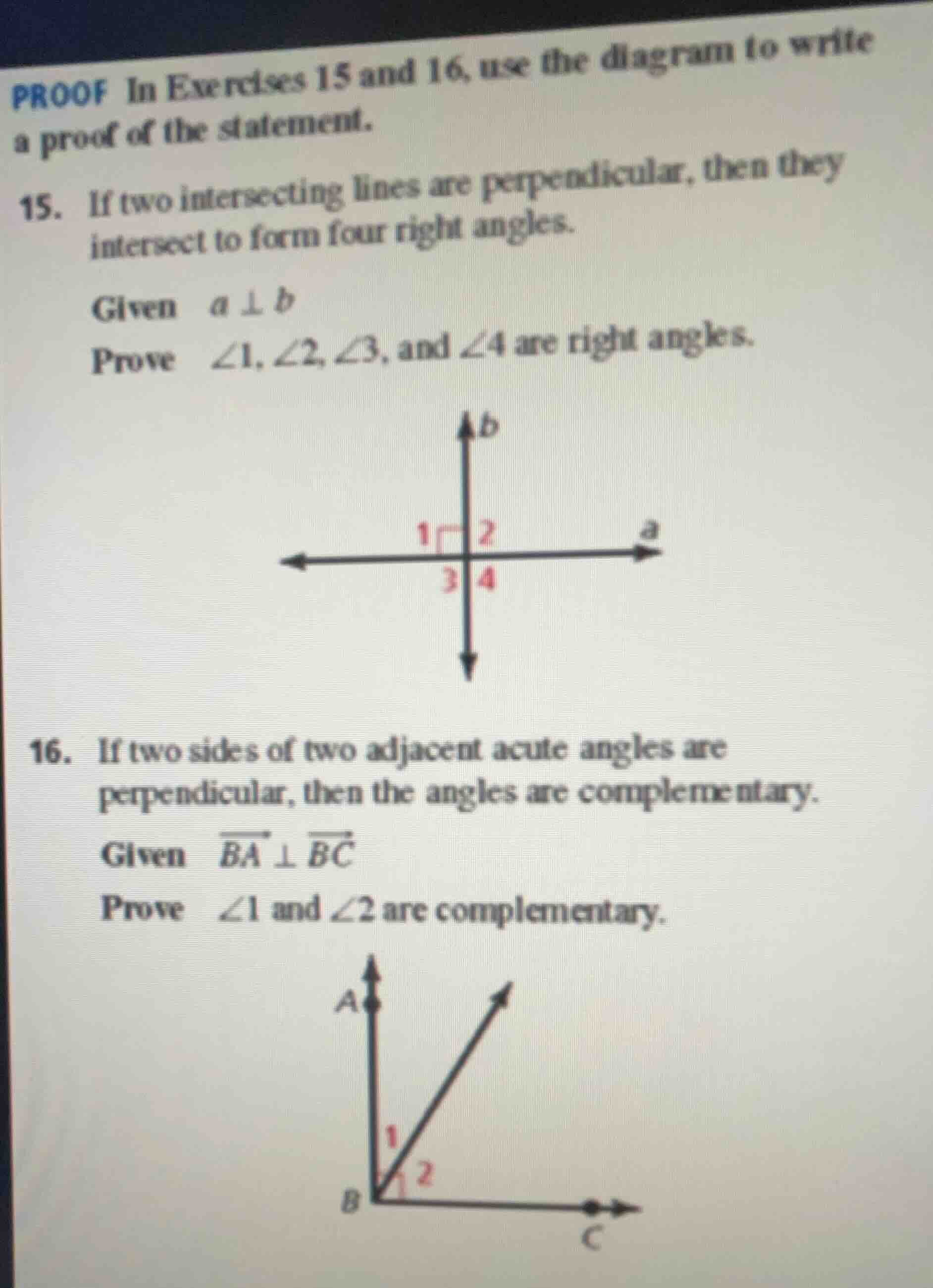
proof in exercises 15 and 16, use the diagram to write a proof of the statement. 15. if two intersecting lines are perpendicular, then they intersect to form four right angles. given ( a perp b ) prove ( angle 1, angle 2, angle 3, ) and ( angle 4 ) are right angles. diagram of two perpendicular lines ( a ) (horizontal) and ( b ) (vertical) intersecting, forming angles ( angle 1, angle 2, angle 3, angle 4 ) with ( angle 1 ) marked as a right angle 16. if two sides of two adjacent acute angles are perpendicular, then the angles are complementary. given ( overrightarrow{ba} perp overrightarrow{bc} ) prove ( angle 1 ) and ( angle 2 ) are complementary. diagram with point ( b ), vertical ray ( overrightarrow{ba} ) (upward), horizontal ray ( overrightarrow{bc} ) (rightward), and a ray from ( b ) between them forming ( angle 1 ) (between ( overrightarrow{ba} ) and the middle ray) and ( angle 2 ) (between the middle ray and ( overrightarrow{bc} ))
Exercise 15 Proof:
Step 1: Recall Perpendicular Definition
By definition, if \( a \perp b \), then the angle between them (e.g., \( \angle 1 \)) is \( 90^\circ \) (a right angle). So \( m\angle 1 = 90^\circ \).
Step 2: Use Linear Pair Postulate
\( \angle 1 \) and \( \angle 2 \) form a linear pair, so \( m\angle 1 + m\angle 2 = 180^\circ \). Substituting \( m\angle 1 = 90^\circ \), we get \( 90^\circ + m\angle 2 = 180^\circ \), so \( m\angle 2 = 90^\circ \).
Step 3: Use Vertical Angles Theorem
\( \angle 1 \) and \( \angle 3 \) are vertical angles, so \( m\angle 3 = m\angle 1 = 90^\circ \). Similarly, \( \angle 2 \) and \( \angle 4 \) are vertical angles, so \( m\angle 4 = m\angle 2 = 90^\circ \).
Step 1: Recall Perpendicular Definition
Given \( \overrightarrow{BA} \perp \overrightarrow{BC} \), \( \angle ABC = 90^\circ \) (by definition of perpendicular lines forming a right angle).
Step 2: Angle Addition Postulate
\( \angle ABC = \angle 1 + \angle 2 \) (angle addition postulate, as \( \angle 1 \) and \( \angle 2 \) are adjacent and form \( \angle ABC \)).
Step 3: Substitute and Solve
Substitute \( \angle ABC = 90^\circ \) into \( \angle 1 + \angle 2 = \angle ABC \), so \( \angle 1 + \angle 2 = 90^\circ \). By definition of complementary angles (sum to \( 90^\circ \)), \( \angle 1 \) and \( \angle 2 \) are complementary.

Snap & solve any problem in the app
Get step-by-step solutions on Sovi AI
Photo-based solutions with guided steps
Explore more problems and detailed explanations
\( \angle 1, \angle 2, \angle 3, \angle 4 \) are right angles (proven using perpendicular definition, linear pair postulate, and vertical angles theorem).