QUESTION IMAGE
Question
proteins are coded for by a group of genes on chromosome 6 and genetically specific and unique to each individual. all lymphocytes have antigen receptors that recognize our own \self\ mhc antigens and are able to tell them apart from any
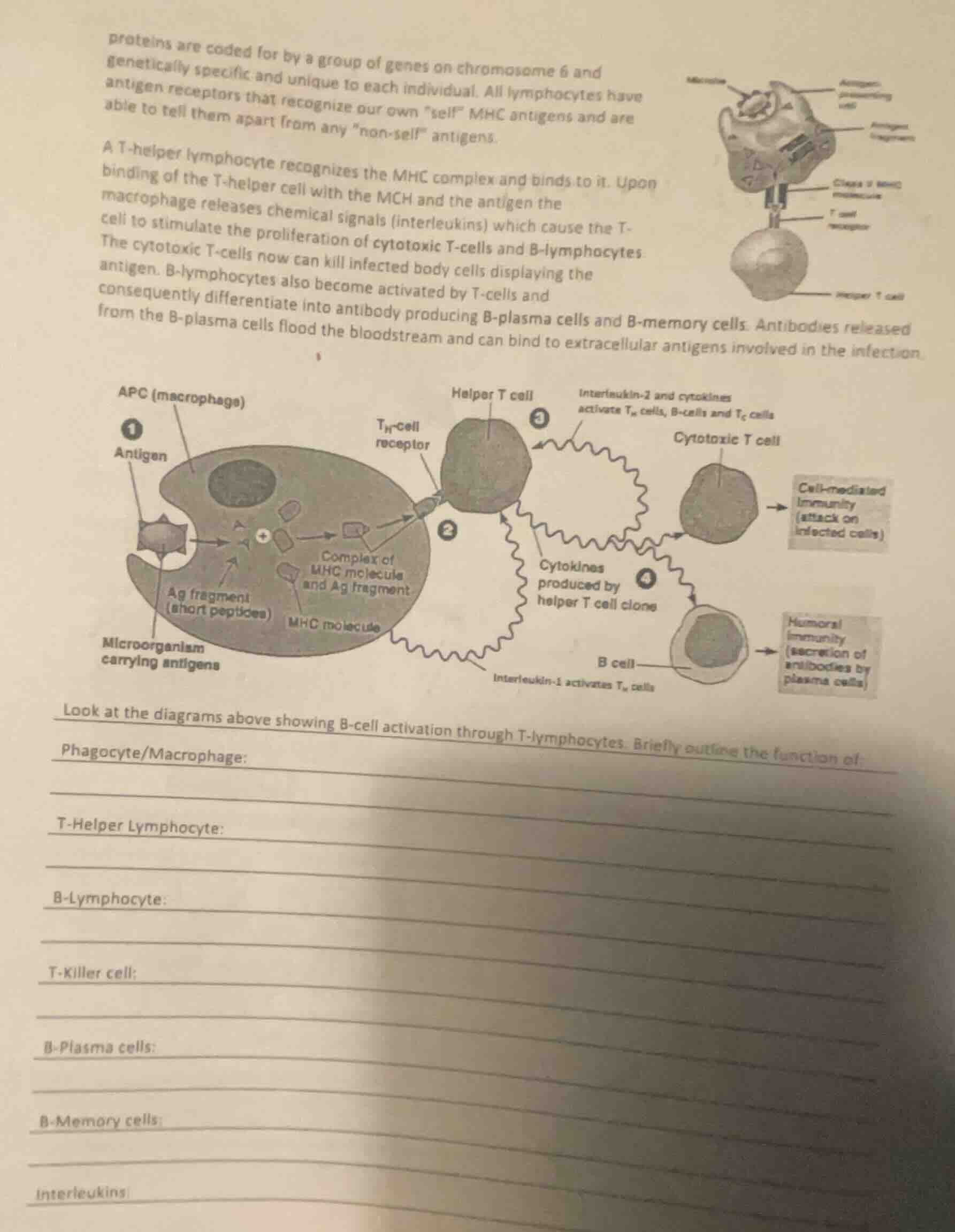
on-self\ antigens.a t-helper lymphocyte recognizes the mhc complex and binds to it. upon binding of the t-helper cell with the mch and the antigen the macrophage releases chemical signals (interleukins) which cause the t-cell to stimulate the proliferation of cytotoxic t-cells and b-lymphocytesthe cytotoxic t-cells now can kill infected body cells displaying the antigen. b-lymphocytes also become activated by t-cells and consequently differentiate into antibody producing b-plasma cells and b-memory cells. antibodies released from the b-plasma cells flood the bloodstream and can bind to extracellular antigens involved in the infection.apc (macrophage)helper t cellinterleukin-2 and cytokinesactivate tₖ cells, b-cells and tc cellstₕ-cellreceptorcytotoxic t cell①②cell-mediatedimmunity(attack oninfected cells)antigencomplex ofmhc moleculeand ag fragmentcytokinesproduced byhelper t cell clone④ag fragment(short peptides)mhc moleculehumoralimmunity(secretion ofantibodies byplasma cells)microorganismcarrying antigeninterleukin-1 activates tₕ cellsb celllook at the diagrams above showing b-cell activation through t-lymphocytes. briefly outline the function of:phagocyte/macrophage:t-helper lymphocyte:b-lymphocyte:t-killer cell:b-plasma cells:b-memory cells:interleukins
- Phagocyte/Macrophage: Engulfs pathogens, breaks them into antigen fragments, presents these fragments bound to MHC molecules on its surface, and releases chemical signals to activate other immune cells.
- T-Helper Lymphocyte: Recognizes the MHC-antigen complex on macrophages, then releases cytokines/interleukins to stimulate proliferation and activation of cytotoxic T-cells and B-lymphocytes.
- B-Lymphocyte: Gets activated by T-helper cells, then differentiates into antibody-producing plasma cells and long-lived memory cells.
- T-Killer cell (Cytotoxic T-cell): Kills infected body cells that display the target antigen on their surface, mediating cell-mediated immunity.
- B-Plasma cells: Secrete large amounts of specific antibodies that bind to extracellular antigens to neutralize or mark them for destruction.
- B-Memory cells: Remain in the body long-term; quickly activate and differentiate into plasma cells if the same antigen is encountered again, enabling a faster secondary immune response.
- Interleukins: Chemical signaling molecules released by macrophages and T-helper cells that trigger activation, proliferation, and coordination of other immune cells (T-cells, B-cells).

Snap & solve any problem in the app
Get step-by-step solutions on Sovi AI
Photo-based solutions with guided steps
Explore more problems and detailed explanations
- Phagocyte/Macrophage: Engulfs pathogens, processes antigens, presents MHC-antigen complexes, and secretes activating signals.
- T-Helper Lymphocyte: Recognizes MHC-antigen complexes, secretes signals to activate cytotoxic T-cells and B-lymphocytes.
- B-Lymphocyte: Activated by T-helper cells, differentiates into plasma and memory cells.
- T-Killer cell: Kills infected body cells displaying the target antigen.
- B-Plasma cells: Secretes specific antibodies to target extracellular antigens.
- B-Memory cells: Provides rapid, secondary immune response to repeat antigen exposure.
- Interleukins: Acts as chemical signals to coordinate and activate immune cell proliferation/function.