QUESTION IMAGE
Question
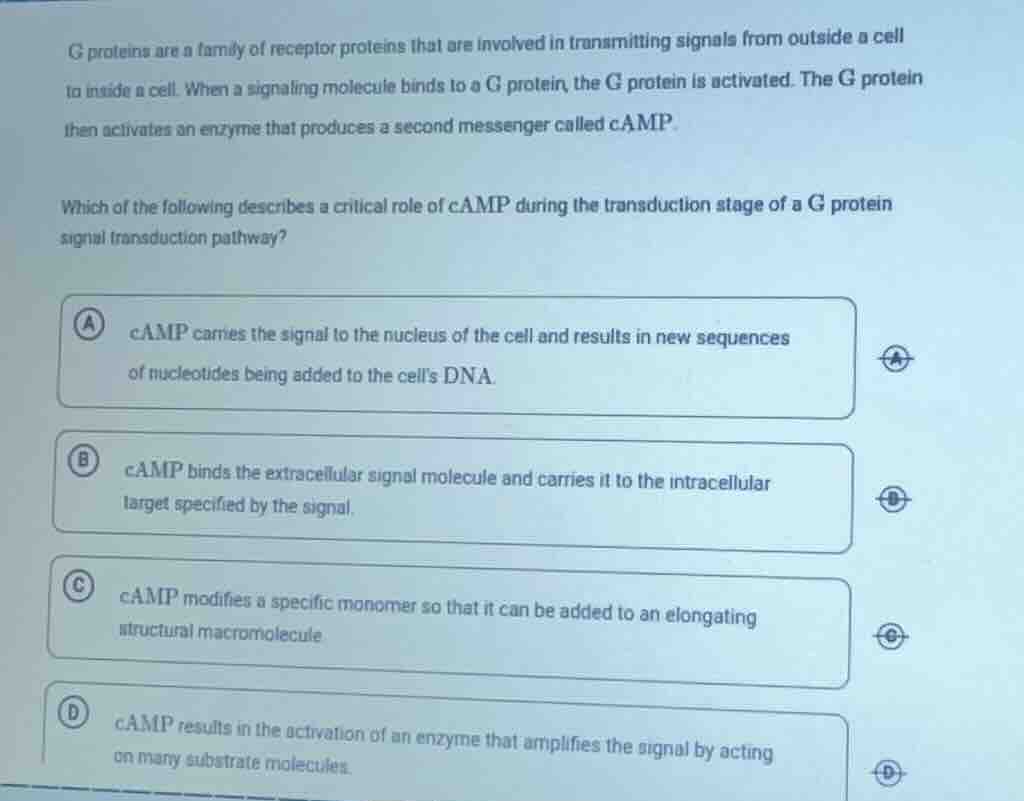
g proteins are a family of receptor proteins that are involved in transmitting signals from outside a cell to inside a cell. when a signaling molecule binds to a g protein, the g protein is activated. the g protein then activates an enzyme that produces a second messenger called camp. which of the following describes a critical role of camp during the transduction stage of a g protein signal transduction pathway? a camp carries the signal to the nucleus of the cell and results in new sequences of nucleotides being added to the cells dna. b camp binds the extracellular signal molecule and carries it to the intracellular target specified by the signal. c camp modifies a specific monomer so that it can be added to an elongating structural macromolecule d camp results in the activation of an enzyme that amplifies the signal by acting on many substrate molecules.
cAMP is a second messenger in G protein pathways. Its key role is signal amplification: it activates enzymes like protein kinase A, which can act on many substrate molecules to amplify the initial signal. Option A is incorrect because cAMP does not modify DNA nucleotide sequences. Option B is wrong because cAMP does not bind extracellular signaling molecules (those bind G protein receptors). Option C is incorrect as cAMP does not modify monomers for structural macromolecule synthesis.

Snap & solve any problem in the app
Get step-by-step solutions on Sovi AI
Photo-based solutions with guided steps
Explore more problems and detailed explanations
D. cAMP results in the activation of an enzyme that amplifies the signal by acting on many substrate molecules.