QUESTION IMAGE
Question
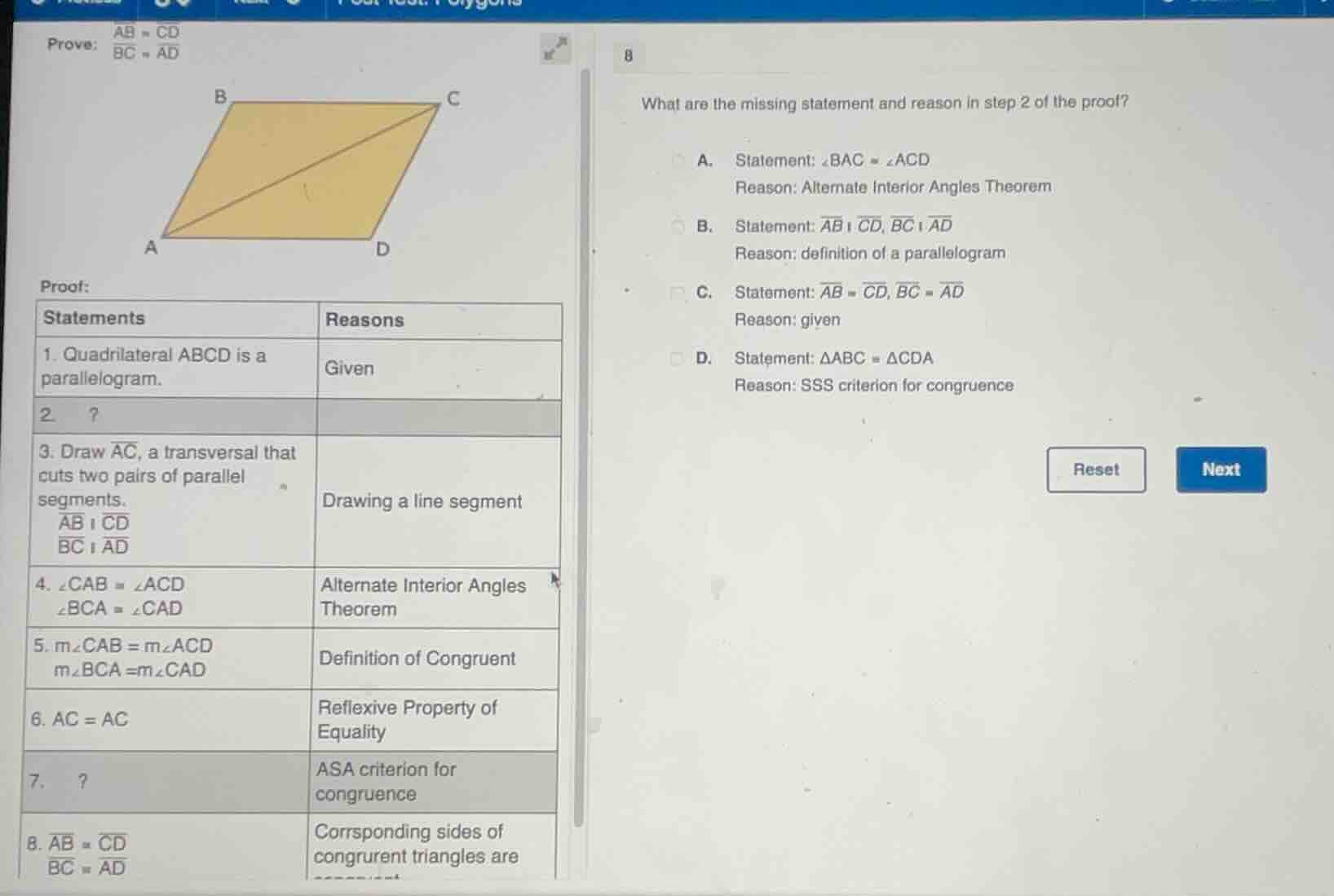
prove:
\
\
proof:
| statements | reasons |
|---|---|
| 2. ? | ? |
| 3. draw (overline{ac}), a transversal that cuts two pairs of parallel segments. (overline{ab} \parallel overline{cd}) (overline{bc} \parallel overline{ad}) | drawing a line segment |
| 4. (angle cab \cong angle acd) (angle bca \cong angle cad) | alternate interior angles theorem |
| 5. (mangle cab = mangle acd) (mangle bca = mangle cad) | definition of congruent |
| 6. (ac = ac) | reflexive property of equality |
| 7. ? | asa criterion for congruence |
| 8. (overline{ab} \cong overline{cd}) (overline{bc} \cong overline{ad}) | corresponding sides of congruent triangles are congruent |
- what are the missing statement and reason in step 2 of the proof?
a. statement: (angle bac \cong angle acd)
reason: alternate interior angles theorem
b. statement: (overline{ab} \parallel overline{cd}), (overline{bc} \parallel overline{ad})
reason: definition of a parallelogram
c. statement: (overline{ab} \cong overline{cd}), (overline{bc} \cong overline{ad})
reason: given
d. statement: (\triangle abc \cong \triangle cda)
reason: sss criterion for congruence
To fill step 2 of the proof for the paralleram, we use the definition of a parallelogram, which states that opposite sides are parallel. This sets up the necessary context for using the alternate interior angles theorem in subsequent steps, and it is a direct consequence of the given information that ABCD is a parallelogram.

Snap & solve any problem in the app
Get step-by-step solutions on Sovi AI
Photo-based solutions with guided steps
Explore more problems and detailed explanations
B. Statement: $\overline{AB} \parallel \overline{CD}$, $\overline{BC} \parallel \overline{AD}$
Reason: definition of a parallelogram