QUESTION IMAGE
Question
proving congruence (triangle congruence: asa, aas, and hl)\
homework\
\
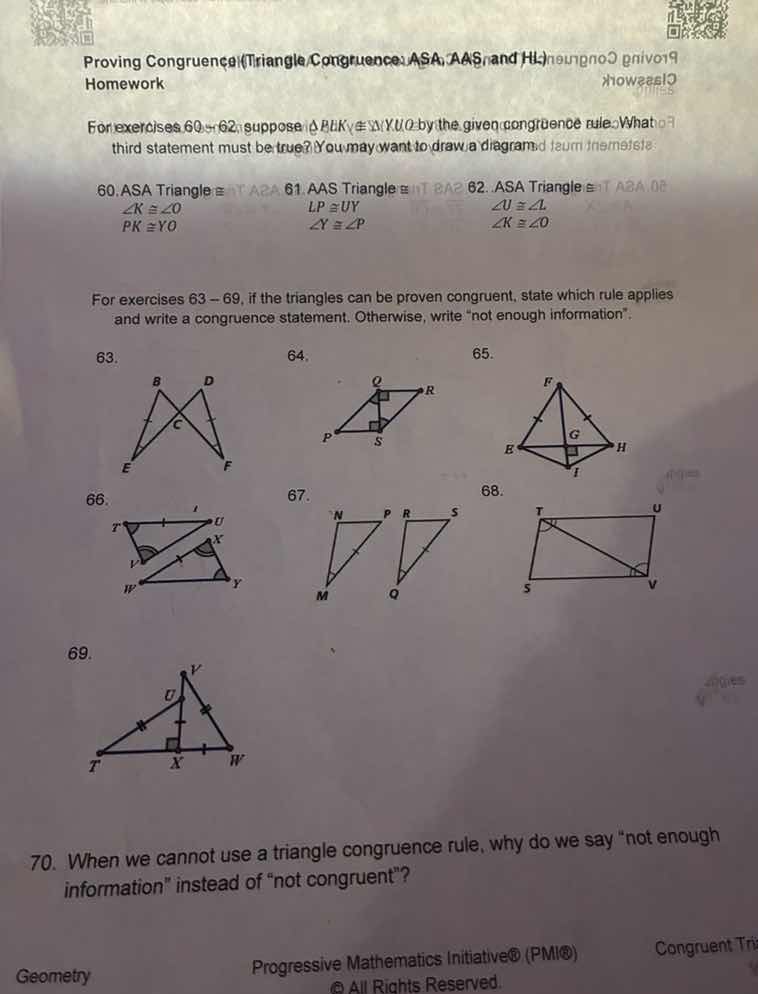
for exercises 60 – 62, suppose $\triangle b k y \cong \triangle y u o$ by the given congruence rule. what third statement must be true? you may want to draw a diagram.\
\
- asa triangle\
$\angle k \cong \angle o$\
$pk \cong yo$\
- aas triangle\
$lp \cong uy$\
$\angle y \cong \angle p$\
- asa triangle\
$\angle u \cong \angle a$\
$\angle k \cong \angle o$\
\
for exercises 63 – 69, if the triangles can be proven congruent, state which rule applies and write a congruence statement. otherwise, write
ot enough information\.\
\
- triangle diagram with points b, d, e, f, c\
- quadrilateral diagram with right angles at q, s, points p, q, r, s\
- triangle diagram with points f, e, h, i, g\
- triangle diagram with points t, i, u, v, w, y, angles at t, k\
- two triangle diagrams with points n, m, p and r, q, s\
- quadrilateral diagram with points t, u, v, s, diagonal tv\
- triangle diagram with points v, u, t, w, x, right angle at x\
\
- when we cannot use a triangle congruence rule, why do we say
ot enough information\ instead of
ot congruent\?\
\
geometry\
progressive mathematics initiative\\u00ae (pmi\\u00ae)\
congruent tri...\
\\u00a9 all rights reserved.
Step 1: Solve 60 (ASA Congruence)
ASA requires 2 angles + included side. Given $\angle K \cong \angle O$, $PK \cong YO$, the included side for $\angle K$ is $PK$, for $\angle O$ is $YO$. Missing: $\angle P \cong \angle Y$
Step 2: Solve 61 (AAS Congruence)
AAS requires 2 angles + non-included side. Given $LP \cong UY$, $\angle Y \cong \angle P$, missing: $\angle L \cong \angle U$
Step 3: Solve 62 (ASA Congruence)
ASA requires 2 angles + included side. Given $\angle U \cong \angle L$, $\angle K \cong \angle O$, included side between $\angle U$ and $\angle K$ is $UK$, between $\angle L$ and $\angle O$ is $LO$. Missing: $UK \cong LO$
Step 4: Solve 63 (Triangle Congruence)
Vertical angles $\angle BCE \cong \angle DCF$, $BC \cong DC$, $EC \cong FC$. SAS applies: $\triangle BCE \cong \triangle DCF$
Step 5: Solve 64 (Triangle Congruence)
Right angles $\angle Q \cong \angle S$, $QR \cong SR$, $PQ \cong TS$. HL applies: $\triangle PQR \cong \triangle TSR$
Step 6: Solve 65 (Triangle Congruence)
$EG \cong HG$, $\angle EGF \cong \angle HGF$ (right angles), $FG \cong FG$. SAS applies: $\triangle EFG \cong \triangle HFG$
Step 7: Solve 66 (Triangle Congruence)
$\angle TVW \cong \angle XYW$, $TW \cong XY$, $\angle W \cong \angle W$. AAS applies: $\triangle TVW \cong \triangle XYW$
Step 8: Solve 67 (Triangle Congruence)
Only one pair of sides marked congruent. No angle info. Not enough information
Step 9: Solve 68 (Triangle Congruence)
Right angles $\angle T \cong \angle V$, $TV \cong TV$, $\angle TUV \cong \angle VST$? No, only one side and one angle. Not enough information
Step 10: Solve 69 (Triangle Congruence)
$TU \cong XW$, $\angle TXU \cong \angle WXV$ (right angles), $TX \cong WX$. SAS applies: $\triangle TXU \cong \triangle WXV$
Step 11: Solve 70 (Concept Question)
"Not congruent" claims certainty the triangles do not match, but "not enough information" means we lack proof to confirm or deny congruence—they could still be congruent, we just can't prove it with given data.

Snap & solve any problem in the app
Get step-by-step solutions on Sovi AI
Photo-based solutions with guided steps
Explore more problems and detailed explanations
- $\boldsymbol{\angle P \cong \angle Y}$
- $\boldsymbol{\angle L \cong \angle U}$
- $\boldsymbol{UK \cong LO}$
- SAS; $\boldsymbol{\triangle BCE \cong \triangle DCF}$
- HL; $\boldsymbol{\triangle PQR \cong \triangle TSR}$
- SAS; $\boldsymbol{\triangle EFG \cong \triangle HFG}$
- AAS; $\boldsymbol{\triangle TVW \cong \triangle XYW}$
- not enough information
- not enough information
- SAS; $\boldsymbol{\triangle TXU \cong \triangle WXV}$
- We say "not enough information" because we cannot definitively confirm the triangles are not congruent—we only lack the necessary evidence to prove they are congruent, so we cannot state they are definitely non-congruent.