QUESTION IMAGE
Question
proving the congruent supplements theorem
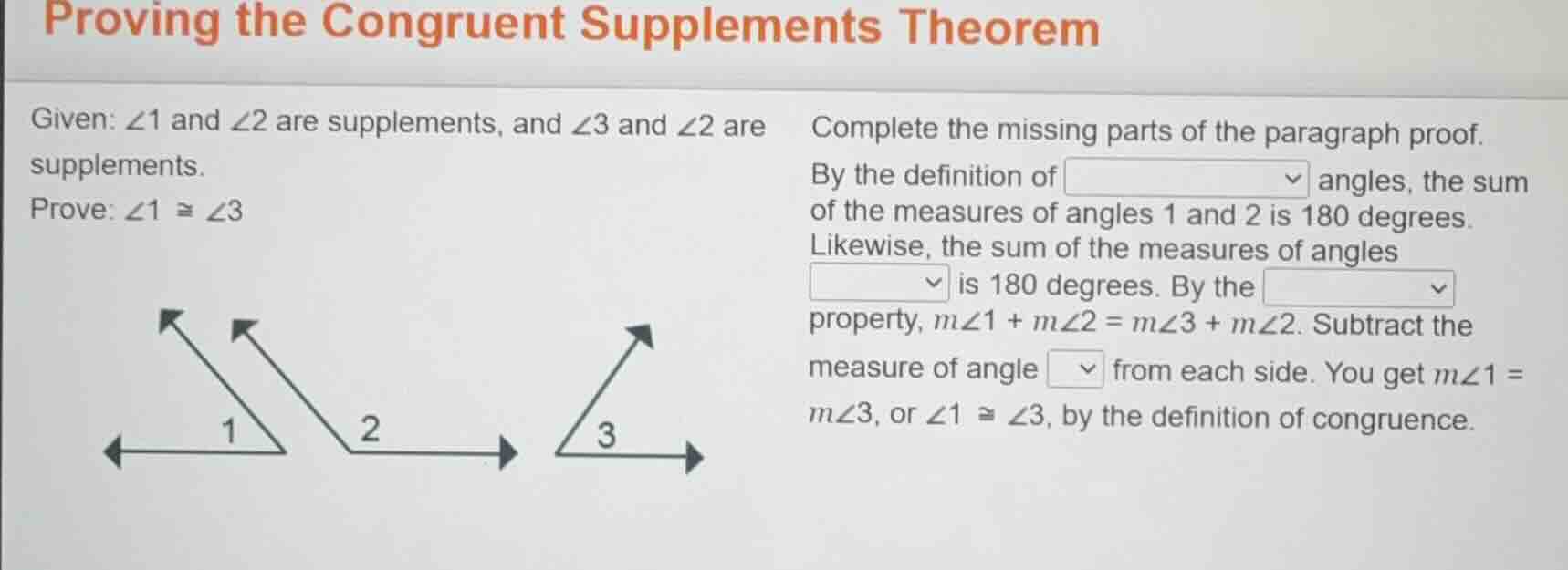
given: $angle 1$ and $angle 2$ are supplements, and $angle 3$ and $angle 2$ are supplements.
prove: $angle 1 cong angle 3$
complete the missing parts of the paragraph proof.
by the definition of $\boldsymbol{square}$ angles, the sum of the measures of angles 1 and 2 is 180 degrees.
likewise, the sum of the measures of angles $\boldsymbol{square}$ is 180 degrees. by the $\boldsymbol{square}$ property, $mangle 1 + mangle 2 = mangle 3 + mangle 2$. subtract the measure of angle $\boldsymbol{square}$ from each side. you get $mangle 1 = mangle 3$, or $angle 1 cong angle 3$, by the definition of congruence.
- The first blank refers to the type of angles given (supplementary), so we use the definition of supplementary angles.
- The second blank follows the same logic as the first pair: since ∠3 and ∠2 are supplements, we reference angles 3 and 2.
- The third blank uses the transitive property of equality, as two quantities equal to 180° are equal to each other.
- The fourth blank subtracts the common angle (∠2) from both sides to isolate the measures of ∠1 and ∠3.

Snap & solve any problem in the app
Get step-by-step solutions on Sovi AI
Photo-based solutions with guided steps
Explore more problems and detailed explanations
- First blank: supplementary
- Second blank: 3 and 2
- Third blank: transitive (equality)
- Fourth blank: 2
Full completed proof:
By the definition of supplementary angles, the sum of the measures of angles 1 and 2 is 180 degrees.
Likewise, the sum of the measures of angles 3 and 2 is 180 degrees. By the transitive (equality) property, $m\angle1 + m\angle2 = m\angle3 + m\angle2$. Subtract the measure of angle 2 from each side. You get $m\angle1 = m\angle3$, or $\angle1 \cong \angle3$, by the definition of congruence.