QUESTION IMAGE
Question
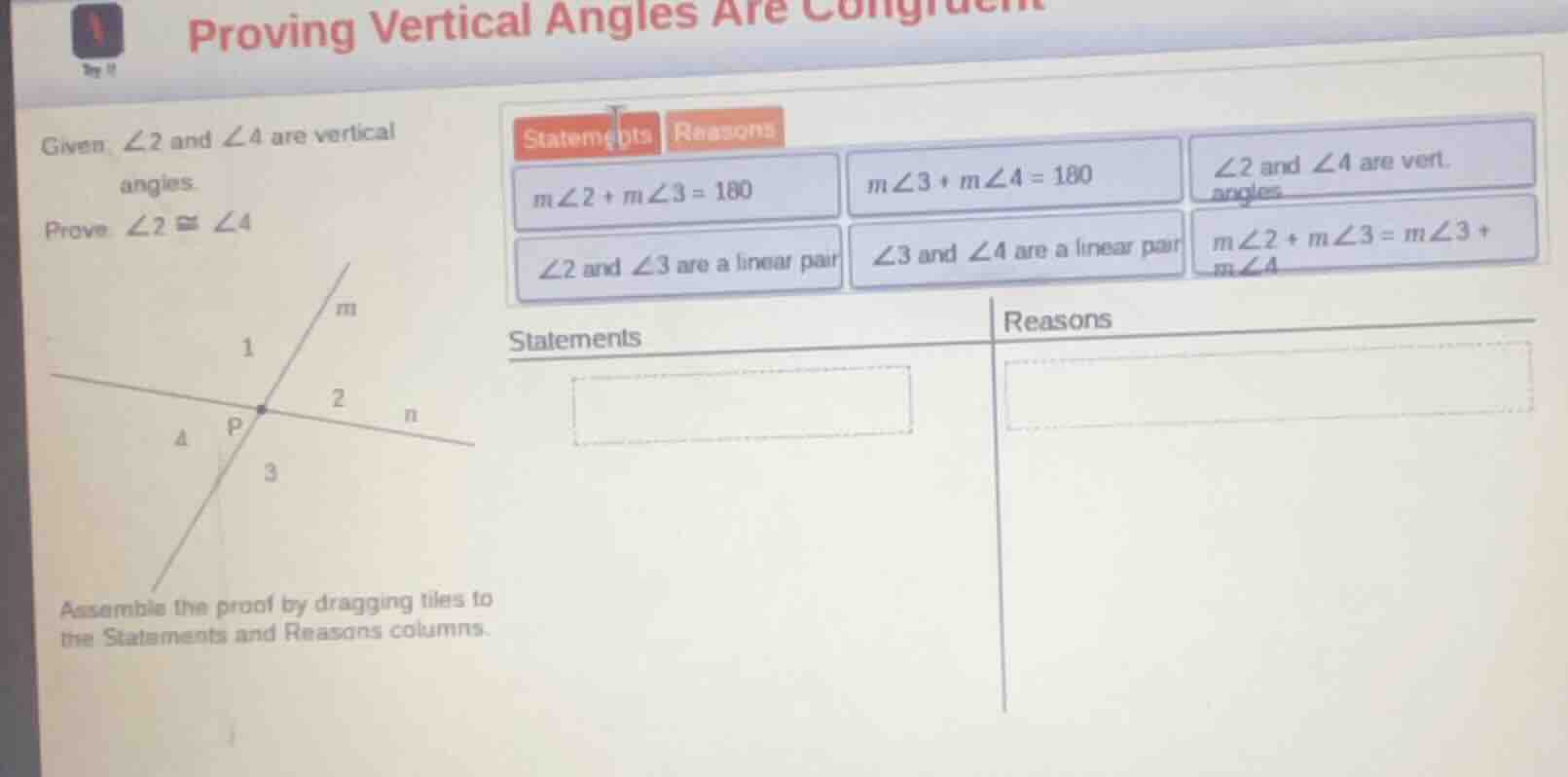
proving vertical angles are congruent
given, ∠2 and ∠4 are vertical angles.
prove: ∠2 ≅ ∠4
assemble the proof by dragging tiles to the statements and reasons columns.
statements (tiles):
m∠2 + m∠3 = 180
m∠3 + m∠4 = 180
∠2 and ∠4 are vert. angles
∠2 and ∠3 are a linear pair
∠3 and ∠4 are a linear pair
m∠2 + m∠3 = m∠3 + m∠4
Step1: Recall Linear Pair Postulate
A linear pair of angles is supplementary, so if two angles form a linear pair, their measures sum to \(180^\circ\). For \(\angle 2\) and \(\angle 3\), since they are a linear pair, \(m\angle 2 + m\angle 3 = 180\) (Linear Pair Postulate). Similarly, \(\angle 3\) and \(\angle 4\) are a linear pair, so \(m\angle 3 + m\angle 4 = 180\) (Linear Pair Postulate).
Step2: Use Substitution Property
From the two equations \(m\angle 2 + m\angle 3 = 180\) and \(m\angle 3 + m\angle 4 = 180\), we can substitute the right - hand sides. So \(m\angle 2 + m\angle 3=m\angle 3 + m\angle 4\) (Substitution, since both equal \(180\)).
Step3: Subtract \(m\angle 3\) from both sides
Using the Subtraction Property of Equality, if we subtract \(m\angle 3\) from both sides of the equation \(m\angle 2 + m\angle 3=m\angle 3 + m\angle 4\), we get \(m\angle 2=m\angle 4\).
Step4: Recall Definition of Congruent Angles
If two angles have equal measures, then they are congruent. Since \(m\angle 2 = m\angle 4\), by the Definition of Congruent Angles, \(\angle 2\cong\angle 4\).
Now, to assemble the proof in the table:
Statements Column (in order):
- \(\angle 2\) and \(\angle 3\) are a linear pair; \(\angle 3\) and \(\angle 4\) are a linear pair
- \(m\angle 2 + m\angle 3 = 180\); \(m\angle 3 + m\angle 4 = 180\)
- \(m\angle 2 + m\angle 3=m\angle 3 + m\angle 4\)
- \(m\angle 2 = m\angle 4\)
- \(\angle 2\cong\angle 4\)
Reasons Column (in order):
- Given (for the linear pair relationships, as per the problem's context of vertical angles and the diagram)
- Linear Pair Postulate (for each linear pair summing to \(180^\circ\))
- Substitution Property (substituting the equal sums)
- Subtraction Property of Equality (subtracting \(m\angle 3\) from both sides)
- Definition of Congruent Angles (if \(m\angle A=m\angle B\), then \(\angle A\cong\angle B\))

Snap & solve any problem in the app
Get step-by-step solutions on Sovi AI
Photo-based solutions with guided steps
Explore more problems and detailed explanations
To prove \(\angle 2\cong\angle 4\) (where \(\angle 2\) and \(\angle 4\) are vertical angles), we use the following proof structure:
| Statements | Reasons |
|---|---|
| 2. \(m\angle 2 + m\angle 3 = 180\); \(m\angle 3 + m\angle 4 = 180\) | 2. Linear Pair Postulate (linear pairs are supplementary) |
| 3. \(m\angle 2 + m\angle 3=m\angle 3 + m\angle 4\) | 3. Substitution Property (both sums equal \(180\)) |
| 4. \(m\angle 2 = m\angle 4\) | 4. Subtraction Property of Equality (subtract \(m\angle 3\) from both sides) |
| 5. \(\angle 2\cong\angle 4\) | 5. Definition of Congruent Angles (equal - measure angles are congruent) |
The key idea is to use the properties of linear pairs (supplementary angles) and then algebraic properties (substitution, subtraction) to show the vertical angles have equal measures, hence are congruent.