QUESTION IMAGE
Question
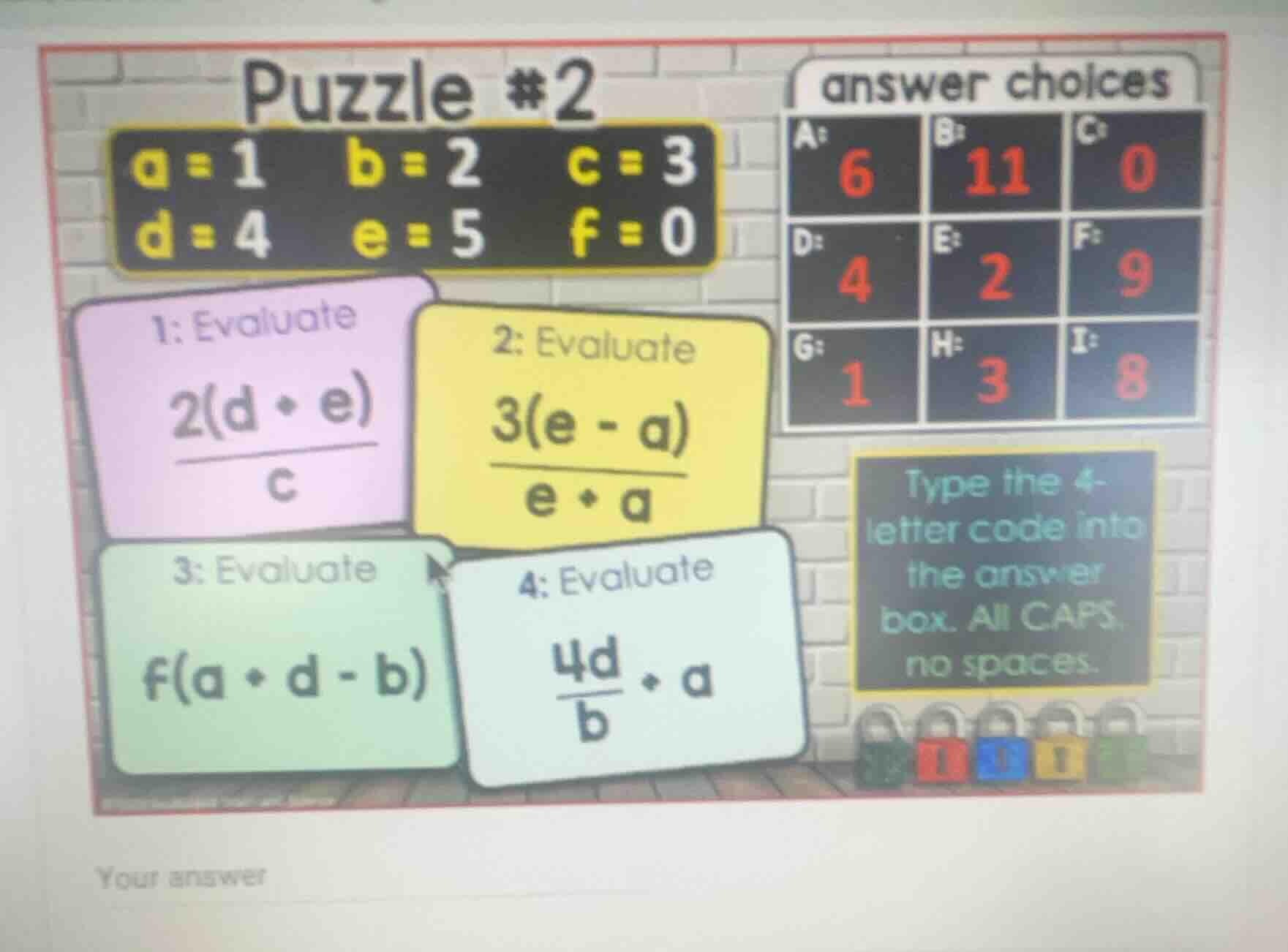
puzzle #2
a = 1 b = 2 c = 3
d = 4 e = 5 f = 0
1: evaluate
\\(\frac{2(d + e)}{c}\\)
2: evaluate
\\(\frac{3(e - a)}{e + a}\\)
3: evaluate
\\(f(a + d - b)\\)
4: evaluate
\\(\frac{4d}{b} + a\\)
answer choices
a: 6 b: 11 c: 0
d: 4 e: 2 f: 9
g: 1 h: 3 i: 8
type the 4 - letter code into the answer box. all caps, no spaces.
your answer
Sub - Question 1: Evaluate \(2(d\cdot e)\div c\)
Step 1: Substitute values
Given \(d = 4\), \(e = 5\), \(c = 3\). Substitute into the expression: \(2(4\times5)\div3\)
Step 2: Calculate inside the parentheses
First, calculate \(4\times5=20\), so the expression becomes \(2\times20\div3=\frac{40}{3}\)? Wait, no, maybe I misread the operation. Wait, the original expression is \(2(d\cdot e)\) over \(c\), maybe it's \(2\times(d\times e)\div c\). Wait, \(d = 4\), \(e = 5\), so \(d\times e=20\), \(2\times20 = 40\), \(40\div3\) is not in the options. Wait, maybe the operation is \(2\times(d + e)\)? Let's check the options. If it's \(d + e=4 + 5 = 9\), \(2\times9 = 18\), no. Wait, maybe the dot is a plus? Let's re - check the problem. The first expression is \(2(d\cdot e)\) over \(c\). Wait, the answer choices have 6, 11, 0, etc. Wait, maybe \(d = 4\), \(e = 5\), \(c = 3\). If the expression is \(2\times(d + e)\div c\), \(d + e=9\), \(2\times9 = 18\), \(18\div3 = 6\). Oh! Maybe the dot is a plus sign. So let's assume the operation is addition. So:
Step 1: Substitute values with addition
\(d = 4\), \(e = 5\), \(c = 3\). The expression is \(2\times(d + e)\div c=2\times(4 + 5)\div3\)
Step 2: Calculate inside the parentheses
\(4+5 = 9\)
Step 3: Multiply and divide
\(2\times9=18\), \(18\div3 = 6\). So the answer for sub - question 1 is 6, which is option A.
Sub - Question 2: Evaluate \(3(e - a)\div(e + a)\)
Step 1: Substitute values
\(e = 5\), \(a = 1\). So the expression is \(3\times(5 - 1)\div(5 + 1)\)
Step 2: Calculate inside the parentheses
\(5 - 1=4\), \(5 + 1 = 6\). The expression becomes \(3\times4\div6\)
Step 3: Multiply and divide
\(3\times4 = 12\), \(12\div6 = 2\). Wait, no, \(3\times(5 - 1)=12\), \(5 + 1 = 6\), \(12\div6 = 2\). But option E is 2. Wait, or maybe the operation is \(3\times(e - a)\) divided by \(e + a\). Wait, \(e - a=4\), \(3\times4 = 12\), \(e + a=6\), \(12\div6 = 2\). So sub - question 2 answer is E (2)? No, wait, let's recalculate. \(e - a=5 - 1 = 4\), \(3\times4 = 12\), \(e + a=5 + 1 = 6\), \(12\div6 = 2\). So option E.
Sub - Question 3: Evaluate \(f(a + d - b)\)
Step 1: Substitute values
\(f = 0\), \(a = 1\), \(d = 4\), \(b = 2\). The expression is \(0\times(1 + 4 - 2)\)
Step 2: Calculate inside the parentheses
\(1+4 - 2=3\)
Step 3: Multiply by f
\(0\times3 = 0\). So the answer is C (0).
Sub - Question 4: Evaluate \(\frac{4d}{b}+a\)

Snap & solve any problem in the app
Get step-by-step solutions on Sovi AI
Photo-based solutions with guided steps
Explore more problems and detailed explanations
AECF