QUESTION IMAGE
Question
the pythagorean theorem
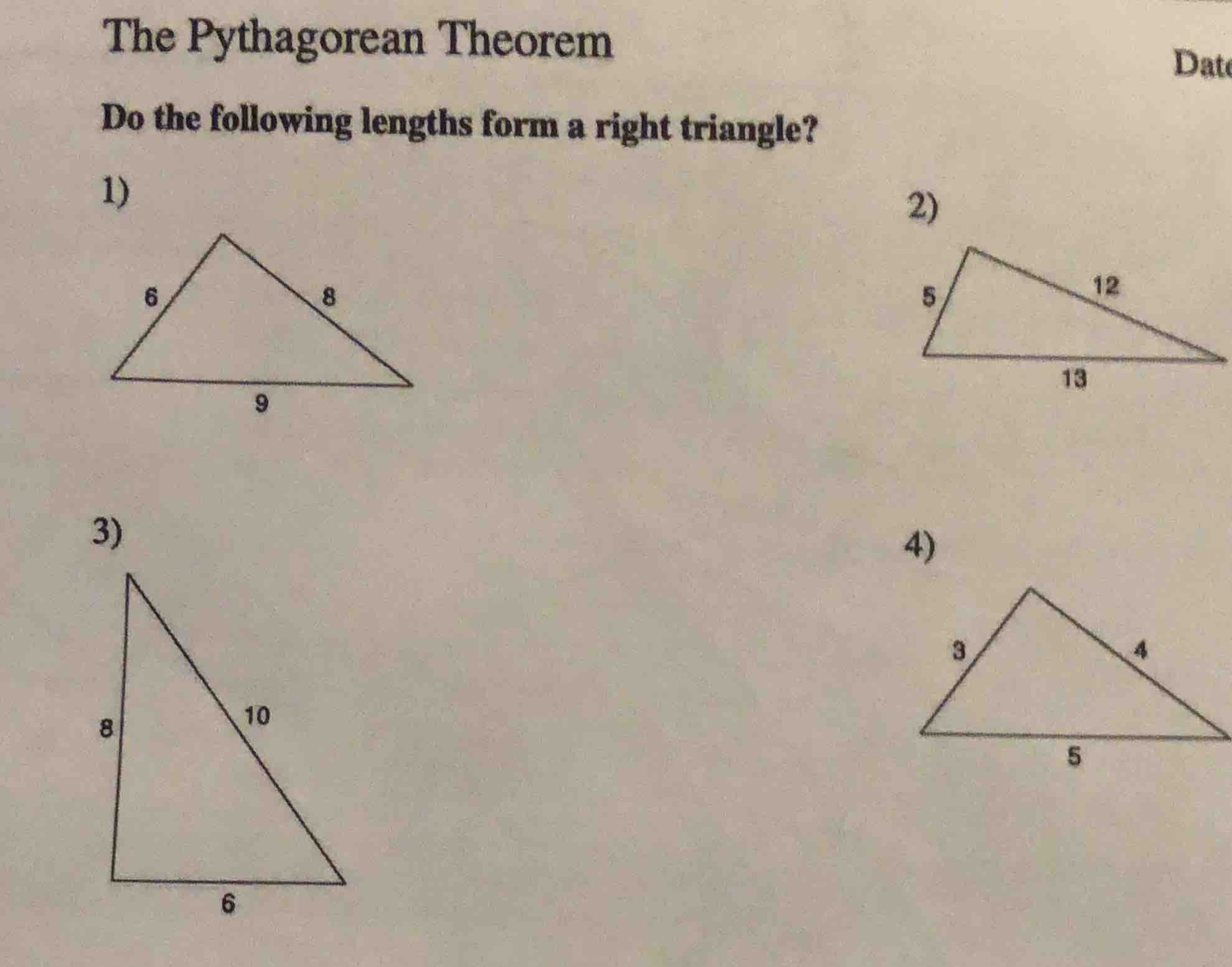
do the following lengths form a right triangle?
1)
2)
3)
4)
Response
Problem 1:
Step1: Identify the longest side (hypotenuse candidate)
The sides are 6, 8, 9. The longest side is 9.
Step2: Apply Pythagorean theorem ($a^2 + b^2 = c^2$)
Calculate $6^2 + 8^2 = 36 + 64 = 100$. Calculate $9^2 = 81$. Since $100
eq 81$, the sides do not satisfy the theorem.
Step1: Identify the longest side (hypotenuse candidate)
The sides are 5, 12, 13. The longest side is 13.
Step2: Apply Pythagorean theorem ($a^2 + b^2 = c^2$)
Calculate $5^2 + 12^2 = 25 + 144 = 169$. Calculate $13^2 = 169$. Since $169 = 169$, the sides satisfy the theorem.
Step1: Identify the longest side (hypotenuse candidate)
The sides are 6, 8, 10. The longest side is 10.
Step2: Apply Pythagorean theorem ($a^2 + b^2 = c^2$)
Calculate $6^2 + 8^2 = 36 + 64 = 100$. Calculate $10^2 = 100$. Since $100 = 100$, the sides satisfy the theorem.

Snap & solve any problem in the app
Get step-by-step solutions on Sovi AI
Photo-based solutions with guided steps
Explore more problems and detailed explanations
No