QUESTION IMAGE
Question
q3 - accelerated mathematics gr 8 | guided notes: solving and graphing linear inequalities in one-variable
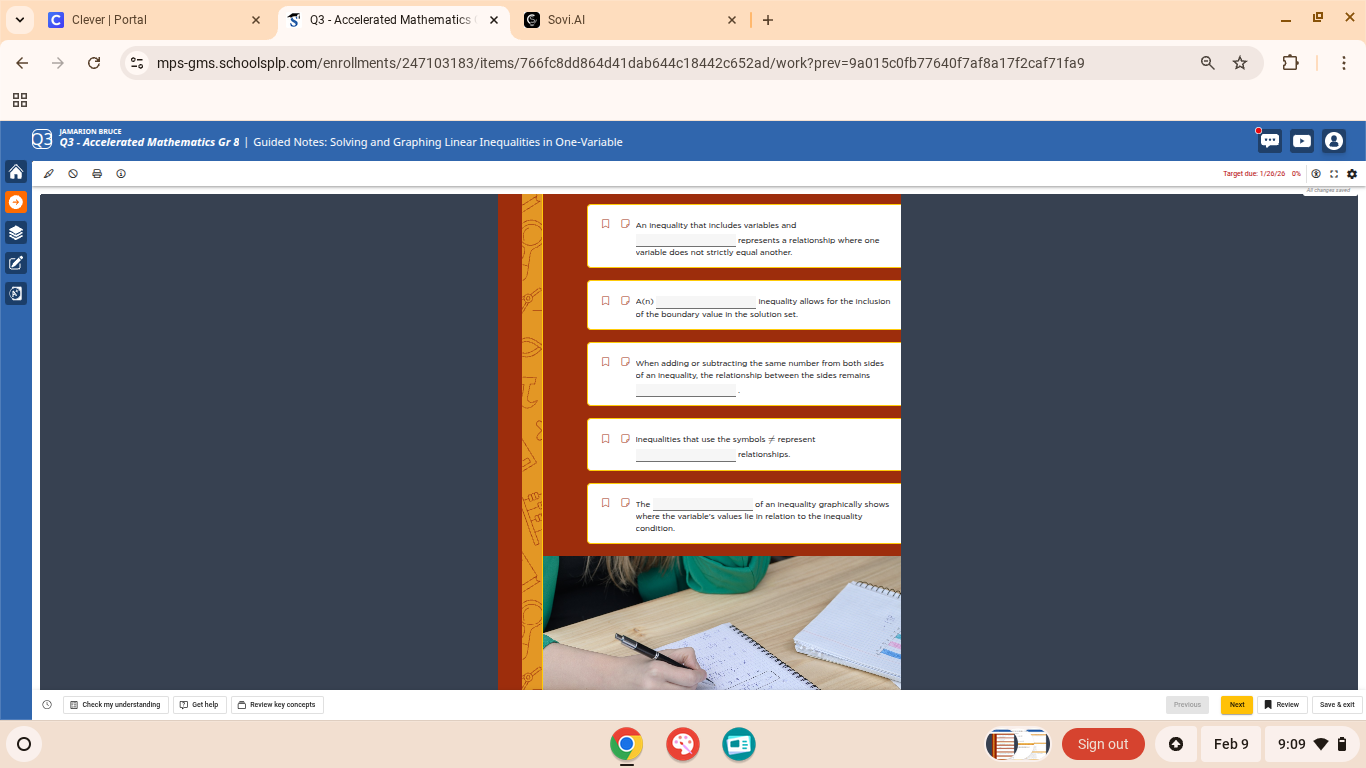
- an inequality that includes variables and ______ represents a relationship where one variable does not strictly equal another.
- a(n) ______ inequality allows for the inclusion of the boundary value in the solution set.
- when adding or subtracting the same number from both sides of an inequality, the relationship between the sides remains ______.
- inequalities that use the symbols ≠ represent ______ relationships.
- the ______ of an inequality graphically shows where the variables values lie in relation to the inequality condition.
Brief Explanations
- The first blank defines a linear inequality (with variables and an inequality symbol) as a non-strict equality relationship.
- "Inclusive" inequalities use ≤ or ≥, which include the boundary value.
- The addition/subtraction property of inequalities states the relationship stays unchanged when adding/subtracting the same number to both sides.
- The symbols ≠ represent non-equivalent, or not equal, relationships.
- A graph of an inequality uses a number line to show the solution set, which is the visual representation of valid variable values.

Snap & solve any problem in the app
Get step-by-step solutions on Sovi AI
Photo-based solutions with guided steps
Explore more problems and detailed explanations
- An inequality that includes variables and an inequality symbol represents a relationship where one variable does not strictly equal another.
- A(n) inclusive inequality allows for the inclusion of the boundary value in the solution set.
- When adding or subtracting the same number from both sides of an inequality, the relationship between the sides remains unchanged.
- Inequalities that use the symbols ≠ represent not equal / non-equivalent relationships.
- The graph / solution set graph of an inequality graphically shows where the variable's values lie in relation to the inequality condition.