QUESTION IMAGE
Question
q3 - mathematics gr 8 - section 1 | lesson: describing sequences of transformations for similar figures
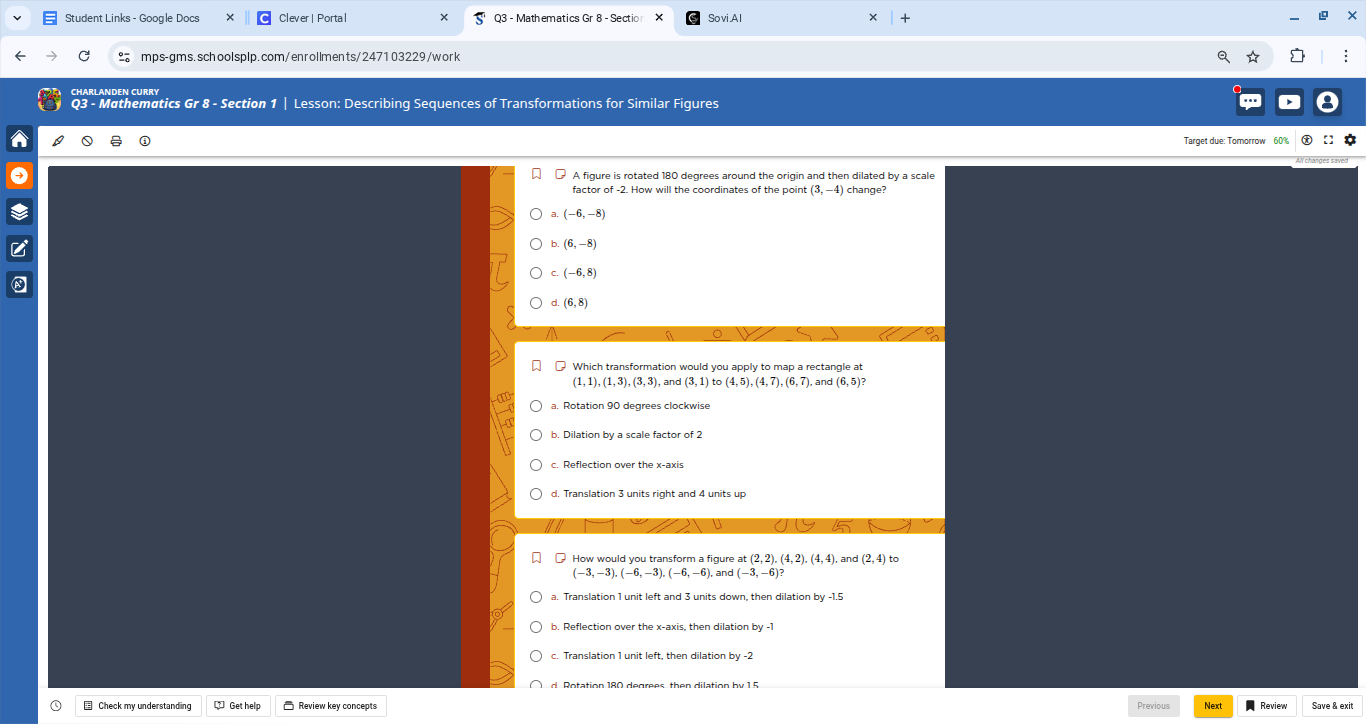
- a figure is rotated 180 degrees around the origin and then dilated by a scale factor of -2. how will the coordinates of the point (3, -4) change?
○ a. (-6, -8)
○ b. (6, -8)
○ c. (-6, 8)
○ d. (6, 8)
- which transformation would you apply to map a rectangle at (1,1), (1,3), (3,3), and (3,1) to (4,5), (4,7), (6,7), and (6,5)?
○ a. rotation 90 degrees clockwise
○ b. dilation by a scale factor of 2
○ c. reflection over the x-axis
○ d. translation 3 units right and 4 units up
- how would you transform a figure at (2,2), (4,2), (4,4), and (2,4) to (-3,-3), (-6,-3), (-6,-6), and (-3,-6)?
○ a. translation 1 unit left and 3 units down, then dilation by -1.5
○ b. reflection over the x-axis, then dilation by -1
○ c. translation 1 unit left, then dilation by -2
○ d. rotation 180 degrees, then dilation by 1.5
Step1: Rotate (3,-4) 180° origin
Rotating a point $(x,y)$ 180° around the origin gives $(-x,-y)$.
$(-3, 4)$
Step2: Dilate by scale factor -2
Dilating a point $(x,y)$ by scale factor $k$ gives $(k \cdot x, k \cdot y)$.
$(-2 \times -3, -2 \times 4) = (6, -8)$
Step3: Analyze rectangle coordinate shift
Take point (1,1) to (4,5): $4-1=3$, $5-1=4$. Same for all points: $(x+3, y+4)$.
This matches translation 3 right, 4 up.
Step4: Transform (2,2) to (-3,-3)
First, check translation: $-3 - 2 = -5$, $-3 - 2 = -5$ (not 1 left). Check reflection over x-axis: $(2,-2)$, dilate by -1: $(-2,2)$ (no). Rotate 180°: $(-2,-2)$, dilate by 1.5: $(-3,-3)$. This matches the target point, and works for all given points.

Snap & solve any problem in the app
Get step-by-step solutions on Sovi AI
Photo-based solutions with guided steps
Explore more problems and detailed explanations
- b. (6,−8)
- d. Translation 3 units right and 4 units up
- d. Rotation 180 degrees, then dilation by 1.5