QUESTION IMAGE
Question
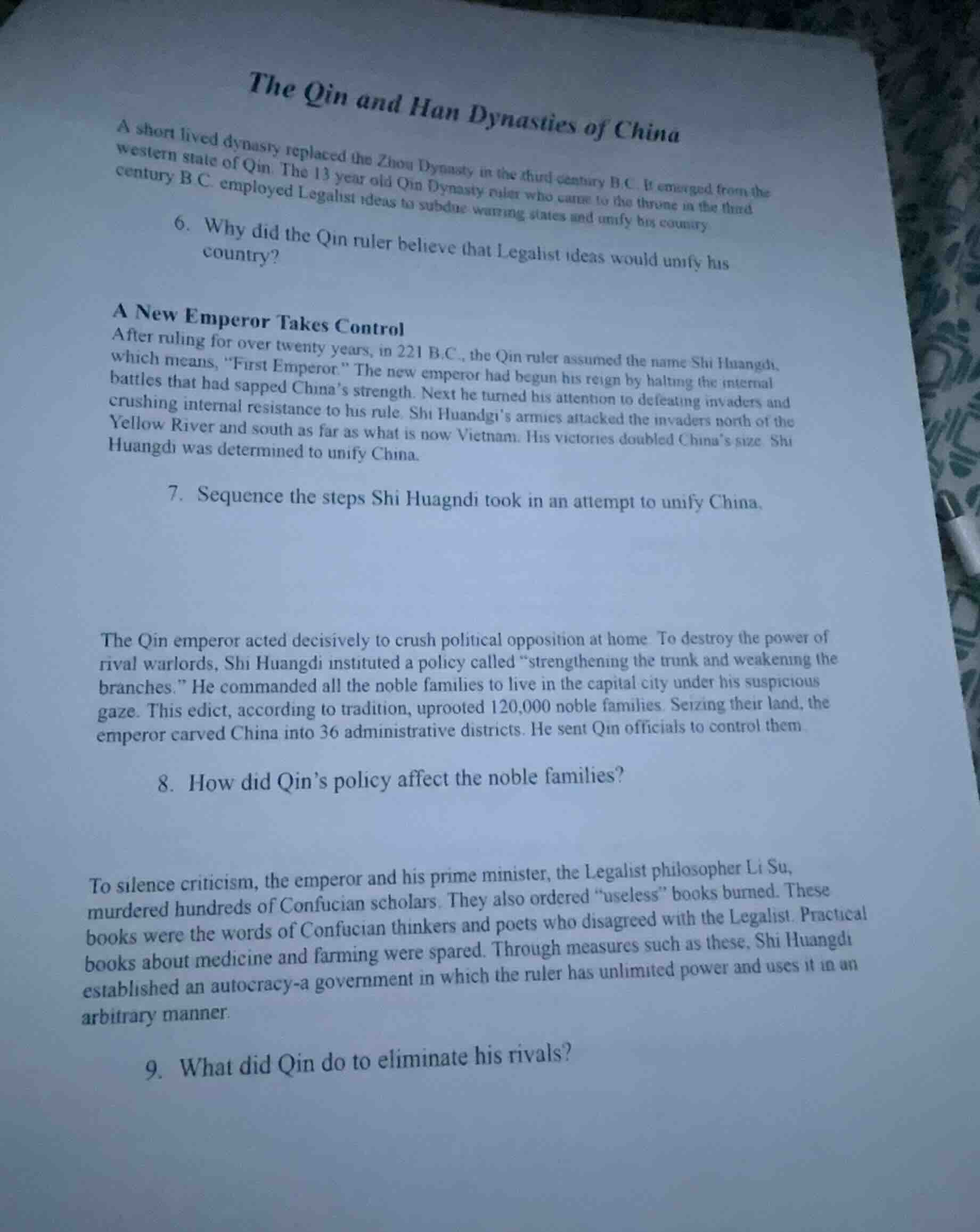
the qin and han dynasties of china
a short lived dynasty replaced the zhou dynasty in the third century b.c. it emerged from the western state of qin. the 13 year old qin dynasty ruler who came to the throne in the third century b.c. employed legalist ideas to subdue warring states and unify his country
- why did the qin ruler believe that legalist ideas would unify his country?
a new emperor takes control
after ruling for over twenty years, in 221 b.c., the qin ruler assumed the name shi huangdi, which means, \first emperor.\ the new emperor had begun his reign by halting the internal battles that had sapped china’s strength. next he turned his attention to defeating invaders and crushing internal resistance to his rule. shi huandgi’s armies attacked the invaders north of the yellow river and south as far as what is now vietnam. his victories doubled china’s size. shi huangdi was determined to unify china.
- sequence the steps shi huagndi took in an attempt to unify china.
the qin emperor acted decisively to crush political opposition at home. to destroy the power of rival warlords, shi huangdi instituted a policy called \strengthening the trunk and weakening the branches.\ he commanded all the noble families to live in the capital city under his suspicious gaze. this edict, according to tradition, uprooted 120,000 noble families. seizing their land, the emperor carved china into 36 administrative districts. he sent qin officials to control them.
- how did qin’s policy affect the noble families?
to silence criticism, the emperor and his prime minister, the legalist philosopher li su, murdered hundreds of confucian scholars. they also ordered \useless\ books burned. these books were the words of confucian thinkers and poets who disagreed with the legalist. practical books about medicine and farming were spared. through measures such as these, shi huangdi established an autocracy - a government in which the ruler has unlimited power and uses it in an arbitrary manner.
- what did qin do to eliminate his rivals?
For Question 6:
Legalist ideas emphasized strict, uniform laws, centralized control, and harsh punishments. The Qin ruler believed this would suppress the power of warring states and unify the fragmented country by enforcing a single, authoritative system that eliminated regional dissent and chaos.
For Question 7:
- First, he halted internal battles that weakened China.
- Next, he defeated foreign invaders.
- Then, he crushed internal resistance to his rule.
- Finally, he expanded China's territory through military campaigns.
For Question 8:
Under the "strengthening the trunk and weakening the branches" policy, noble families were forced to move to the capital under the emperor's direct supervision, uprooting 120,000 families. Their land was seized, stripping them of their local power and wealth.
For Question 9:
- He crushed political opposition with the "strengthening the trunk and weakening the branches" policy: forcing nobles to live in the capital and seizing their land, replacing local noble control with Qin officials.
- He murdered hundreds of Confucian scholars who criticized his rule.
- He burned books written by Confucian thinkers and poets that opposed Legalist ideas, to silence dissent.

Snap & solve any problem in the app
Get step-by-step solutions on Sovi AI
Photo-based solutions with guided steps
Explore more problems and detailed explanations
- The Qin ruler believed Legalist ideas, with their strict uniform laws, centralized authority, and harsh punishments, would suppress warring states and eliminate regional chaos, enforcing a single, unifying system across the country.
- 1. Halted internal weakening battles
- Defeated foreign invaders
- Crushed internal resistance to his rule
- Expanded China's territory via military campaigns
- Noble families were forced to relocate to the capital under the emperor's direct watch, and their land was seized, stripping them of their local power and wealth.
- 1. Forced nobles to live in the capital and seized their land, replacing their local control with Qin officials
- Murdered hundreds of dissenting Confucian scholars
- Burned books that opposed Legalist ideas to silence criticism