QUESTION IMAGE
Question
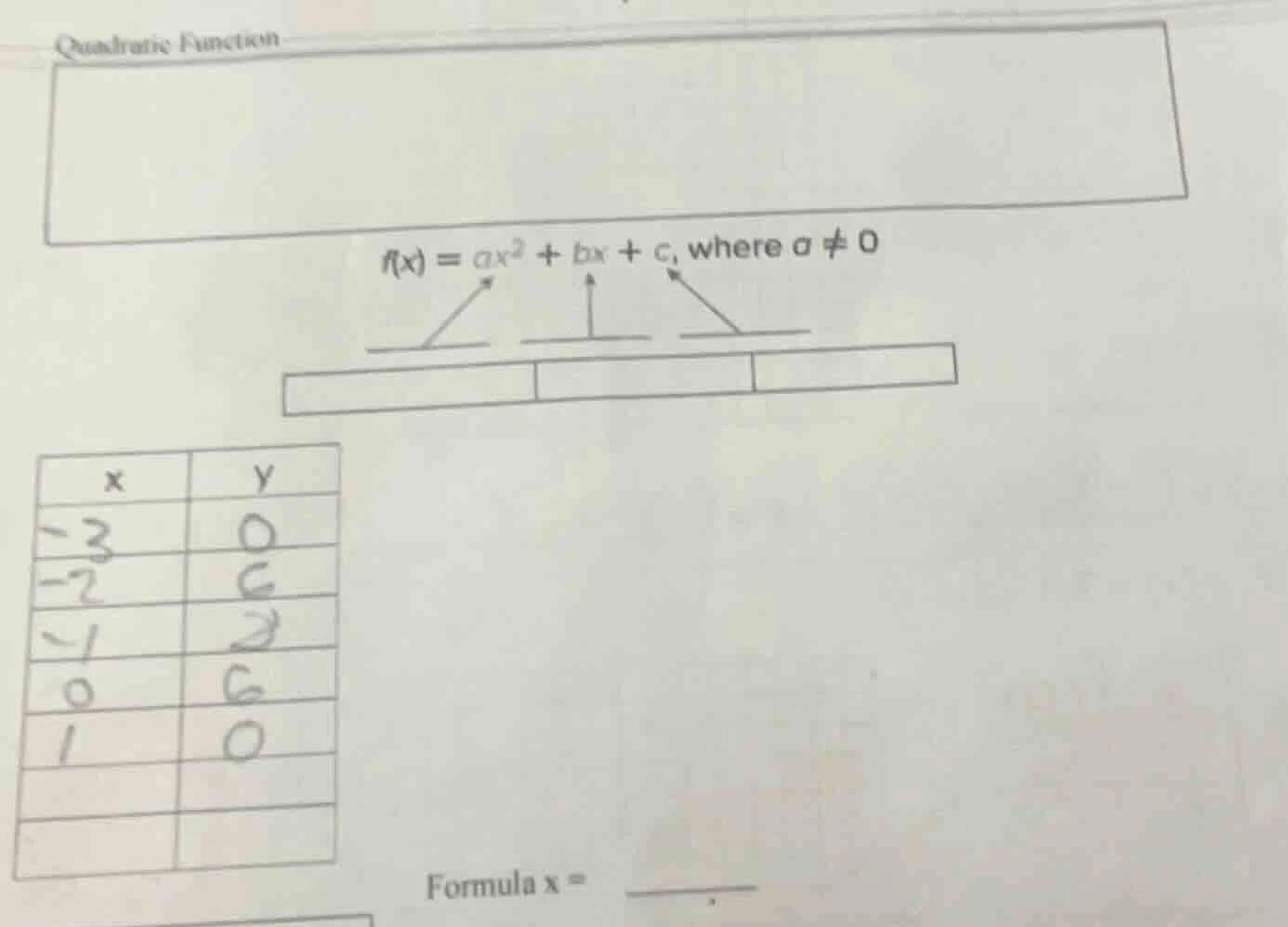
quadratic function
$f(x) = ax^2 + bx + c$, where $a \
eq 0$
| x | y |
|---|---|
| -2 | 6 |
| -1 | 2 |
| 0 | 6 |
| 1 | 0 |
formula $x = $
Step1: Recall quadratic function vertex formula
The formula for the x - coordinate of the vertex (and also related to finding the axis of symmetry) of a quadratic function \( f(x)=ax^{2}+bx + c\) (where \( a
eq0\)) is derived from completing the square or using calculus (for the vertex). The formula for the x - value (axis of symmetry or x - coordinate of vertex) is \( x=-\frac{b}{2a}\). Also, if we are finding the roots of the quadratic equation \( ax^{2}+bx + c = 0\), the quadratic formula is \( x=\frac{-b\pm\sqrt{b^{2}-4ac}}{2a}\). But from the context of the quadratic function and the table (with roots at \( x=- 3\) and \( x = 1\)), the axis of symmetry (mid - point of the roots) can also be calculated as \( x=\frac{-3 + 1}{2}=\frac{-2}{2}=-1\), and using the formula \( x =-\frac{b}{2a}\) is consistent. However, the general formula for the x - coordinate related to the quadratic function (vertex or axis of symmetry) is \( x=-\frac{b}{2a}\), and for the roots (solutions of \( ax^{2}+bx + c = 0\)) is \( x=\frac{-b\pm\sqrt{b^{2}-4ac}}{2a}\). Given the label "Formula x =", and the quadratic function \( f(x)=ax^{2}+bx + c\), the most relevant formula for the x - coordinate (axis of symmetry or vertex x - coordinate) is \( x =-\frac{b}{2a}\), and for the roots (solutions) is the quadratic formula \( x=\frac{-b\pm\sqrt{b^{2}-4ac}}{2a}\). But from the table, we can see that the roots are at \( x=-3\) and \( x = 1\), so the axis of symmetry is \( x=\frac{-3 + 1}{2}=-1\), and the formula for the axis of symmetry (x - coordinate of vertex) of a quadratic function is \( x=-\frac{b}{2a}\). Also, the quadratic formula for the roots is \( x=\frac{-b\pm\sqrt{b^{2}-4ac}}{2a}\).
Step2: Identify the formula
For a quadratic function \( f(x)=ax^{2}+bx + c\) (\( a
eq0\)), the formula for the x - coordinate of the vertex (axis of symmetry) is \( x =-\frac{b}{2a}\), and the formula for the roots (solutions to \( ax^{2}+bx + c = 0\)) is \( x=\frac{-b\pm\sqrt{b^{2}-4ac}}{2a}\). Given the context of the quadratic function and the table (with two x - intercepts at \( x=-3\) and \( x = 1\)), if we are looking for the formula for the x - coordinate of the axis of symmetry (mid - point of the roots), it is \( x=\frac{-b}{2a}\), and if we are looking for the roots, it is the quadratic formula. But the question says "Formula x =", and from the quadratic function structure, the formula for the x - coordinate of the vertex (or axis of symmetry) is \( x=-\frac{b}{2a}\), and the quadratic formula for the roots is \( x=\frac{-b\pm\sqrt{b^{2}-4ac}}{2a}\). Since the table has \( x=-3,y = 0\) and \( x = 1,y = 0\), these are the roots, so the formula for the roots (solutions of \( ax^{2}+bx + c = 0\)) is \( x=\frac{-b\pm\sqrt{b^{2}-4ac}}{2a}\), and the formula for the axis of symmetry is \( x=-\frac{b}{2a}\).

Snap & solve any problem in the app
Get step-by-step solutions on Sovi AI
Photo-based solutions with guided steps
Explore more problems and detailed explanations
If it's the axis of symmetry (x - coordinate of vertex): \( \boldsymbol{-\frac{b}{2a}}\)
If it's the roots of the quadratic equation \( ax^{2}+bx + c = 0\): \( \boldsymbol{\frac{-b\pm\sqrt{b^{2}-4ac}}{2a}}\)
(From the table, since there are roots at \( x=-3\) and \( x = 1\), the axis of symmetry is \( x=-1\), and the formula for the axis of symmetry is \( x =-\frac{b}{2a}\), and the quadratic formula for the roots is \( x=\frac{-b\pm\sqrt{b^{2}-4ac}}{2a}\))