QUESTION IMAGE
Question
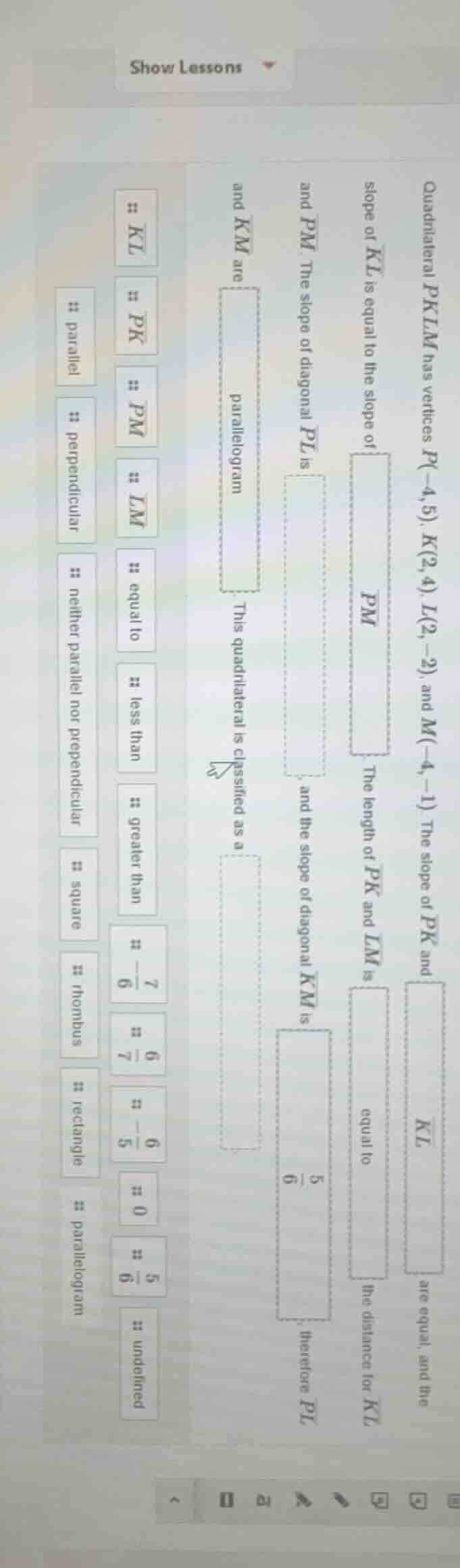
quadrilateral pklm has vertices p(-4,5), k(2,4), l(2,-2), and m(-4,-1) the slope of \\(\overline{pk}\\) and \\(\overline{kl}\\) are equal, and the slope of \\(\overline{kl}\\) is equal to the slope of \\(\overline{pm}\\) the length of \\(\overline{pk}\\) and \\(\overline{lm}\\) is equal to the distance for \\(\overline{kl}\\) and \\(\overline{pm}\\). the slope of diagonal \\(\overline{pl}\\) is \\(\frac{5}{6}\\) and the slope of diagonal \\(\overline{km}\\) is \\(-\frac{7}{6}\\), therefore \\(\overline{pl}\\) and \\(\overline{km}\\) are neither parallel nor perpendicular parallelogram this quadrilateral is classified as a dropdown options: \\(\overline{kl}\\), \\(\overline{pk}\\), \\(\overline{pm}\\), \\(\overline{lm}\\), equal to, less than, greater than, \\(-\frac{7}{6}\\), \\(\frac{7}{6}\\), \\(-\frac{6}{5}\\), 0, \\(\frac{6}{5}\\), undefined, parallel, perpendicular, neither parallel nor perpendicular, square, rhombus, rectangle, parallelogram
Step1: Calculate slope of $\overline{KL}$
Slope formula: $m=\frac{y_2-y_1}{x_2-x_1}$
$m_{\overline{KL}}=\frac{-2-4}{2-2}=\frac{-6}{0}=\text{undefined}$
Step2: Calculate slope of $\overline{PK}$
$m_{\overline{PK}}=\frac{4-5}{2-(-4)}=\frac{-1}{6}=-\frac{1}{6}$
Step3: Calculate slope of $\overline{PM}$
$m_{\overline{PM}}=\frac{-1-5}{-4-(-4)}=\frac{-6}{0}=\text{undefined}$
Step4: Calculate slope of $\overline{LM}$
$m_{\overline{LM}}=\frac{-1-(-2)}{-4-2}=\frac{1}{-6}=-\frac{1}{6}$
Step5: Calculate length of $\overline{PK}$
Distance formula: $d=\sqrt{(x_2-x_1)^2+(y_2-y_1)^2}$
$d_{\overline{PK}}=\sqrt{(2-(-4))^2+(4-5)^2}=\sqrt{36+1}=\sqrt{37}$
Step6: Calculate length of $\overline{KL}$
$d_{\overline{KL}}=\sqrt{(2-2)^2+(-2-4)^2}=\sqrt{0+36}=6$
Step7: Calculate length of $\overline{LM}$
$d_{\overline{LM}}=\sqrt{(-4-2)^2+(-1-(-2))^2}=\sqrt{36+1}=\sqrt{37}$
Step8: Calculate length of $\overline{PM}$
$d_{\overline{PM}}=\sqrt{(-4-(-4))^2+(-1-5)^2}=\sqrt{0+36}=6$
Step9: Calculate slope of $\overline{PL}$
$m_{\overline{PL}}=\frac{-2-5}{2-(-4)}=\frac{-7}{6}=-\frac{7}{6}$
Step10: Calculate slope of $\overline{KM}$
$m_{\overline{KM}}=\frac{-1-4}{-4-2}=\frac{-5}{-6}=\frac{5}{6}$
Step11: Check relation of $\overline{PL}$ and $\overline{KM}$
Product of slopes: $-\frac{7}{6} \times \frac{5}{6}=-\frac{35}{36}
eq -1$, so they are neither parallel nor perpendicular.
Step12: Classify the quadrilateral
Opposite sides are equal and parallel, so it is a parallelogram.

Snap & solve any problem in the app
Get step-by-step solutions on Sovi AI
Photo-based solutions with guided steps
Explore more problems and detailed explanations
The slope of $\overline{PK}$ and $\boldsymbol{\overline{LM}}$ are equal, and the slope of $\overline{KL}$ is equal to the slope of $\boldsymbol{\overline{PM}}$.
The length of $\overline{PK}$ and $\overline{LM}$ is $\boldsymbol{\text{equal to}}$ the distance for $\overline{KL}$ and $\overline{PM}$.
The slope of diagonal $\overline{PL}$ is $\boldsymbol{-\frac{7}{6}}$, and the slope of diagonal $\overline{KM}$ is $\boldsymbol{\frac{5}{6}}$, therefore $\overline{PL}$ and $\overline{KM}$ are $\boldsymbol{\text{neither parallel nor perpendicular}}$.
This quadrilateral is classified as a $\boldsymbol{\text{parallelogram}}$.