QUESTION IMAGE
Question
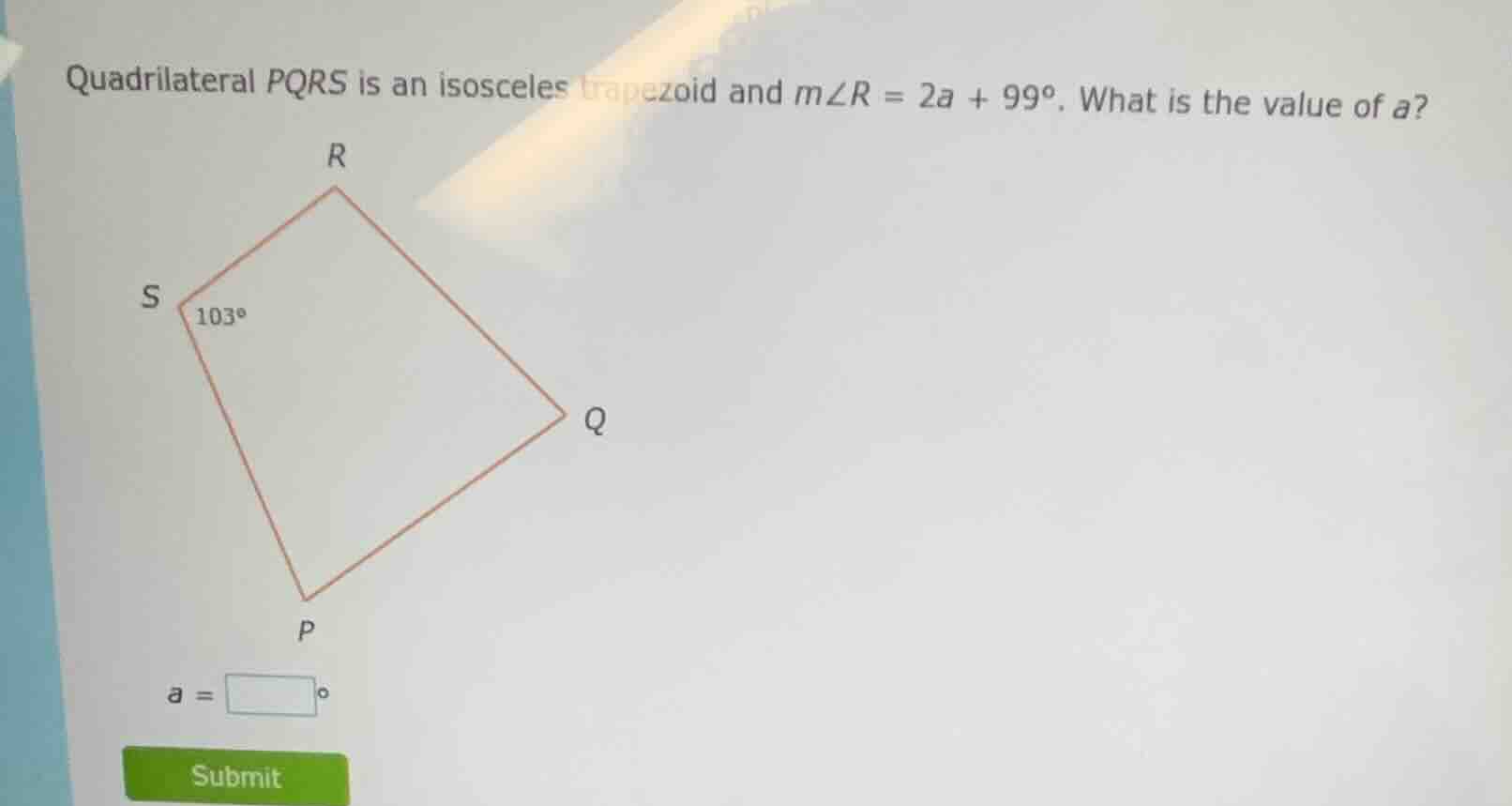
quadrilateral pqrs is an isosceles trapezoid and $m\angle r = 2a + 99^\circ$. what is the value of $a$?
(there is a diagram of isosceles trapezoid pqrs with angle s being $103^\circ$)
$a = \square ^\circ$
Step1: Recall isosceles trapezoid angle property
In an isosceles trapezoid, consecutive angles between the bases are supplementary? No, wait, actually, in an isosceles trapezoid, angles adjacent to each non - parallel side are supplementary? Wait, no, the correct property is that in an isosceles trapezoid, each pair of base angles is equal, and consecutive angles between the legs (the non - parallel sides) are supplementary. Wait, looking at the trapezoid PQRS, sides SR and PQ are the legs? Wait, no, in a trapezoid, the two parallel sides are the bases. Let's assume that SR and PQ are the legs, and SP and RQ are the bases? Wait, no, the angle at S is 103 degrees, and angle at R. In an isosceles trapezoid, consecutive angles along a leg are supplementary. So angle S and angle R are consecutive angles along leg SR, so they should be supplementary. So \(m\angle S + m\angle R=180^{\circ}\). We know that \(m\angle S = 103^{\circ}\) and \(m\angle R=2a + 99^{\circ}\). So we can set up the equation \(103+(2a + 99)=180\).
Step2: Simplify the left - hand side of the equation
First, combine like terms: \(103 + 99+2a=180\). \(202+2a = 180\)? Wait, that can't be right. Wait, maybe I got the angles wrong. Wait, in an isosceles trapezoid, base angles are equal, and angles on the same side of a leg are supplementary. Wait, maybe angle S and angle R are not supplementary. Wait, maybe the bases are SP and RQ. Then angle S and angle P are base angles, and angle R and angle Q are base angles. And angle S and angle R are adjacent angles (along side SR). Wait, no, let's re - examine the trapezoid. The vertices are S, R, Q, P in order. So sides SR and PQ are the legs, and SP and RQ are the bases. So angle at S (∠S) and angle at R (∠R) are adjacent angles (between leg SR and the two bases SP and RQ). In an isosceles trapezoid, consecutive angles between a leg and the two bases are supplementary. So ∠S and ∠R are supplementary? Wait, no, if SP and RQ are the bases (parallel), then ∠S and ∠P are supplementary (since they are on the same side of leg SP), and ∠R and ∠Q are supplementary. Also, ∠S = ∠P and ∠R = ∠Q? No, wait, in an isosceles trapezoid, base angles are equal. So the angles adjacent to each base are equal. So if SP and RQ are the bases, then ∠S = ∠P and ∠R = ∠Q. Also, ∠S and ∠R are supplementary (because consecutive angles between the legs and the bases: since SP || RQ, then ∠S + ∠R=180^{\circ} (same - side interior angles). Ah, that's the key. So since SP is parallel to RQ, and SR is a transversal, ∠S and ∠R are same - side interior angles, so they are supplementary. So \(m\angle S+m\angle R = 180^{\circ}\). Given \(m\angle S = 103^{\circ}\) and \(m\angle R=2a + 99^{\circ}\), we substitute into the equation:
\(103+(2a + 99)=180\)
First, combine the constant terms: \(103 + 99=202\), so the equation becomes \(202+2a=180\). Wait, that would give \(2a=180 - 202=- 22\), which is impossible. So I must have made a mistake in identifying the parallel sides. Let's try the other way. Maybe SR and PQ are the bases (parallel), and SP and RQ are the legs. Then ∠S and ∠P are supplementary, and ∠R and ∠Q are supplementary. Also, ∠S = ∠R (base angles) because it's an isosceles trapezoid. Ah! That's the mistake. In an isosceles trapezoid, the base angles (angles adjacent to each base) are equal. So if SR and PQ are the bases (parallel), then ∠S and ∠R are base angles (adjacent to base SR), so they should be equal. So \(m\angle S=m\angle R\). So \(103^{\circ}=2a + 99^{\circ}\).
Step3: Solve for a
Now we solve the equation \(103=2a + 99\). Subtract 99 from…

Snap & solve any problem in the app
Get step-by-step solutions on Sovi AI
Photo-based solutions with guided steps
Explore more problems and detailed explanations
\(a = 2\)